
Make an appointment Call now

Weak Lintels: Causes and Repair of Cracking

Crack formation in masonry is a common issue that can arise from various structural problems such as foundation subsidence, improper lintel support, or shrinkage. Understanding the root cause is crucial before carrying out repairs, and consulting a structural engineer for spans over 3.50 meters can prevent further damage and ensure the stability of the structure.

When determining the probable cause of crack formation, we may be dealing with a stable crack ; damage that has not developed further (caused by shrinkage and creep) or an unstable crack ; damage that is developing further (e.g., due to foundation subsidence). In these cases, the cause must first be eliminated before a proper repair can be carried out.

Crack recognition

⁠⁠⁠⁠⁠⁠⁠At the location of facade openings:

  • Deflection of the lintel, sagging of the upper sills
  • Tapering cracks from the corners at the lintel support
  • The triangular or strip-shaped detachment of overlying masonry
  • Crack in the center of the bottom of the brickwork
  • Cracked and fallen joints above a lintel

Lack of (properly functioning) lintels

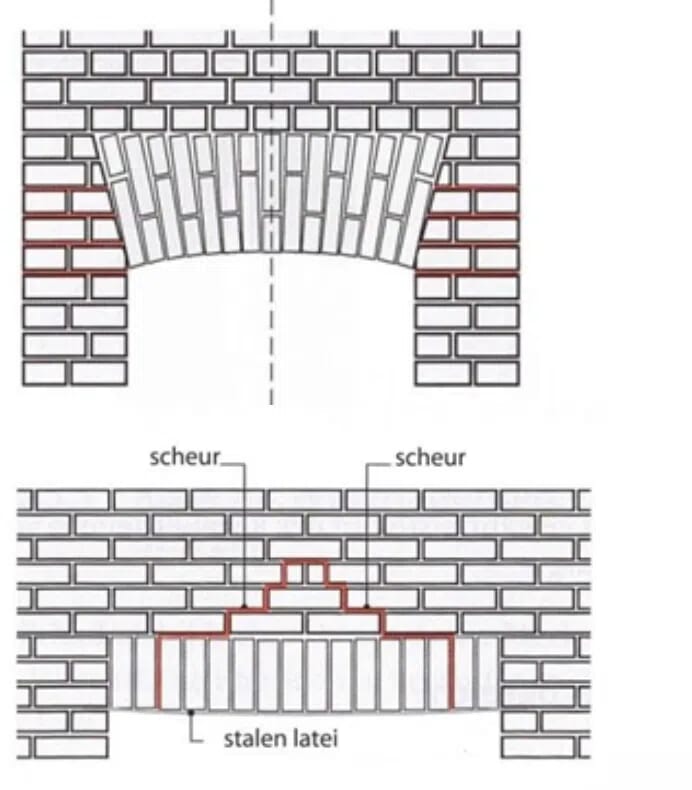
  • In a span in masonry, the span will naturally form a compression arch.
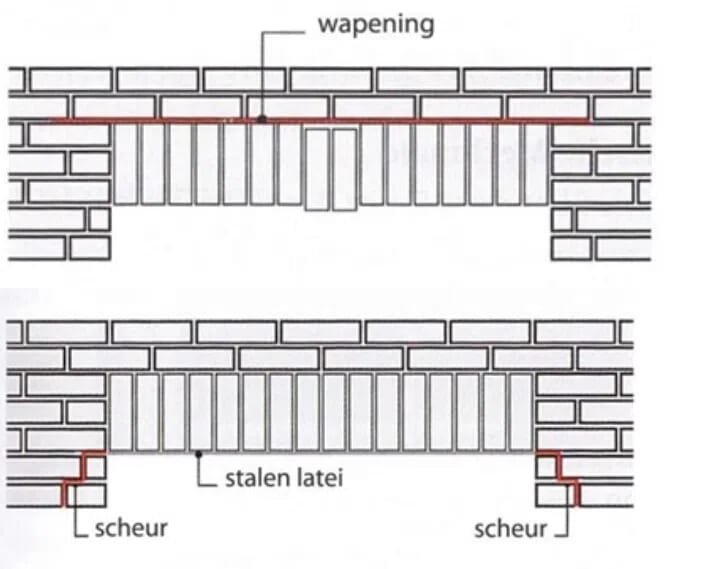
  • A straight span in the masonry is only possible for small dimensions. If this is implemented, it is preferable to install a so-called roll course that begins diagonally in the wall at the sides. This creates a slightly wedge-shaped joint in the roll course. If a brick threatens to sink out of this roll course, it will remain wedged in place by this wedge shape, creating lateral pressure.
  • In addition to an arched span in masonry, the masonry can also be supported by a beam, or lintel.
  • A design error or execution error is often the cause of such damage.
  • In order to support the overlying masonry, a lintel must be of sufficient strength (calculated for weight and span).
  • If a lintel is inadequate or insufficiently dimensioned it will sag under the weight of the overlying masonry (In practice, these cracks usually run from the corners in a triangular shape diagonally upwards).
  • When beams or lintels sag, the masonry will be subjected to the greatest tension load in the middle and will therefore tend to crack at the bottom.
rollaag.png
drukboog.png

Repair is usually relatively simple in many ways. For spans exceeding 3.50 m, we always recommend consulting a structural engineer.

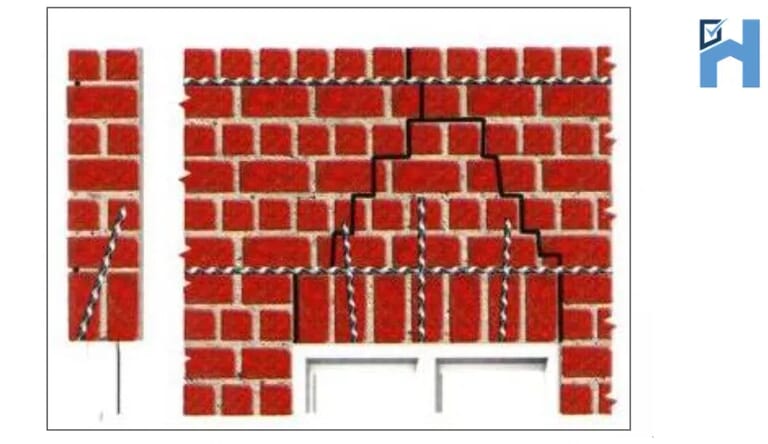
You can also choose to reinforce the brickwork above openings as a preventative measure. This is recommended, for example, before replacing (wooden) window frames with new (plastic) frames. Are you unsure about certain anomalies in your facade? A building inspection will clarify the situation.

sparingen-versterken.png

Would you like to make an appointment for a building inspection?

The cost of a building inspection (up to 250 m²) is only €489 including VAT. We'll conduct a comprehensive building inspection and you'll receive a building report. Do you have any questions? We're happy to help and can schedule an appointment with an expert inspector right away if you wish!

Recent articles

Een vrouw wijst naar een tablet die een man vasthoudt en een andere man kijkt mee
blog
13 February 2026
Hidden defects in a home
Hidden defects are not uncommon, especially in existing homes. They are often not immediately visible, but can have significant consequences for comfort, safety, and costs. This article explains how hidden defects are assessed and the role of investigation and inspection.
blazen plooien bitumen dak
video
13 February 2026
Common roof detail mistakes: what an inspection reveals
During roof inspections, problems often turn out to be not in the roofing itself, but in the details. In this practical case study, we demonstrate which installation errors are frequently encountered and why these, in particular, pose an increased risk of leaks and damage.
WhatsApp Image 2026-02-12 at 08.51.37
video
12 February 2026
Three Roof Eave Mistakes That Cause Leaks (And Are Often Overlooked)
Roof problems rarely arise suddenly. They usually start with a minor issue. In this inspection, we see how a torn lead flashing, improper installation, and a loose joint can all pose a serious risk. What should you look for—and how can you prevent them?