Thermal cracks; causes:
When determining a probable cause of cracking, it can be determined whether you are dealing with a stable crack ; damage that has not developed further (caused by shrinkage and creep) or an unstable crack ; damage that has developed further (e.g. due to subsidence of the foundation). In this case, the cause must first be eliminated before a proper repair can be carried out.
Thermal length change
Materials expand as they heat up (creep) and contract as they cool (shrinkage). This creep and shrinkage due to temperature changes is also called thermal length change. Building materials must have sufficient freedom of movement to accommodate the required creep and shrinkage.
Unfortunately, this required space isn't always taken into account, and often insufficient or no expansion joints are installed. In such cases, temperature fluctuations will cause tensions that exceed the tensile forces the masonry can withstand.
The crack width in this type of cracking tends to increase over time because crumbling wall particles prevent the cracks from closing with rising temperatures.
In addition to the influence of temperature changes, creep and shrinkage can also occur in materials as a result of the influence of moisture.
Long, contiguous facades
Crack recognition:
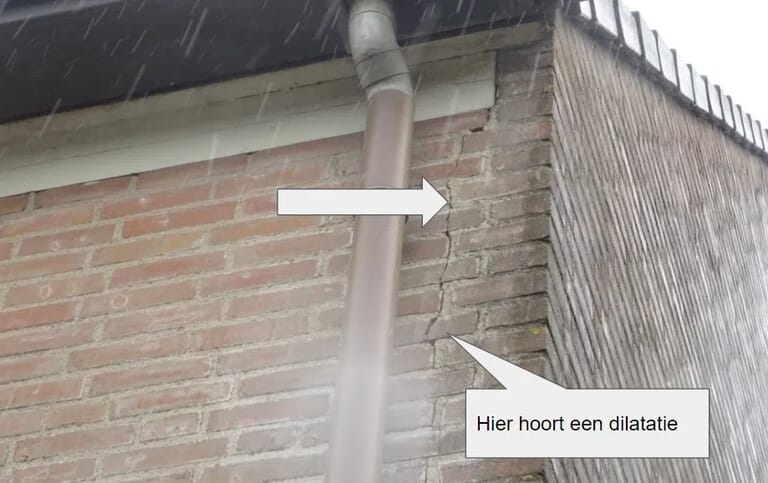
- Vertical cracks at corners
- Vertical cracks along facade openings
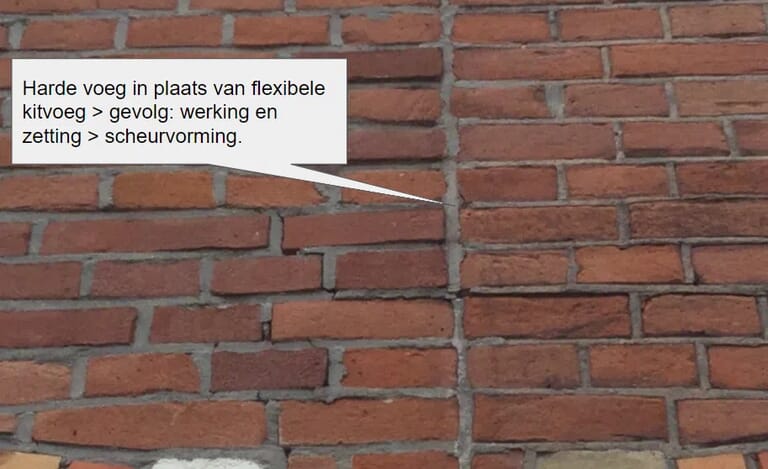
- Vertical cracks at regular intervals
- Cracks that vary in width depending on temperature fluctuations
- Cracks in facades exposed to large temperature fluctuations, especially south and south-west facades
Causes of damage to long, continuous facades:
- No or too few expansion joints
- Expansion joints in the wrong places
- Exposure to temperature changes
- Exposure to high moisture
Repair of cracks in long, continuous facades
Repairing damage to masonry caused by temperature fluctuations is pointless, as the cause of the temperature fluctuations remains.
We often see that after an initial repair attempt by patching, the cracks simply return.
The crack was, as it were, a natural dilation, and by compensating for the crack, that space for movement was taken away, and the stresses arose again due to the prevented deformation, resulting in crack formation.
Repairs are made by creating an expansion joint in the wall. When tension is applied to the facade, it will crack at its weakest point. By choosing the location of this expansion joint at offsets or behind rainwater drains, the appearance or character of the facade is least affected.
After applying these expansion joints, the crack can be repaired, as the cause of the crack formation has been eliminated and the situation is then stable. By applying sufficient reinforcement, the remaining creep and shrinkage will be distributed across many cracks.
Cracks at the corners
These are often cavity wall ties that are placed too close to corners or facade openings
- This is a common example of prevented deformation from thermal movement.
- The wall, which expands and contracts, is hindered in its movement by the cavity wall ties.
- The tensile forces become too great (brick can barely absorb tensile forces), and cracks develop where the cavity wall ties are located. These cracks essentially form a natural expansion joint.
One solution for damage caused by cavity wall ties placed too close to a corner is to remove the cause (in this case, the ties) and repair the masonry. Another option is to expand the walls that are perpendicular to each other.
Combination of materials
- Cracks at the meeting of different materials, such as:
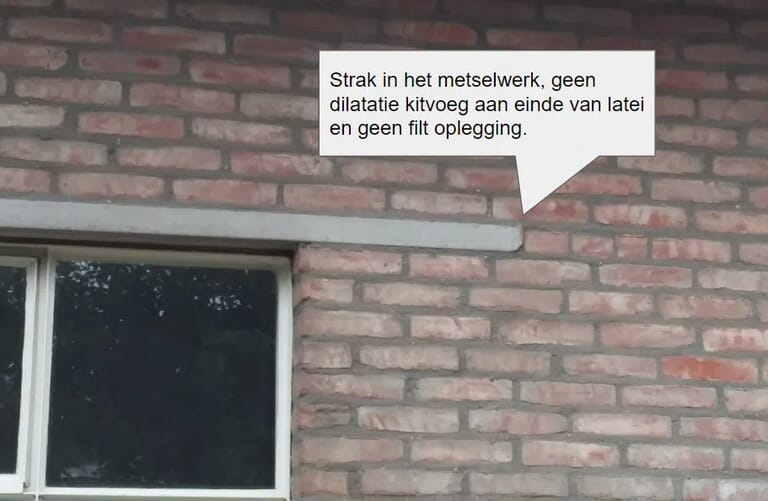
- cracks at the supports of concrete lintels
- damage to joints where different materials meet (shear stresses)
- Bending masonry and cracks in concrete floors (particularly poured floors), such as:
- at meetings of facade masonry with concrete floors at balcony and gallery floors.
- joint between edge beam and masonry breaks
- Cracks in flat roofs and a (roof) overhang, such as:
- a horizontal crack in the gable end at the top corners of a roof edge or close to the roof structure
- a horizontal crack under the roof structure
Causes of damage due to the combination of materials
- Design and/or execution error (insufficient expansion joints)
- Exposure to exceptional temperature fluctuations (often south-facing facades)
- Exposure to excessive moisture
Common cases
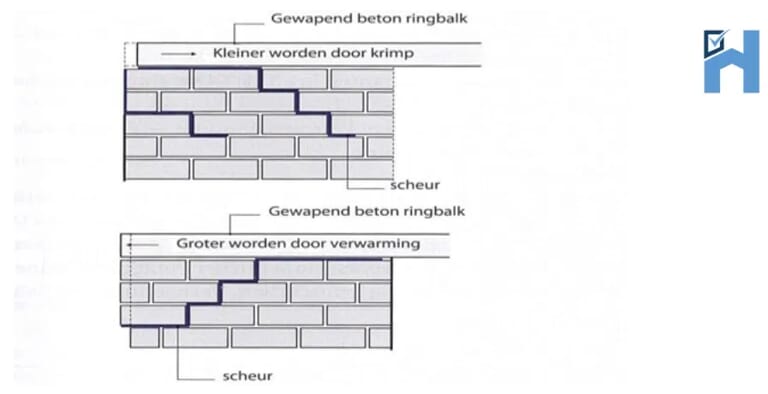
- Floors or beams poured against the outer cavity wall cause lateral forces on the masonry due to expansion. This often results in bulging masonry and cracking.
- Casting roofs on load-bearing walls on-site creates a situation where the roof can become extremely hot due to solar radiation, while at night, under clear skies, that same roof becomes much colder than the underlying masonry.
- Temperature movements cause cracks to form, the shape of which indicates whether the masonry is uplifting due to shrinkage of the roof slab and poor quality pointing, and whether the masonry is tearing off due to expansion of the roof slab.
- When the roof plate expands, lateral forces can arise, causing the facade to buck.
- In high facades (of apartment buildings, for example), edge or floor beams are often installed at floor height.
- During a building inspection, extensive attention is of course paid to these possible deviations.
The expansion coefficient of concrete is about twice that of brick, so changes in length due to temperature differences will also differ.
Depending on the quality of the materials, the stresses resulting from prevented deformation may or may not be absorbed by the materials. Above the edge beams, we often see shear stresses cause the joint between the edge beam and the masonry to fail, or the masonry to crack.
Would you like to make an appointment for a building inspection?
The cost of a building inspection (up to 250 m²) is only €489 including VAT. We'll conduct a comprehensive building inspection and you'll receive a building report. Do you have any questions? We're happy to help and can schedule an appointment with an expert inspector right away if you wish!
Recent articles