

Make an appointment Call now

Foundation problems; causes and consequences!

Foundation problems and crack formations in buildings can spell disaster if not addressed promptly, often stemming from issues like uneven settlements, vibrations, or geological conditions. Understanding the root cause and taking immediate action, such as a professional building inspection, can prevent further damage and save on costly repairs. Dive deeper to learn about the intricacies of these issues and how they can be effectively managed.

When determining the probable cause of crack formation, we may be dealing with a stable crack ; damage that has not developed further (caused by shrinkage and creep) or an unstable crack ; damage that is developing further (e.g., due to foundation subsidence). In these cases, the cause must first be eliminated before a proper repair can be carried out.

Foundation problems are caused by:

  • Lowering/raising the groundwater level
  • Soil accumulation
  • Vibrations
  • Geological conditions
  • Design and/or implementation errors
  • Uneven settlements due to the geometry of the structure
  • Trees that are too close to the building
  • Crack recognition in a foundation problem

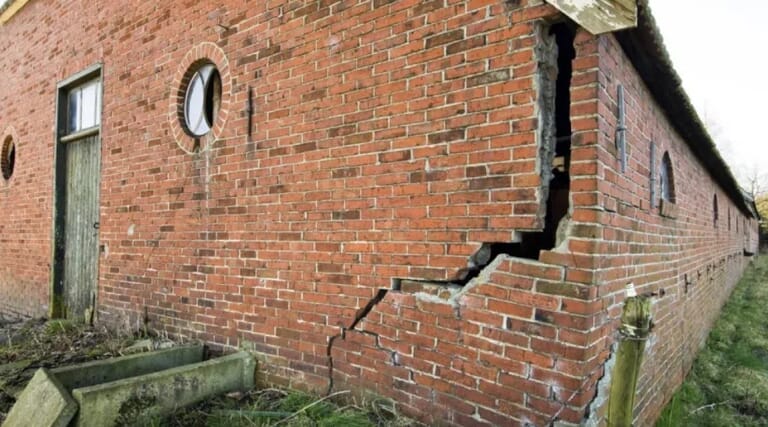
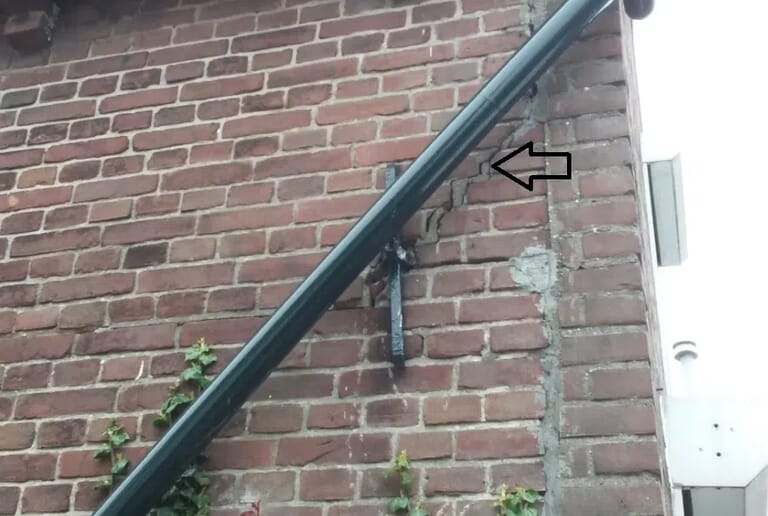
Recognizing crack formation in a foundation problem

  1. Cracks that become wider or narrower towards the top
  2. Diagonal cracking, often serrated, through the joint, subsidence of (part of) the building
  3. The torn parts have shifted vertically from each other

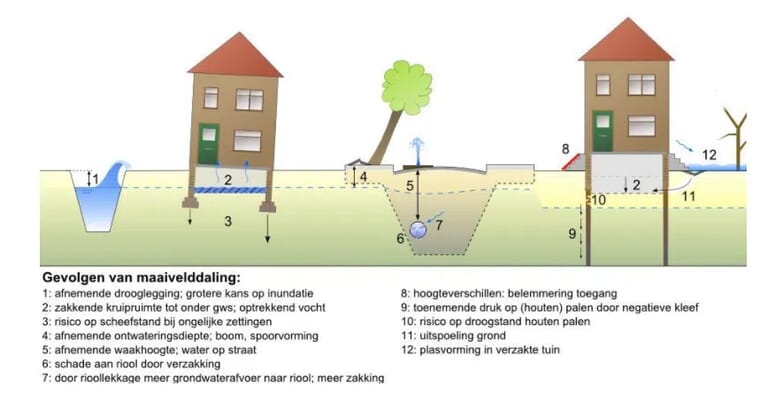
Lowering the groundwater level

As the groundwater level drops, the soil settles. This can lead to negative friction in pile foundations, pulling the piles downward.

Also, when the groundwater level drops, a current can occur that carries soil along, resulting in a landslide.

Finally, due to a lowering of the groundwater level, wooden poles may suddenly come partially above the water level (the phreatic surface), causing them to rot.

Lowering of the groundwater level can be caused by:

  • Construction of buildings in the area where open drainage or well drainage is used (temporary subsidence).
  • A large tree near the building, whose roots locally extract water from the ground.
Homekeur-maaivelddaling.png

Increase in the groundwater level

Due to excessive water inflow, water can no longer drain through the ground, creating a more or less quicksand-like structure. The granules will seek a denser packing, causing the building to settle, resulting in cracks.

Increased groundwater level can be caused by:

  • Floods
  • Regulation by water board
  • Poor drainage of the site/the area around the building does not drain properly
  • Leaks (broken and leaking sewers, gutters or rainwater drains)

Soil accumulation

Localized ground raising creates uneven ground loads . For example, when paving is periodically raised, the piles on the facade side are subjected to additional loads, increasing the negative friction (layers of soil, as it were, cling to the piles). This causes the building to tilt toward the street.

A landfill causes a drop in the original ground level.

Stresses can be distributed through the ground in such a way that it is pushed up in another place.

Vibrations

Vibrations can cause the ground to settle locally.

Vibrations can be caused by:

  • Heavy road or train traffic close to the building
  • Piling works in the area
  • Earthquakes

Geological conditions

Cohesive soils are highly compressible, such as clay and loam . Due to the associated poor permeability of these soil types, settlements sometimes take decades to reach their final value.

Non-cohesive soils are generally very low-cohesion soils, such as sand and gravel. These soils are relatively permeable to water and have low compressibility. Final settlement is reached quickly. The rate of settlement is therefore related to the soil's permeability to water.

Homekeur-ernstig-scheurvorming-voor-geologie.png

Causes of damage due to (failure to take into account) geological conditions:

  • Insufficient bearing capacity of the soil
  • Different soil layers (cohesive and non-cohesive) that can absorb different pressures
  • Locally undisturbed soil
  • The presence of a ditch system
  • Not properly compacted fill

Design and/or implementation errors

Common design and implementation errors:

  • Insufficiently deep foundation (not below the frost line)
  • Insufficiently sized foundation
  • Material defects occur during pile driving (failure/cracks in piles)
  • Change of function of the building

Uneven settlements due to the geometry of the structure

In a standard single-family home, the weight of the excavated soil for the basement exceeds the weight of the building that will take its place. Therefore, settlement in the basemented section is usually zero. However, settlement (and therefore damage) will occur under the non-basement section.

Homekeur-scheurvorming-gevel.png
  • Uneven settlement is caused by, among other things:
  • Partial basement
  • Non-expanded extension
  • Concentrated loads with insufficient distribution options

Trees that are too close to the building

Roots from trees that are too close to the building can push up the foundation of buildings with shallow foundations . The tree roots locally extract water from the ground, lowering the water table. The cracks will be open in summer and closed/smaller in winter. The size and type of tree play a significant role in daily water consumption.

Recovery from foundation problems

Foundation subsidence is usually a slow but continuous process, with the crack reappearing after a longer or longer period. Unfortunately, it's not easy to determine whether the situation has stabilized or not. Sometimes, an indication can be obtained by asking questions:

  • How long have the cracks been there?
  • Have the cracks become wider recently?
  • Have any cracks appeared recently?
  • Has a foundation survey already been carried out?

In the case of a structural foundation problem, something will have to be done to the foundation.

Would you like to make an appointment for a building inspection?

The cost of a building inspection (up to 250 m²) is only €489 including VAT. We'll conduct a comprehensive building inspection and you'll receive a building report. Do you have any questions? We're happy to help and can schedule an appointment with an expert inspector right away if you wish!

Recent articles

Een vrouw wijst naar een tablet die een man vasthoudt en een andere man kijkt mee
blog
13 February 2026
Hidden defects in a home
Hidden defects are not uncommon, especially in existing homes. They are often not immediately visible, but can have significant consequences for comfort, safety, and costs. This article explains how hidden defects are assessed and the role of investigation and inspection.
blazen plooien bitumen dak
video
13 February 2026
Common roof detail mistakes: what an inspection reveals
During roof inspections, problems often turn out to be not in the roofing itself, but in the details. In this practical case study, we demonstrate which installation errors are frequently encountered and why these, in particular, pose an increased risk of leaks and damage.
WhatsApp Image 2026-02-12 at 08.51.37
video
12 February 2026
Three Roof Eave Mistakes That Cause Leaks (And Are Often Overlooked)
Roof problems rarely arise suddenly. They usually start with a minor issue. In this inspection, we see how a torn lead flashing, improper installation, and a loose joint can all pose a serious risk. What should you look for—and how can you prevent them?