Make an appointment Call now

Floors in the home

Choosing the right flooring for your home involves more than just aesthetics; it requires understanding the potential risks and maintenance needs of materials like wood and concrete, especially when dealing with high-risk structures like NeHoBo floors. Discover how a comprehensive building inspection can safeguard your investment and ensure your floors meet safety and longevity standards.

Wooden floor with beams (structural).

A home may have wooden floors: wooden floors can transmit noise to other floors in the house. This should always be taken into account when using the home. Wooden floors require more maintenance than concrete floors. Wooden ground-floor floors with a damp crawl space, in particular, pose a higher risk, for example, from wood-destroying insects, wood rot in beams or floorboards, and the like. However, under good conditions, none of this need be a problem, and a wooden floor is, of course, perfectly fine.

Concrete floors/stone-like (structural).

A home may have concrete and/or stone floors. You cannot inspect these floors from above if they have a finish or covering. In other articles in this knowledge base, you can find much more information about so-called high-risk floors, such as kwaaitaal , manta , nehobo , etc. Below is some basic information about the different types of floors used in construction.

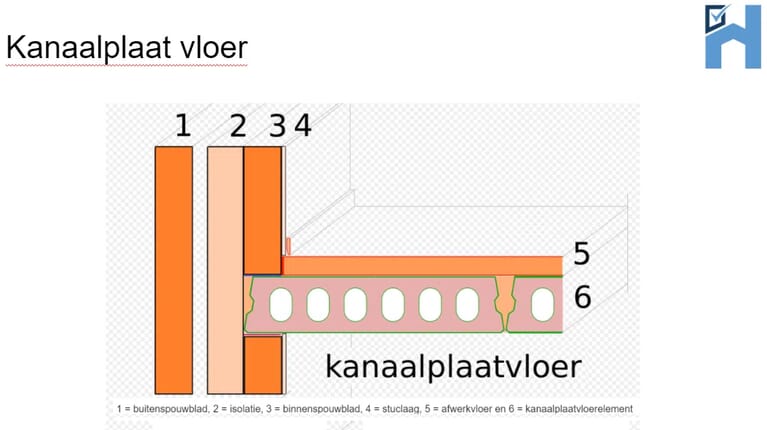
kanaalplaat-vloer.png
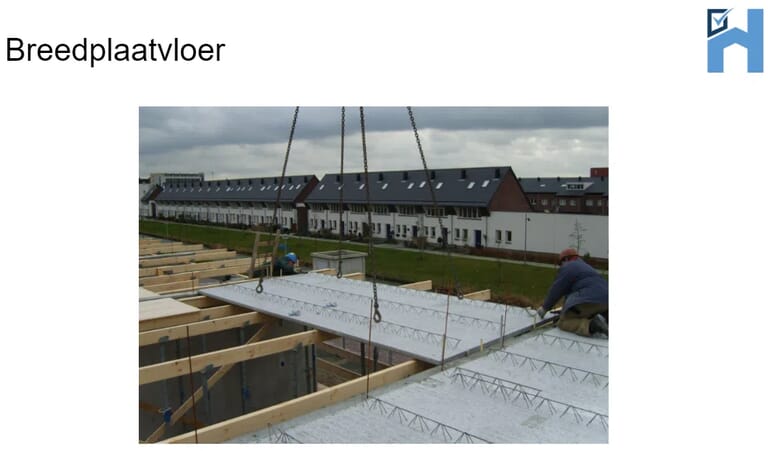
breedplaatvloer.png

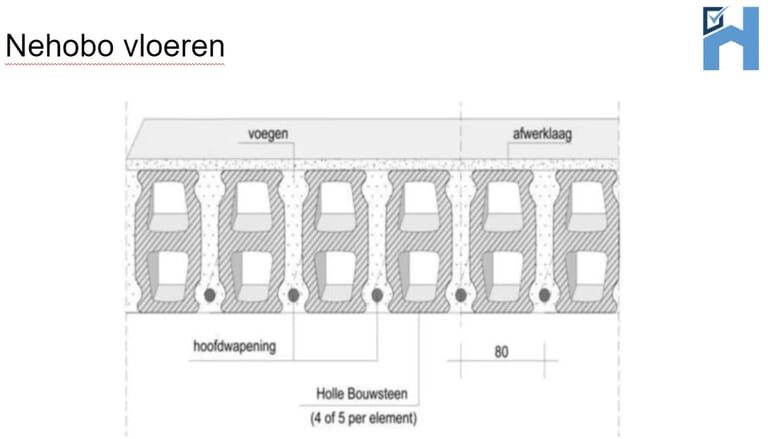
NeHoBo mezzanine floor

These were produced between 1956 and 1984 and are made of ceramic hollow building blocks. The floor consists of orange bricks with joints between them, and reinforcement bars are placed in the joints. This is a so-called high-risk floor; if you want more information or greater certainty, you can consider having a follow-up inspection carried out by an expert. With mezzanine floors, the risk of defects in the reinforcement and the NeHoBo floor in general is virtually zero. The conditions for the floor (if it functions as a mezzanine floor) are usually better than, for example, exposure in a damp and drafty crawl space.

The reinforcement in the joints is primarily intended to absorb the floor's tensile forces. These tensile forces often occur at the bottom of the floor system, which is why most of the reinforcement is located in the joint on the underside of the floor. If the joint is intact, the reinforcement will not be visible.

  • It's known that this reinforcement often rusts. This rust formation isn't always visually visible because the joints are still intact.
  • If conditions are not favourable, the reinforcement may rust due to carbonation or chloride , and the tensile forces can no longer be adequately absorbed.
  • Due to a corrosion process (which is not always immediately visually observable), the reinforcement expands and presses the surrounding mortar (joints) and stones in such a way that visually visible damage occurs.
  • In the worst-case scenario, the floor's load-bearing capacity decreases, and it can sag or collapse. Therefore, not all these floors meet the expected and designed lifespan of 50 years.

A visual inspection does not provide complete certainty regarding the technical condition and state of an existing NeHoBo floor. Further investigation is necessary to ensure the technical condition and state of the floor and its reinforcement. During a follow-up inspection, all joints and elements, one by one and meter by meter, must be meticulously inspected in all compartments, starting from the crawl space underneath the floor, and then tapped with a metal object.

nehobo-vloer.png

Defects, comments or points of attention regarding stone floors in the home

  • Mechanical damage: this damage usually has no structural significance and can easily be repaired.
  • If the floors slope and the horizontal alignment of the floor is not optimal: this could be caused by a one-off settlement or change in the object or the ground structure.
  • If the cement screed is loose: this could be due to poor adhesion to the concrete (structural) subfloor. Tensions in the subfloor can also be a cause. The structural floor has a different function than the cement screed and can therefore separate. Tensions in floors are caused by weakening or defects in the floor structure, or by significant changes in the home's climate (for example, if insulation has been installed).

Defects, comments or points of attention regarding wooden floors in the home

  • If the floors slope and the horizontal alignment of the floor is not optimal: this could be caused by a one-off settlement or change in the object or the ground structure.
  • If movement is clearly visible when applying pressure to the floors, this could be due to the floor joists spanning too far, or if the joists are insufficiently sized, causing them to bend under pressure . This can be a nuisance during use; therefore, heavy loads should be carefully distributed across the floor area.
    • For a ground floor, the floor joists can be supported from the crawl space (if present) by installing supports in the middle of the joists.
    • With a mezzanine floor, joists can be added, or the existing floor joists can be made stiffer by thickening them. This is always a major operation because it requires removing the ceiling beneath the floor.
    • Always seek expert advice on the correct approach to this work or have a certified contractor carry out and improve this work!
    • Also read this article about joists and piles.
  • Defects in the floor boarding can always be easily repaired; in the worst case, several square meters of floor boarding can be replaced.
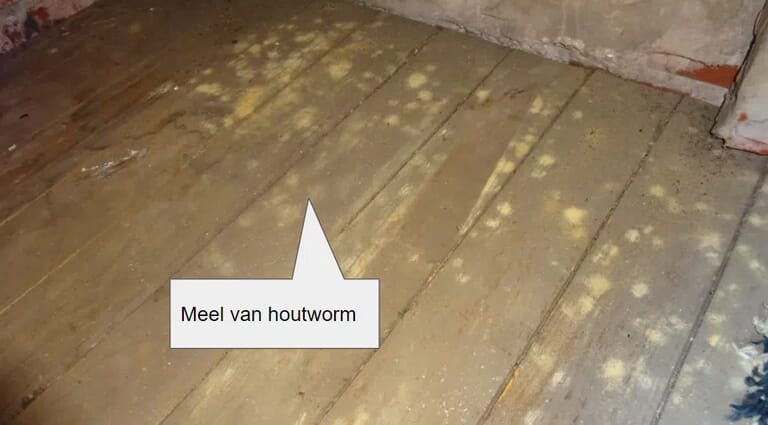
  • If traces of active woodworm are found in the floorboards, woodworm can further damage and weaken the floorboards. Treatment is easily possible by yourself or by a qualified specialist. To prevent further spread, we recommend taking the necessary action as soon as possible. Also, seek further information about preventative woodworm control and prevention options.
Homekeur-mail-van-houtworm-1.png
  • If traces of inactive woodworm are found in the floorboards, it appears that they are no longer active and may have already been treated. It's also possible that the woodworm has left "naturally" due to changing conditions in the room.
    • Woodworm is a name for various insect larvae that live in wood.
    • If woodworm has been noticed, it cannot be ruled out that it is also present (to a greater or lesser extent) in other wooden parts elsewhere in the house.
    • The larva of the common furniture beetle or common doorknob beetle is also called the large woodworm.

Would you like to make an appointment for a building inspection?

The cost of a building inspection (up to 250 m²) is only €489 including VAT. We'll conduct a comprehensive building inspection and you'll receive a building report. Do you have any questions? We're happy to help and can schedule an appointment with an expert inspector right away if you wish!

Recent articles

Een vrouw wijst naar een tablet die een man vasthoudt en een andere man kijkt mee
blog
13 February 2026
Hidden defects in a home
Hidden defects are not uncommon, especially in existing homes. They are often not immediately visible, but can have significant consequences for comfort, safety, and costs. This article explains how hidden defects are assessed and the role of investigation and inspection.
blazen plooien bitumen dak
video
13 February 2026
Common roof detail mistakes: what an inspection reveals
During roof inspections, problems often turn out to be not in the roofing itself, but in the details. In this practical case study, we demonstrate which installation errors are frequently encountered and why these, in particular, pose an increased risk of leaks and damage.
WhatsApp Image 2026-02-12 at 08.51.37
video
12 February 2026
Three Roof Eave Mistakes That Cause Leaks (And Are Often Overlooked)
Roof problems rarely arise suddenly. They usually start with a minor issue. In this inspection, we see how a torn lead flashing, improper installation, and a loose joint can all pose a serious risk. What should you look for—and how can you prevent them?