Inspection of a NeHoBo floor
NeHoBo or Perfora floors (Hollow brick)
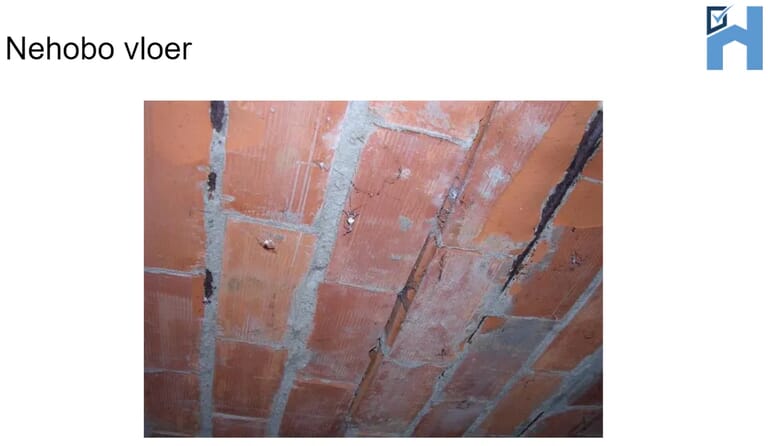
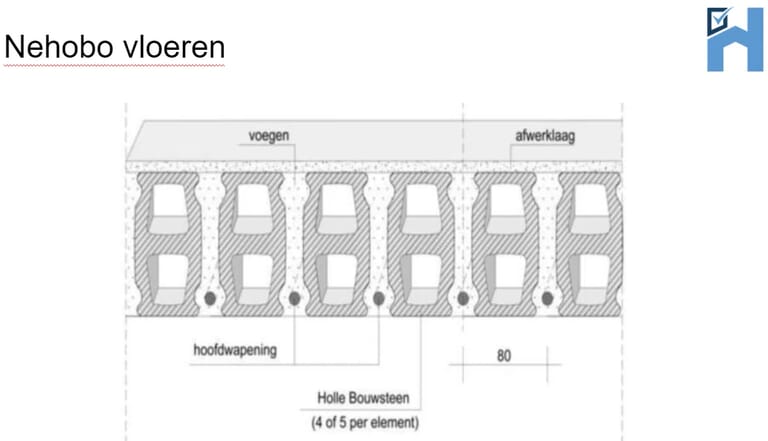
These were produced between 1956 and 1984 and are made of hollow ceramic building blocks. The floor consists of orange bricks with joints between them, and reinforcement bars are placed in the joints. 80% of NeHoBo floors have a problem, and often these problems or defects are not visible!
- A building inspection will immediately give you more clarity about the risk floor.
- The reinforcement in the joints is primarily intended to absorb the floor's tensile forces. These tensile forces often occur at the bottom of the floor system, which is why most of the reinforcement is located in the joint on the underside of the floor. If the joint is intact, the reinforcement will not be visible.
- It's known that this reinforcement often rusts, primarily due to the humid environment in a crawl space. This rust formation isn't always visible because the joints are still intact. A dry and well-ventilated crawl space is therefore crucial for preserving the reinforcement in this NeHoBo floor.
- If conditions are not favourable, the reinforcement may rust due to carbonation or chloride, and the tensile forces can no longer be adequately absorbed.
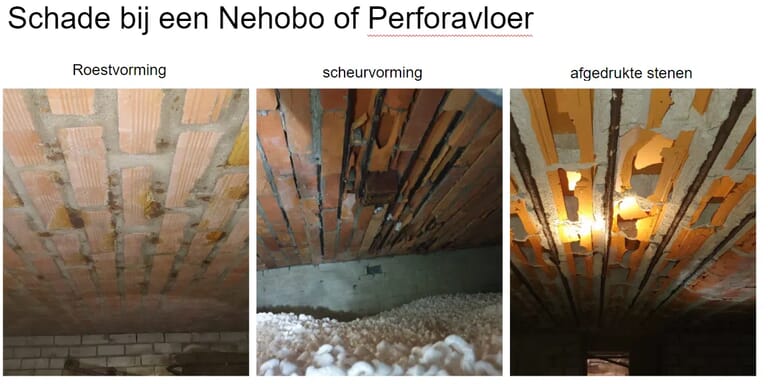
- Due to a corrosion process (which is not always immediately visually observable), the reinforcement expands and presses the surrounding mortar (joints) and stones in such a way that visually visible damage occurs.
- In the worst-case scenario, the floor's load-bearing capacity decreases, and it can sag or collapse. Therefore, not all these floors meet the expected and designed lifespan of 50 years.
- House with NeHoBo floor: 5 points of attention
A visual inspection never gives you complete certainty regarding the technical condition and state of an existing NeHoBo floor. Further investigation is necessary to ensure the technical condition and state of the floor and its reinforcement. During a follow-up inspection, all joints and elements, one by one and meter by meter, should be meticulously inspected in all compartments, starting from the crawl space underneath the floor, and then tapped with a metal object.
If there are any risks and/or defects regarding the reinforcement and/or structural safety of the NeHoBo floor, we recommend further investigation of the reinforcement in the floor structure.
Possible defects or risks of NeHoBo flooring?
- Hairline cracks in the joints . These cracks could be caused by rusting reinforcement in the joints.
- Damage to joints and bricks . This damage can be caused by rusting reinforcement in the joints.
- Rusting reinforcement is visible . This rusting reinforcement can weaken the floor structure.
- Subsidence or sagging of the elements is visible . The floor structure appears weakened.
During the production (on the construction site) of these elements, calcium chloride was sometimes added to the mortar as an accelerator so that more could be produced.
The reinforcement in the NeHoBo floor is primarily intended to absorb the tensile forces in the concrete. These tensile forces often occur at the bottom of the floor system, which is why most of the reinforcement is located there. Due to calcium chloride or carbonation, the reinforcement rusts away and can no longer adequately absorb the tensile forces.
The corrosion process causes the reinforcement to expand and crush the surrounding mortar and bricks. The load-bearing capacity of the elements decreases, and the floor can fail. This damage clearly negatively impacts the safety and functioning of the ground floor. Over time, this can lead to excessive deflection and premature, sudden failure of the floor.
Inspection of a NeHoBo floor
The NeHoBo floor (also known as a hollow brick floor) is, in our opinion, the most annoying and treacherous floor you can encounter in a home. In more than 75% of cases where we conduct a follow-up investigation, damage is found. NeHoBo floors were originally built on-site as a wall, with primary reinforcement placed in the hollow. The bricks were cemented together with mortar to the correct dimensions. After drying, the walls were tilted and used as floor elements.
The NeHoBo floor was produced from 1956 to 1984. NeHoBo floors are made of hollow ceramic building blocks. The underside of the floor is always flat. The NeHoBo floor consists of orange masonry bricks, with reinforcement bars placed between them in the joints.
The mortar used is always porous, and a slightly damp crawl space quickly erodes the main reinforcement. Due to rust and corrosion, this reinforcement expands, causing damage to the floor. The damage isn't always visually noticeable. Sometimes cracks develop from the reinforcement to the cavity in the brick. At any given moment, several square meters can spontaneously become detached. Therefore, the ideal conditions for a NeHoBo floor are a completely dry and well-ventilated crawl space.
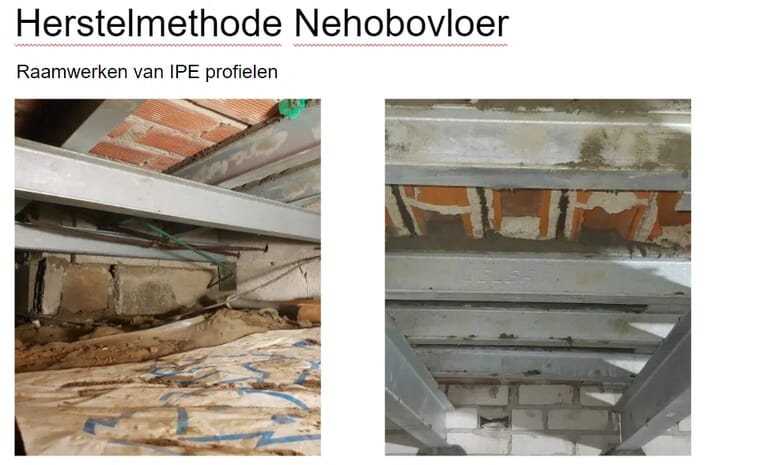
Visually, a NeHoBo floor can still be in reasonable or even good condition. Because 3 out of 4 floors exhibit defects, we always recommend a detailed, specialist inspection. During this inspection, every joint along its entire length and every hollow brick is tapped and inspected in detail by an experienced inspector. After the inspection, you will receive a detailed report and, if applicable, a repair plan including an estimate. NeHoBo floors are difficult to repair, and supporting (steel) structures are often used for repairs.
The reinforcement in the NeHoBo floor is primarily intended to absorb the tensile forces in the concrete. These tensile forces often occur at the bottom of the floor system, which is why most of the reinforcement is located there. During construction, calcium chloride was also added to the mortar in some cases to accelerate the drying process. This chloride also corrodes the reinforcement; it rusts away and can no longer adequately absorb the tensile forces.
The corrosion process causes the reinforcement to expand and crush the surrounding mortar and bricks. The load-bearing capacity of the elements decreases, and the floor can fail. This damage clearly negatively impacts the safety and functioning of the ground floor. Over time, this can lead to excessive deflection and premature, sudden failure of the floor. Therefore, not all floors meet the expected and designed lifespan of fifty years.
A supporting structure was developed to repair the damaged floor elements. This structure is composed of separate parts, made of galvanized steel, and is installed from foundation to foundation under the floor elements. The structure then replaces the rusting reinforcement in the floor, making the reinforcement in the concrete redundant. The supporting structure has a lifespan of at least 50 years.

Would you like to make an appointment for a building inspection?
The cost of a building inspection (up to 250 m²) is only €489 including VAT. We'll conduct a comprehensive building inspection and you'll receive a building report. Do you have any questions? We're happy to help and can schedule an appointment with an expert inspector right away if you wish!
Recent articles