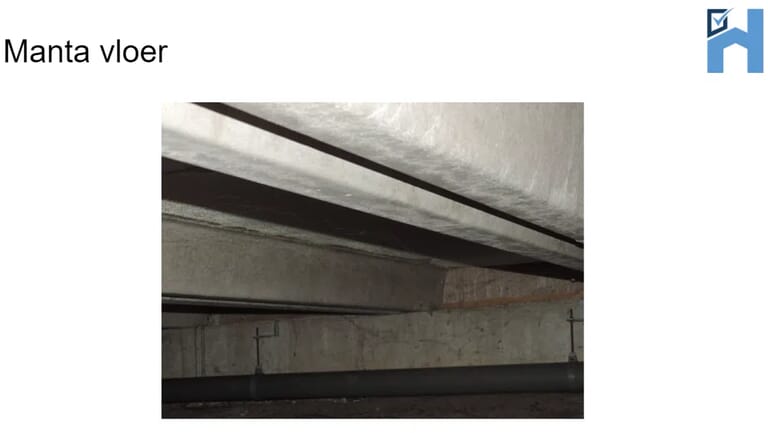
Inspection of a Manta floor
Manta floor
Manta floors were installed in certain homes built between 1965 and 1981. The use of calcium chloride in the concrete during the production process can cause rust to form on the metal reinforcement. Over time, this rust can cause chunks of concrete to break off, reducing the strength and thus the safety of the floor.
100% certainty about the technical condition and state of the floor and its reinforcement can only be achieved through further inspection. During a follow-up inspection, all elements and ribs, one by one and meter by meter, must be meticulously inspected from the crawl space underneath the floor, in all compartments, and tapped with a metal object.
Much less so than, for example, a screed floo , these floors also sometimes use calcium chloride as a (drying) accelerator added during the production of the elements. The calcium chloride causes the reinforcement to rust away, and it can no longer adequately absorb the tensile forces. The corrosion process causes the reinforcement in the Manta floor to expand and crush the surrounding concrete. The load-bearing capacity of the ribs decreases, and the Manta floor can fail. This problem is also known as "concrete rot."
- Dato factory floors are visually indistinguishable from Manta floors. You can find the floor's brand name on the so-called "headboards," if they are present.
- It is certainly not the case that calcium chloride has been used in all risk floors and that these are therefore by definition floors on which concrete rot will occur at some point.
- Read our BLOG about the risks of a manta floor
If any defects are found in the floor's ribs, they must be repaired. However, we recommend a follow-up inspection by a specialist company. They will knock down all the ribs on the floor and examine them thoroughly. Only then will the total extent of the damage be clearly visible and a well-founded repair estimate be prepared.
- Because this is a high-risk floor, the crawl space and the underside of the floor must be absolutely dry. The crawl space must also be properly ventilated.
- In many cases, after careful examination, it turns out that rust on the reinforcement is more present than is currently visible. Generally, the repair costs are lower than expected.
Inspection of a Manta floor
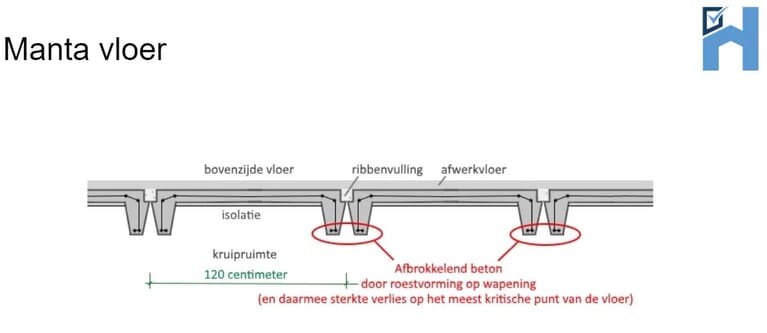
The Manta floor is a so-called ribbed cassette floor. Each element consists of two concrete beams (ribs) with a thin floor slab between them on top. The ribs are on the underside. The element width is 1200 mm. The floor slab is 55 mm thick and tensioned between the ribs.
Much less so than, for example, a screed floor, these floors also sometimes use calcium chloride as a (drying) accelerator added during the production of the elements. The calcium chloride causes the reinforcement to rust away, meaning it can no longer adequately absorb the tensile forces. The corrosion process causes the reinforcement in the Manta floor to expand and crush the surrounding concrete. The load-bearing capacity of the ribs decreases, and the Manta floor can fail. This problem is also known as "concrete rot."
The reinforcement in the Manta floor is primarily intended to absorb the tensile forces in the concrete. These tensile forces often occur at the bottom of the floor system, which is why most of the reinforcement is located there. Clearly, this concrete damage negatively impacts the safety and functioning of the ground floor. Therefore, the floor no longer meets its expected and designed lifespan of fifty years.
Rust spots are visible as brown patches on the concrete and dented concrete. Rusting causes the reinforcement to expand, cracking the concrete cover and reducing the diameter of the reinforcement. This exposes the reinforcing bars, accelerating the rusting process, partly due to the oxygen and moisture content in the crawl space. A dry and well-ventilated crawl space is important!
Concrete rot isn't caused solely by the addition of calcium chloride! In some cases, the reinforcement is too close to the surface, or the concrete isn't sufficiently compacted, allowing a humid environment to damage the reinforcement. The damaged reinforcement corrodes, expands, and causes concrete damage to the ribs of the floor elements.

Would you like to make an appointment for a building inspection?
The cost of a building inspection (up to 250 m²) is only €489 including VAT. We'll conduct a comprehensive building inspection and you'll receive a building report. Do you have any questions? We're happy to help and can schedule an appointment with an expert inspector right away if you wish!
Recent articles