Kwaaitaalvloer: Risks and further research
Bad language stone floors and risks
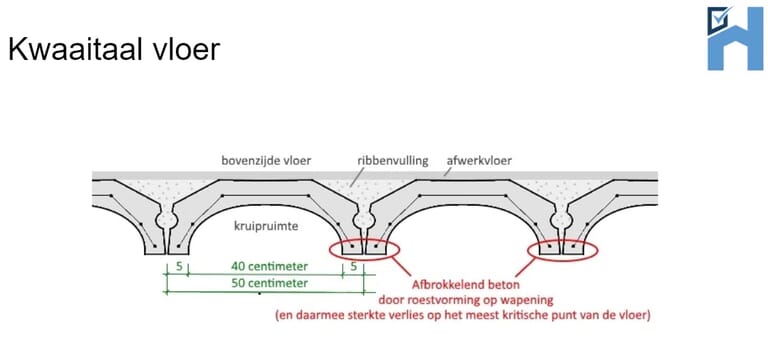
A Kwaaitaal floor (the sibling of a Flevo floor ) is a prefabricated reinforced concrete floor, widely used in the Netherlands between 1965 and 1983. The floorboards were produced by Kwaaitaal in Rotterdam. Kwaaitaal floors consist of a concrete compression arch and two supporting ribs containing the steel reinforcement that ensures the load-bearing capacity of the floor element.
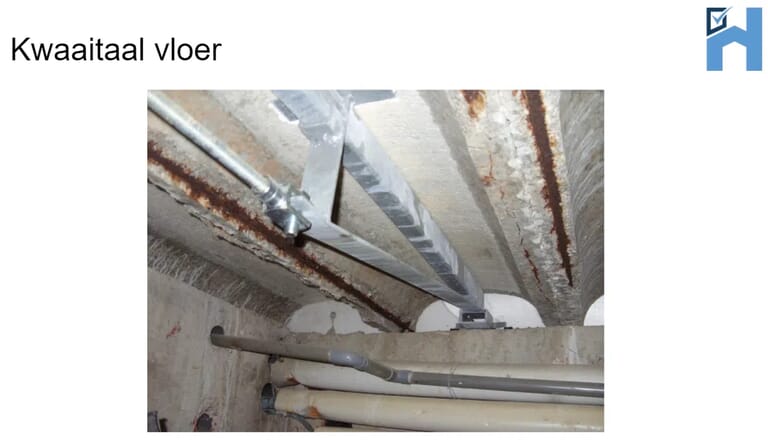
- Calcium chloride was added to accelerate the hardening of the concrete floorboards. This rapid hardening process allowed the morning pour to be removed from the mold in the afternoon to make room for the afternoon pour, doubling production. However, the added calcium chloride eventually caused corrosion of the reinforcement (concrete rot). The rusting and expansion of the reinforcement pushes the outer concrete layer (cover) off the reinforcement, accelerating the corrosion and causing the floor to rapidly lose its strength.
- Especially in a damp crawl space there is an increased risk of problems with bad floor tiles.
- Floors from Flevo factories are visually indistinguishable from Kwaaitaal floors. You can find the floor's brand name in the so-called "kopschotten" (headboards), if they are present.
- A building inspection will immediately give you more clarity about the risk floor.
A visual inspection does not provide complete certainty regarding the technical condition and state of the existing Kwaaitaal floor. Only further inspection can provide 100% certainty regarding the technical condition and state of the floor and its reinforcement. During a follow-up inspection, all elements and ribs, one by one and meter by meter, must be meticulously inspected in all compartments, starting from the crawl space underneath the floor, and tapped with a metal object.
If no defects have been noted in the floor's ribs: it is certainly not the case that calcium chloride has been used in all high-risk floors and that these are therefore by definition floors that will eventually develop concrete rot.
- Because this is a high-risk floor, the crawl space and the underside of the floor must be absolutely dry. The crawl space must also be properly ventilated.
- In many cases, after careful examination, it turns out that rust may be present on the reinforcement. There are several causes for this.
If the floor is insulated on the underside, it's impossible to determine whether or not there's damage. Because of this insulation, the floor can't be assessed from underneath. If more certainty is needed, some of the insulation will have to be removed. And that's a major undertaking!
If defects are noted in the floor's ribs , repairs can be carried out along the entire length of the defect. However, we recommend a follow-up inspection by a specialized company. They will knock off all the ribs of the floor and examine them thoroughly. Only then will the total extent of the damage be clearly visible and a well-founded repair estimate can be made. Instead of repairing, it is increasingly common to install structures under the floor and leave the defects as they are.
The concrete floor regularly exhibits corrosion of the reinforcement due to added (drying) accelerators in the concrete. These accelerators were used to accelerate the curing of the floors during production, thereby increasing production. Calcium chloride was added as an accelerator. Over time, the added calcium chloride causes corrosion of the reinforcement, resulting in concrete rot. Due to the corrosion process, the reinforcement in the concrete floor expands and crushes the surrounding concrete. The load-bearing capacity of the elements decreases, and the concrete floor can fail. This problem is also known as "concrete rot."
The reinforcement in the concrete slab is primarily intended to absorb the tensile forces in the concrete. These tensile forces often occur at the bottom of the floor system, which is why most of the reinforcement is located there. Due to the calcium chloride, the reinforcement corrodes, and the tensile forces can no longer be adequately absorbed.
It's clear that this concrete damage negatively impacts the safety and functioning of the ground floor. Over time, this can lead to excessive deflection and premature, sudden failure of the concrete floor. The floor therefore no longer meets its expected and designed lifespan of fifty years.
It's also important for the crawl space with a concrete floor to be dry and adequately ventilated. Concrete rot isn't caused solely by the addition of calcium chloride! In some cases, the reinforcement is too close to the surface, or the concrete isn't sufficiently compacted, meaning a humid environment can damage it. The damaged reinforcement corrodes, expands, and causes concrete damage to the ribs of the floor elements. Rusting causes the reinforcement to expand, cracking the concrete cover and reducing its diameter. This exposes the reinforcing rods, accelerating the rusting process due to the oxygen and moisture in the crawl space.

Would you like to make an appointment for a building inspection?
The cost of a building inspection (up to 250 m²) is only €489 including VAT. We'll conduct a comprehensive building inspection and you'll receive a building report. Do you have any questions? We're happy to help and can schedule an appointment with an expert inspector right away if you wish!
Recent articles