Make an appointment Call now

Inspection of wooden floor and crawl space

Access to a crawl space is crucial for a thorough inspection of a wooden ground floor, as it allows for an essential evaluation of structural components, potential hazards, and ventilation issues. Without sufficient access, homeowners risk missing critical defects or hazards, such as wood rot or woodworm infestations, which can severely impact the integrity of their home's structure.

Access via a hatch is necessary for the inspection of a wooden ground floor. If there is no or insufficient access, several elements, components, and/or sections of a crawl space will remain uninspected. Therefore, nothing can be said about the floors, the floor structure, the sewer system, the climate in the crawl space, and/or whether there is any asbestos present in the form of sewerage, waste, or similar materials. Full access to a crawl space is therefore essential. With insufficient or no access, you cannot inspect the foundation, sewer system, soil structure, or other unidentified structural features or defects below this floor level.

Why might a crawl space be inaccessible?

  • The crawl space can be divided into different compartments, some of which are not visible or accessible.
  • There may be obstacles in the crawl space that prevent unobstructed and full access.
  • There may be other obstructions (hazardous substances such as asbestos or other risks) in the crawl space that could prevent it from being inspected unobstructed and completely.
  • Or what do you think of a layer of water in the crawl space that prevents unobstructed and full access.

Floor insulation

If the wooden floor is not insulated, living comfort can still be increased by insulating the floor from the crawl space.

  • There are many ways to insulate a floor! Incorrect applications and installation often lead to mistakes when applying floor insulation, which can lead to structural or moisture problems. So always consult an expert about the various options.

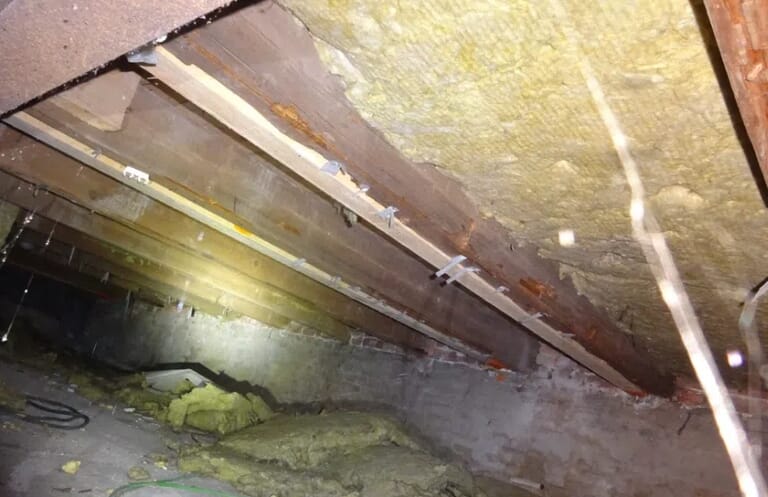
If the floor is insulated, the insulation material may be cold-mounted to the floor boarding , which isn't ideal. If the crawl space is damp and poorly ventilated, this can cause problems. Condensation can also form between the insulation material and the floor boarding, but only if the top side is also vapor-tight. Such insulation is usually not 100% vapor-tight, and often the seams aren't fully sealed, allowing condensation to escape.

Homekeur-balken-met-bruinrot-1.png
  • It's advisable to inspect the floor boarding and joists from the crawl space behind the insulation every two years, for example, in one or more places. This requires removing a section of insulation. There must be absolutely no condensation or excessive humidity between the insulation material and the floor structure.

If the floor is insulated on the underside and the insulation material is installed with a (ventilated) space between the floor boarding and the insulation material, this prevents condensation from forming between the different materials. In our opinion, this is a correct application and installation with maximum efficiency. Insulation installed under the joists also has the same effect and function as installing it between the joists with a (ventilated) space.

  • Depending on the materials used, yields may vary per insulation material used.

Floor joists (wood rot)

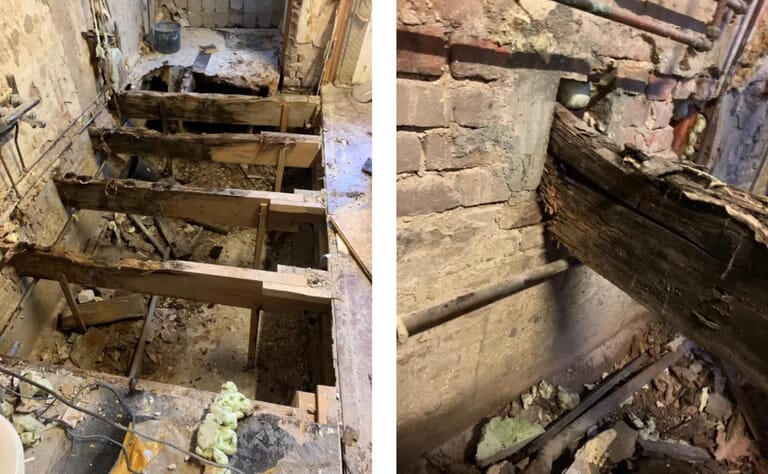
The risk of wood rot in beams can never be completely ruled out. Several wood-destroying pathogens (such as brown rot) originate from the core of the wood and are often not immediately visible. To properly identify this, each beam should be hammered every 30 to 40 cm along its entire length.

Homekeur-vloerbalken-rot-1.png

You can check floor joists for wood rot, whether they are thick enough, strong enough, and stable enough to function as load-bearing beams. Also, pay extra attention to the foundation supports (benching) for wood rot, brown rot, or moisture in the joist heads due to rising damp from the foundation. The quality of joists deteriorates with age; the parts of the joists that actually "stick" into the wall cannot be seen because that would require removing parts of the joists or foundation.

Floor joists are supported by the foundation. If wood rot is detected at this support, we assume it is repairable and/or that a steel bracket can be installed under the joist to the foundation to take over its support function. If wood rot (or brown rot) is detected in the floor joists themselves, the cause and effect must be addressed. Only by addressing these defects can the precise extent of the damage often be determined, and a decision may be made to replace an entire floor joist or several. Replacing a floor joist is not easy, especially because it is cemented in on both sides.

  • If necessary, have a professional company replace the beams; first, get a quote for the work. Unit prices may vary depending on the circumstances.
  • If you believe too many beams need replacing and the costs are too high, you can consider removing the entire floor and replacing it with a concrete one. This is also a major and expensive operation, but it's the best option in the long run.

Floor joists and floor boarding; Woodworm or Longhorn beetle

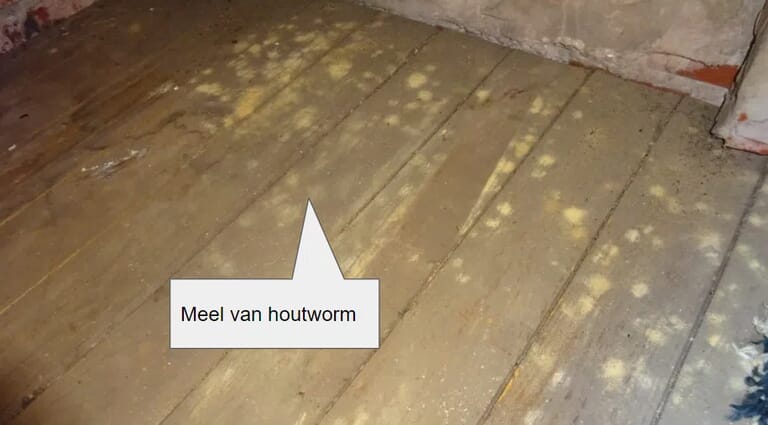
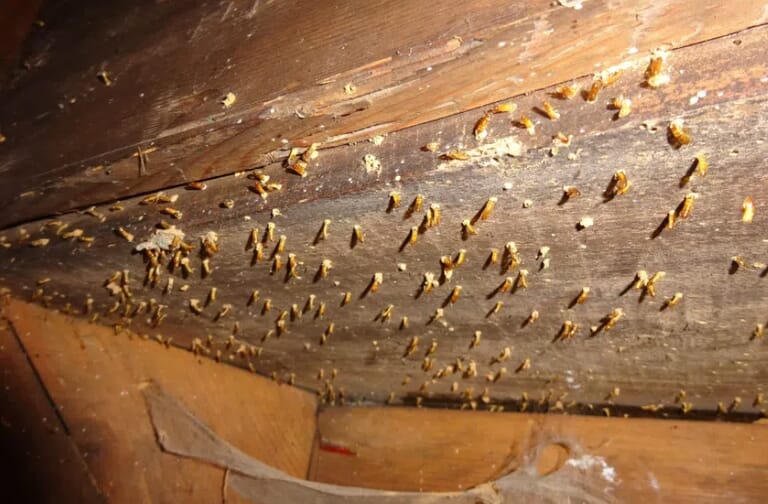
If traces of active woodworm are found in the floor and floor structure, woodworm can further damage the beams and floor boarding and eventually even weaken the structure. Treatment is easily possible by yourself or by a qualified specialist. To prevent further spread, we recommend taking the necessary action as soon as possible. Also, seek further information about preventative woodworm control and prevention options.

If traces of inactive woodworm have been found in the floor and floor structure, it's possible that treatment has already been carried out in the past. It's also possible that the woodworm has left on its own due to changing conditions in the room.

Homekeur-mail-van-houtworm-1.png
  • Woodworm is a name for various insect larvae that live in wood.
  • The larva of the common furniture beetle or common doorknob beetle is also called the large woodworm.
  • If woodworm has been noticed, it cannot be ruled out that it is also present (to a greater or lesser extent) in other wooden parts elsewhere in the house.
  • Woodworm eggs can hatch and become active up to seven years after being laid! Therefore, vigilance is always advised.
  • If complete certainty is required, it can be considered to involve an expert exterminator for a full inventory.
homekeur-houtworm-actief.png

If you suspect the presence of a longhorn beetle in your beams and/or floor boarding, one of the woodworms that can cause the most damage in the Netherlands is the longhorn beetle. Short-term treatment is always recommended if a live longhorn beetle is present. Treatment may even require replacement of parts of the beams in the worst-case scenario.

  • A longhorn beetle gnaws a tunnel in the wood, with exit holes about 6 mm to 9 mm long and oval. These exit holes are present.
  • For woodworm control, it is best to contact an expert, a pest controller specialized in this field.
  • A longhorn beetle can be heard by gnawing at the wood, but is difficult to recognize.
  • Recognize woodworm and prevent worse!
  • A woodworm in the house is a nuisance!

Other defects or comments

If you've checked your wooden floor and beams for woodworm or other wood-destroying pests and haven't noticed any, keep in mind that this is always just a snapshot. Depending on various conditions, such as climate and ventilation, brown rot can develop and spread quickly.

Floor joists are naturally supported by a foundation, and they can also be supported by one or more masonry piers . Such support provides greater stability and strength to the floor as a whole. Due to the span and the dimensions of the joist, this support would have been necessary. In itself, it's an excellent and well-functioning solution that can be retained. If masonry piers were not used for this support, but a less stable support, this may also work, but it should be checked periodically for strength and stability.

Wooden floor joists may also exhibit some sag, which can cause the floor to slope at the top or cause limited movement when excessive loads are applied. If the wooden floor joist(s) lack sufficient support at the supports and/or piers, this can easily be remedied by applying underlayment mortar.

  • Undercutting is the filling of the (small) space between construction components.
  • It is recommended to lift the beams slightly using a car jack or wedge, for example, and then fix the opening with a hard PVC spacer, after which the mortar can be applied.
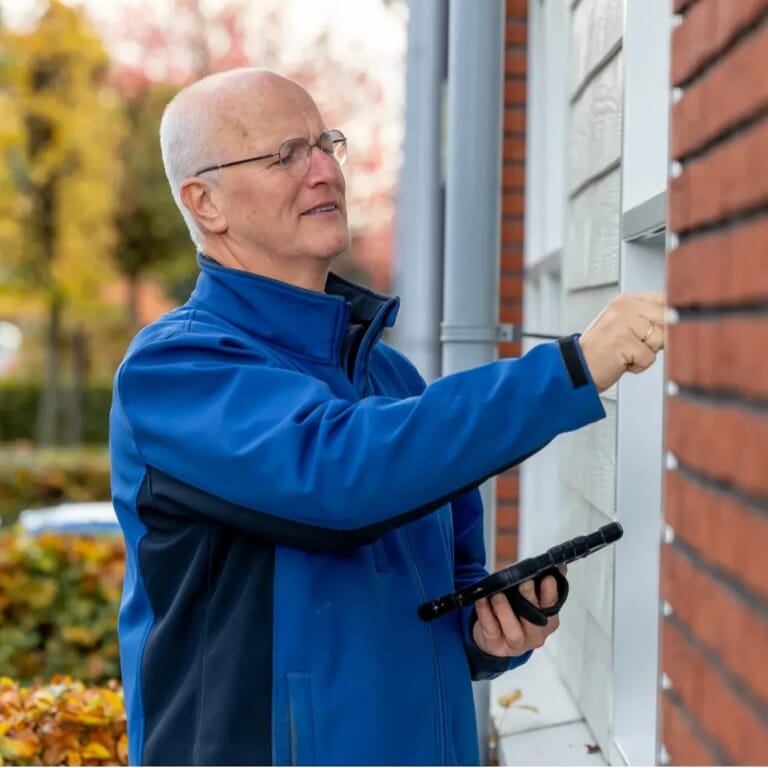
  • If possible, a Homekeur inspector will definitely inspect the crawl space during the building inspection .

Would you like to make an appointment for a building inspection?

The cost of a building inspection (up to 250 m²) is only €489 including VAT. We'll conduct a comprehensive building inspection and you'll receive a building report. Do you have any questions? We're happy to help and can schedule an appointment with an expert inspector right away if you wish!

Recent articles

Een vrouw wijst naar een tablet die een man vasthoudt en een andere man kijkt mee
blog
13 February 2026
Hidden defects in a home
Hidden defects are not uncommon, especially in existing homes. They are often not immediately visible, but can have significant consequences for comfort, safety, and costs. This article explains how hidden defects are assessed and the role of investigation and inspection.
blazen plooien bitumen dak
video
13 February 2026
Common roof detail mistakes: what an inspection reveals
During roof inspections, problems often turn out to be not in the roofing itself, but in the details. In this practical case study, we demonstrate which installation errors are frequently encountered and why these, in particular, pose an increased risk of leaks and damage.
WhatsApp Image 2026-02-12 at 08.51.37
video
12 February 2026
Three Roof Eave Mistakes That Cause Leaks (And Are Often Overlooked)
Roof problems rarely arise suddenly. They usually start with a minor issue. In this inspection, we see how a torn lead flashing, improper installation, and a loose joint can all pose a serious risk. What should you look for—and how can you prevent them?