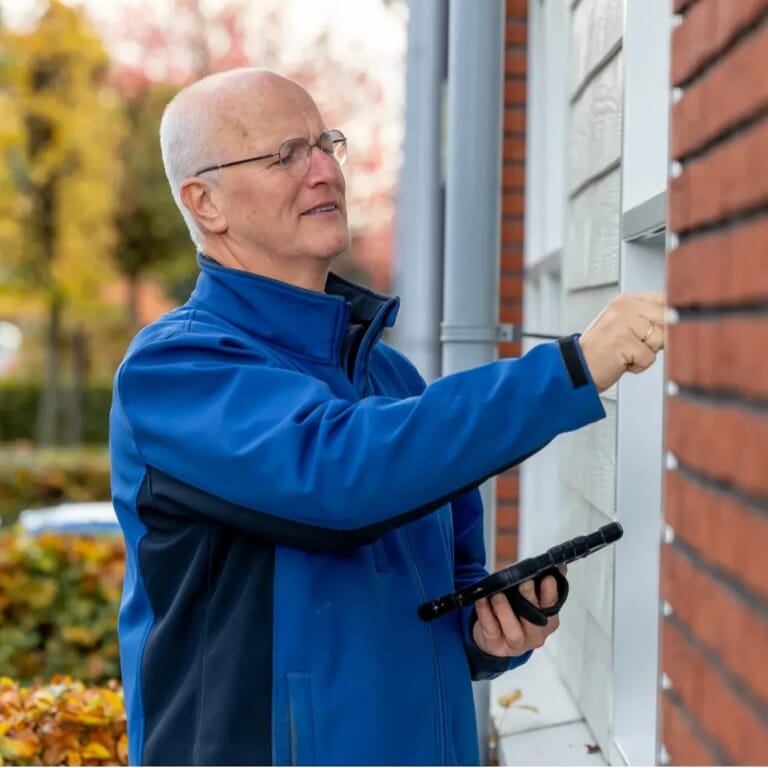
Anyone buying a home wants to know what they are buying. Are there any structural defects? What maintenance is necessary? What costs can be expected in the short term? And are there any risks requiring further investigation?
A professional structural inspection provides insight into the technical structural condition of a home. To ensure that such an inspection is carried out according to a clear and uniform methodology, there is NTA 8060.
At Homekeur, NTA 8060 forms an important basis for our structural inspections. Moreover, we are actively involved in the revision and further development of NTA 8060.
What is NTA 8060?
NTA stands for Nederlandse Technische Afspraak. NTA 8060 describes a methodology for conducting an inspection of the structural condition of a dwelling.
The current version, NTA 8060:2021, is titled Inspection of the structural condition of a dwelling – Methodology and checklist.
The methodology provides guidance on how a dwelling is inspected and assessed. This creates a more uniform working method for structural home inspections.
That is important. After all, a structural inspection should not depend solely on what an individual inspector happens to notice. A professional inspection requires a systematic assessment of the relevant components of a dwelling.
What is assessed according to NTA 8060?
During a structural inspection, the technical condition of various building components is assessed. Consider, for example, components such as:
- foundation and crawl space, insofar as visible and accessible;
- facades and masonry;
- roofs, roofing, and roof structures;
- frames, windows, and doors;
- floors, walls, and ceilings;
- moisture and ventilation issues;
- visible components of dwelling-related installations;
- extensions, balconies, and other relevant structural components.
Which components can actually be assessed always depends on the dwelling and accessibility at the time of the inspection.
Is a structural inspection according to NTA 8060 complete?
This is an important distinction.
A regular structural inspection according to NTA 8060 is, in principle, a visual and non-destructive inspection. Therefore, a structural inspector does not break open walls, ceilings, or floors to see what is behind them.
Furthermore, parts may sometimes be inaccessible or only partially accessible.
A structural inspection is therefore no guarantee that a home is completely free of defects. It is a professional assessment of the observable structural condition of the home at the time of inspection.
That is precisely why the expertise of the inspector is so important. A good structural inspector must not only recognize defects but also be able to assess when something is insufficiently visible and when additional or specialist investigation is necessary.
Why is NTA 8060 important for a structural inspection?
A home is a complex whole of structures, materials, and installations. Without a fixed methodology, significant differences can arise in the way homes are inspected and reported.
NTA 8060 contributes to greater uniformity.
That does not mean that every home or every defect is the same. It does mean, however, that a clear methodology exists for conducting the inspection and recording the findings.
For consumers, this provides more clarity regarding what they can expect from a professional building inspection.
NTA 8060 is being revised
The current NTA 8060 dates from 2021. Since then, the market for home building inspections has developed further, and expectations regarding quality and reporting have also increased.
Therefore, NTA 8060 is currently being revised.
This revision examines, among other things, a further clarification of what a client can expect from a basic inspection, which components must be assessed and reported, and when specialist follow-up research is necessary.
The revision is thus intended to contribute to the further professionalization and standardization of home building inspections in the Netherlands.
Homekeur is co-writing NTA 8060
Homekeur is actively involved in the revision and further development of NTA 8060.
We consider this important.
Our building inspectors carry out building inspections daily throughout the Netherlands. As a result, we possess extensive practical experience with various housing types, construction periods, structures, and structural defects.
Precisely this practical experience is valuable in further developing a methodology for building home inspections.
In practice, we see the challenges inspectors face, what information is important to consumers, and where there is a need within the market for greater clarity and uniformity.
By contributing to the further development of NTA 8060, Homekeur aims not only to further enhance the quality of its own services but also to contribute to the professionalization of the entire industry.
Increasing demands on the building inspector
The role of the building inspector is changing.
Nowadays, a good inspector must be able to do much more than just identify visible defects. He must be able to recognize structural risks, assess the severity of defects, know the limits of a visual inspection, and clearly indicate when further investigation is necessary.
In addition, an inspector must be able to carefully substantiate his findings and translate them into an understandable report.
That is logical. After all, a structural report can be used for one of the biggest financial decisions a consumer makes: the purchase of a home.
Homekeur therefore continuously invests in training, internal quality control, and further education for our structural inspectors.
NTA 8060 and the future of structural inspections
We expect that quality, professional competence, and uniformity will play an increasingly important role within the market for structural inspections in the coming years.
The revision of NTA 8060 fits within this development.
For Homekeur, this means that we not only want to comply with developments within the industry, but also want to actively contribute to them.
By combining our daily practical experience with our involvement in the further development of NTA 8060, we are working together with other experts and market parties towards an increasingly professional structural home inspection.
The ultimate goal is simple: more clarity, better quality, and a reliable structural inspection for the Dutch housing market.