

Safety starts with electricity!
You can only visually assess the electrical installations when purchasing a home; they are not part of the structural component. You can check the installation based on random samples. You will only experience the proper functioning of, for example, the distribution and breakdown of all wall sockets, switches, and appliances across the various circuits in practice. Read more information about a distribution board here.
- 5 practical tips for a safe meter box
- How many earth leakage circuit breakers are required in the meter box?
- Can you replace the fuse box yourself?
- If no defects are noted in the wiring and it is recent, it can be retained. It's possible that the correct colors, consistent with the (European) standard, haven't been used throughout the system. Deviating or changing colors isn't helpful, but it doesn't hinder the proper functioning of the system.
- If loose wiring is present: wiring must be concealed in PVC pipe, making the current situation unsafe. Some adjustments will need to be made regarding finishing and installation.
- If modifications have been made to the electrical system in the past and these were not carried out professionally, this creates an unsafe situation. To get a clear picture and impression of the entire installation, we recommend having the entire system inspected by an installer.
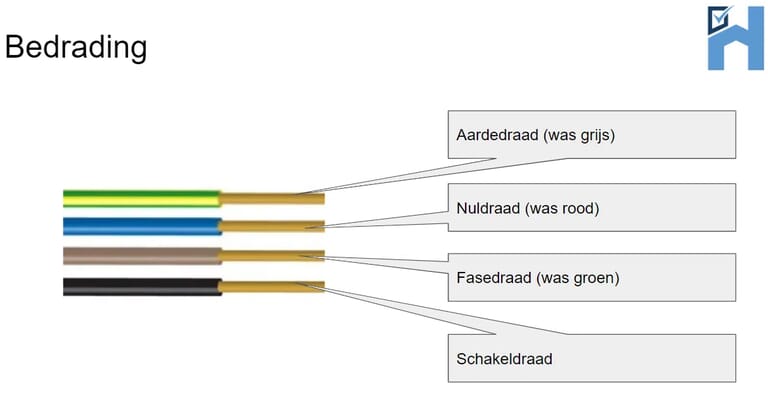
- It's always important to be able to immediately see a wire's function. This is achieved through, among other things, European standardized colors. We often find that electrical installations deviate from these. However, with different colors, the system can still function perfectly.
- The usual colours according to this European standard are as follows:
- Brown is the phase wire
- Blue is the neutral wire
- Black is the switching wire
- Green/yellow is the ground wire
Vinyl or jute wiring
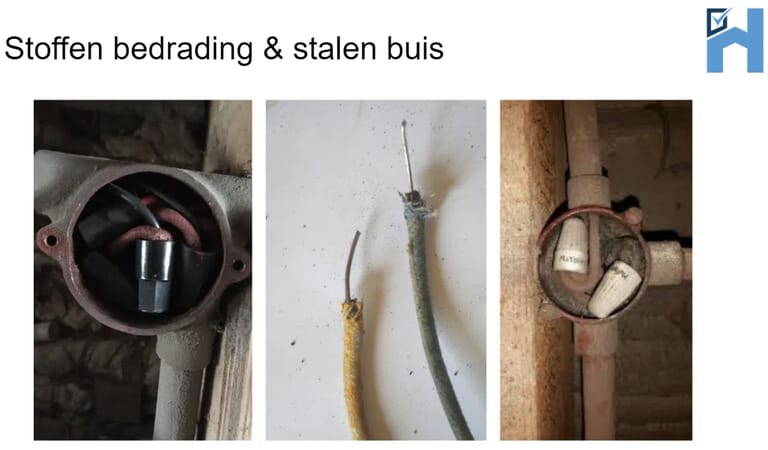
You can check the wiring for fabric sheathing (so-called jute or linen wiring ) based on a random sample. If this is found, we recommend replacing the wiring. The danger, especially with fabric electrical sheathing, is that a short circuit can easily cause a fire. Such old wiring is dangerous, the house cannot be insured, and therefore it must be replaced. Consult an expert and request a fixed-price quote for complete replacement. Depending on the construction year of a house (before 1940), such wiring may still be present but not visible. These wires have a solid copper core and insulation that is usually vinyl.
- If there is also steel/metal pipe in the house, it is better to replace it immediately if possible.
- For technical reasons, new wiring is sometimes also installed in older metal conduit. This is not recommended, but it is an option.
Steel pipe
If you can determine that steel pipes are still being used for electrical wiring, in many cases these pipes rust on the inside, deteriorating the electrical system. Sharp edges in the pipes also pose a risk of short circuits, as the wiring can easily become damaged or crushed. If the technical possibilities and space are available, we recommend replacing the steel pipes with PVC pipe. Considering the age of the houses (older than 1940), the presence of steel pipes in these houses cannot be entirely ruled out.
Groups and meter cupboard
- If there is mechanical damage, or small parts are missing from the distribution box: this can easily be repaired and/or retrofitted.
- Missing components in the distribution box can cause dust to accumulate. The heat from the electrical system, combined with dust and dirt, can be the start of a fire!
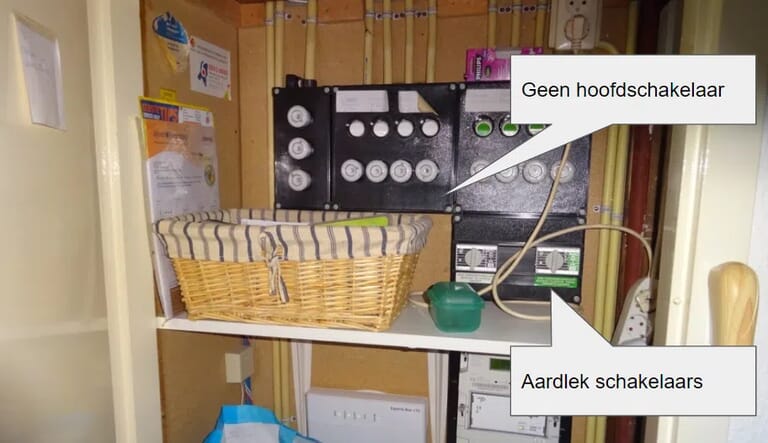
- If a fuse box is present: these electrical installations are now divided into so-called "groups." This makes the system much more organized and easier to distribute power across the various groups. This also makes it much more functional and safer. A fuse box with fuses can be replaced relatively easily with a modern distribution board. This isn't necessary, but it is recommended.
- The meter box is used as a storage area in many households. We strongly advise against using it for this purpose. Furthermore, a tidy meter box allows easy access to the switches, allowing you to switch off the electricity in the event of an emergency. Therefore, ensure the meter box is always easily accessible.
- If a fuse blows or a circuit is disconnected, it's helpful to know where to look for a potential problem or short circuit. You can download templates online to easily and instantly visualize the layout of your circuits.
- A meter cupboard should always be adequately ventilated. If this isn't the case, we recommend installing a ventilation system. This could include a grille in the door (at the bottom) or a grille in the wall of the cupboard. The cupboard will smell much less musty, retain less dust, and be less susceptible to mold and other growth.
- If one or more drains run through the meter box, there are often several glued connections for these drains. This is not permitted under current building regulations. It's better to separate these drains from the electrical system, for example, with a wooden shroud.
Number of groups
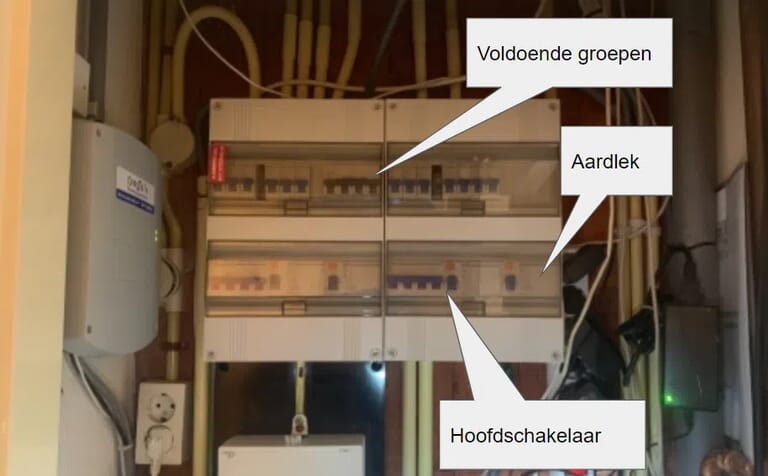
If a distribution board has four or fewer circuits, this is insufficient for an average home. Keep in mind that, for example, only a washing machine, dryer, dishwasher, and oven/microwave each require a separate circuit. This means there aren't enough circuits to distribute power to the rest of the house, shed, and possibly garden. We consider at least seven circuits sufficient, but most homes easily have ten.
Main switch
- Since September 2005, a main switch has been mandatory in every distribution box in new construction or renovation projects.
- Existing older distribution boards do not need to be equipped with a main switch.
- This applies to homes for which the building permit was issued after this date.
- This also applies if major changes are/have been made to the electrical installation or fuse box.
Earth leakage circuit breaker
A residual current device (RCD) is found in almost all distribution boards! The RCD ensures that the system can be de-energized. The system is de-energized when the RCD detects a leakage current.
If there is NO earth leakage circuit breaker (GFCI) present in the distribution board, this is unsafe for the user! It is recommended to modify and improve the installation by installing earth leakage circuit breakers (GFCIs). Almost all distribution boards have an earth leakage circuit breaker (GFCI)! The GFCI ensures that the system can be de-energized when it detects a leakage current. Also consider the risks in bathrooms if there are no GFCIs present. Metal objects in a bathroom must be grounded. Good grounding ensures that the GFCI quickly interrupts the power supply, thus significantly reducing the risk of injury if you come into contact with electrical voltage.
- Leakage current means: current that leaves the installation in a different way than expected.
- The function of the earth leakage circuit breaker should therefore not be underestimated!
- In residential homes, when replacing, expanding or modifying the distribution box, all groups must be protected by an earth leakage circuit breaker.
- The use of earth leakage circuit breakers in new and modified domestic installations has been mandatory in the Netherlands since 1975 according to NEN 1010.
- In some cases, not all groups in the home are mounted behind the earth leakage circuit breaker.
- Earth leakage circuit breakers a must in every meter box
The residual current device (RCD) can be tested regularly using the test button. If you want to be sure these switches are functioning safely and properly, they should be tested.
Switches, wall sockets & fixed light points
In general, we recommend checking all switchgear in the home and wall sockets for defects. Where necessary, improve/tighten the mounting.
If the switches and sockets in your home are outdated but still functioning properly, replacement isn't immediately necessary. However, if you're making changes to the installation, we do recommend replacing these outdated switches and wall sockets.
If defects are found in wall sockets (outlets) and switches, repair is usually pointless; replacement is faster and therefore more cost-effective. Also check for defects in the light fixtures, as such defects are usually more difficult to repair.
Earthing on wall sockets
The mains voltage in homes in the Netherlands is 230 volts. This voltage is life-threatening if someone comes into contact with it. To prevent people from becoming live, electrical machines and appliances are grounded. This grounding ensures that the circuit flows to the earth via the ground wire. The ground wire is yellow-green and is located next to the brown and blue wires in the connection cord of electrical appliances. Sockets with a ground connection provide contact with the earth, but do so indirectly via the ground wire. The earth in these special sockets is therefore called a ground connection.
- An additional safety feature on the outside of metal appliances is the earthing connection. This ensures that the appliance will not become live in the event of a fault. A ground wire is connected to the outside of the appliance (usually invisible). This ground wire runs through the wiring (the cord and plug) and the socket (with an earth connection) via the meter box and a grounding rod into the ground .
- During a building inspection , the grounding is measured at several locations in the home on a random basis and checked for functioning.
If there are NO earthed sockets in your home: as a homeowner, you are responsible for the safety of your home. Because there are no earthed wall sockets in this case, we recommend that you contact a local electrician for a full inspection and approval of your installation.
Would you like to make an appointment for a building inspection?
The cost of a building inspection (up to 250 m²) is only €489 including VAT. We'll conduct a comprehensive building inspection and you'll receive a building report. Do you have any questions? We're happy to help and can schedule an appointment with an expert inspector right away if you wish!
Recent articles