
Make an appointment Call now

Rising Damp: Causes and Solutions

Rising damp unknowingly erodes a home's structure and can lead to damage to walls, floors, and foundations. By understanding the causes and potential solutions early on, you can prevent larger problems and costly repairs.
  • Rising damp is inherently detrimental to a house's structure! It damages the plasterwork. Materials such as brickwork and mortar also become porous and silt up if they are continuously subjected to rising damp.
  • It is important to mention that an ideal climate and breeding ground is also created for fungi and molds.
  • Under certain circumstances this rising damp will be present to a greater or lesser extent.
  • Rising damp, rising damp: what can you do about it?
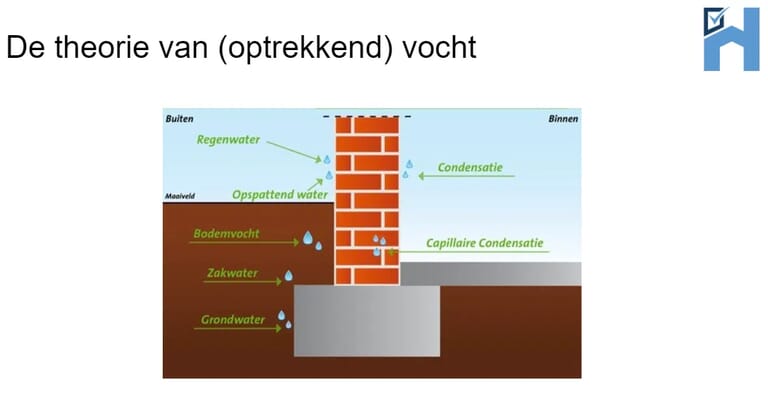
  • 5 possible causes of rising damp
optrekkend-vocht-theorie.png

Moisture measurement of concrete floors

If an increased moisture content is measured: this may indicate water in the crawl space, high groundwater levels, or unforeseen and/or inspectable defects in an adjacent home.

If no increased moisture content is measured, this confirms that there are no significant moisture problems in the crawl space that could adversely affect the foundation, walls, or floor structure.

Moisture measurement of wooden floors

If an increased moisture content is measured: this may indicate water in the crawl space, high groundwater levels, or unforeseen and/or inspectable defects in an adjacent home.

If no increased moisture content is measured, this confirms that there are no significant moisture problems in the crawl space that could adversely affect the foundation, walls, or floor structure.

  • Rising damp is inherently detrimental to a house's structure! It damages the plasterwork. Materials such as brickwork and mortar also become porous and silt up if they are continuously subjected to rising damp.
  • It is important to mention that an ideal climate and breeding ground is also created for fungi and molds .
  • Under certain circumstances this rising damp will be present to a greater or lesser extent.
  • Rising damp poses a significant risk to wooden floors and joists. Wood rot in the joist heads can develop quickly and easily, but because they are built into the walls, they are not visible.

Various measures against rising damp

In appropriate cases, we recommend placing a gravel bed on the outside of the house along the foundation as a preventive measure.

  • Preferably use a gravel pit of approximately 25 cm wide and 60 cm deep.
  • This does not guarantee a 100% solution to such rising damp problems.
  • This measure should be seen as preventive and, in combination with other improvements, can reduce the problem.

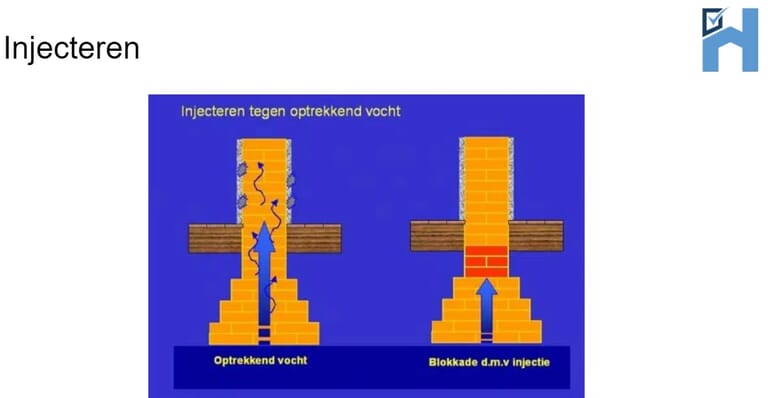
Injecting walls is a popular measure. The most common remedy for rising damp is injecting the walls with a special damp-proofing gel. It's a relatively simple procedure that can provide a lasting solution, especially for mild damp damage. This method involves drilling holes along the entire length of the wall approximately 20 cm above floor level. A damp-proofing gel is then injected into the holes. The gel will slowly be absorbed by the wall, creating a solid barrier against rising damp within a few months.

injecteren.png
  • The above measures do not guarantee a 100% solution to such rising damp problems.
  • These measures should be seen as preventive and, in combination with other improvements, can reduce the problem.

Would you like to make an appointment for a building inspection?

The cost of a building inspection (up to 250 m²) is only €489 including VAT. We'll conduct a comprehensive building inspection and you'll receive a building report. Do you have any questions? We're happy to help and can schedule an appointment with an expert inspector right away if you wish!

Recent articles

Een vrouw wijst naar een tablet die een man vasthoudt en een andere man kijkt mee
blog
13 February 2026
Hidden defects in a home
Hidden defects are not uncommon, especially in existing homes. They are often not immediately visible, but can have significant consequences for comfort, safety, and costs. This article explains how hidden defects are assessed and the role of investigation and inspection.
blazen plooien bitumen dak
video
13 February 2026
Common roof detail mistakes: what an inspection reveals
During roof inspections, problems often turn out to be not in the roofing itself, but in the details. In this practical case study, we demonstrate which installation errors are frequently encountered and why these, in particular, pose an increased risk of leaks and damage.
WhatsApp Image 2026-02-12 at 08.51.37
video
12 February 2026
Three Roof Eave Mistakes That Cause Leaks (And Are Often Overlooked)
Roof problems rarely arise suddenly. They usually start with a minor issue. In this inspection, we see how a torn lead flashing, improper installation, and a loose joint can all pose a serious risk. What should you look for—and how can you prevent them?