Make an appointment Call now

Central heating system in the home: points of attention, risks and maintenance

A central heating system is essential for home comfort, but hidden defects, lack of maintenance, or unsafe connections can pose significant safety and cost risks.

A central heating system can only be inspected visually; if necessary, you can remove the cover and inspect the internals. It's difficult to assess whether the entire system is always connected in accordance with the supplier's instructions. You can only inspect the system to determine whether it's functioning properly. An installer can measure the system's parameters, CO2 (carbon monoxide), and determine whether the boiler and thermostat combination are functioning properly (together) and comply with all safety standards . Such system adjustment and tuning is so specialized that we always recommend an expert, but especially regular and annual maintenance. This is checked and adjusted periodically during normal and routine maintenance.

  • Annual maintenance of a central heating boiler is recommended.
  • Have the maintenance recorded in the maintenance booklet for the central heating boiler.
     

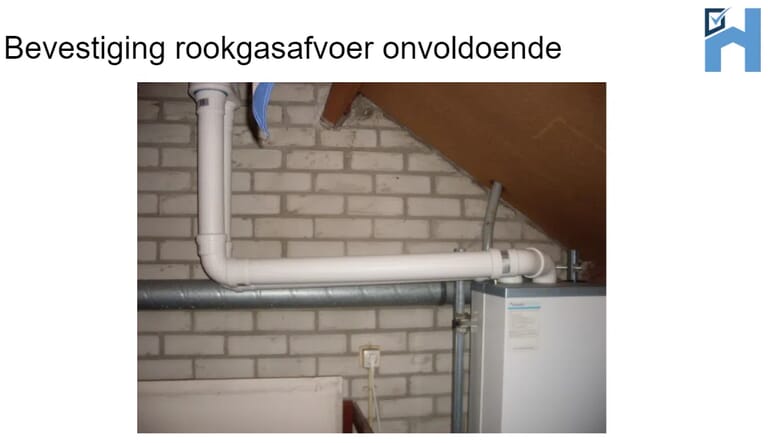
You can visually inspect the boiler, fittings, connections, brackets, intake mounting, and flue gas duct for any defects or abnormalities. If the mounting/bracketing of the flue gas duct and/or intake is inadequate: the ducts must be securely mounted and should have little or no movement. Moving parts pose a risk of leakage. In the worst case, improper installation can lead to carbon monoxide poisoning. The brackets can usually be easily replaced or improved.

  • The Dutch flue gas exhaust manufacturers, united in Rogafa, are committed to contributing to safety. This has resulted in clear and uniform advice: "Always use brackets around the sleeve when installing a flue gas exhaust."
  • To prevent channels or a roof duct from becoming loose and causing dangerous situations, safe installation is essential.
  • Read another article specifically about roof or facade penetrations here
     

If you notice any defects in the central heating flue, we would like to emphasize again that this creates an unsafe situation. There is a limited risk of flue gases in the home! Flue gases can be fatal due to the presence of carbon monoxide! Repairs are possible but must be carried out immediately.

Een afvoer vanuit een cv op een zolder

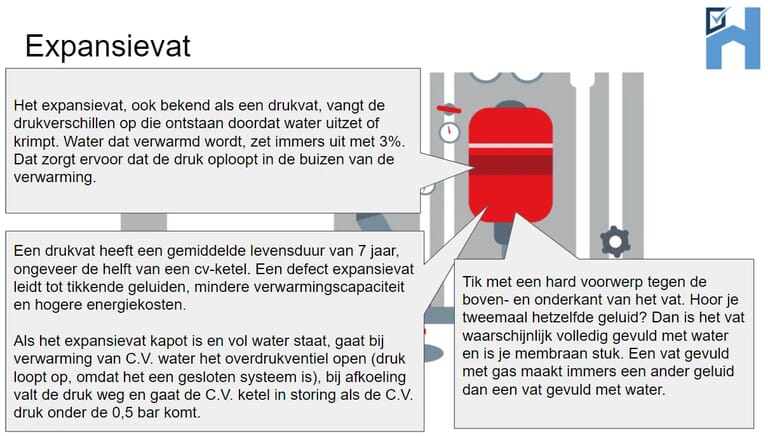
An expansion vessel , also called a pressure vessel, absorbs the pressure differences that arise as water expands or contracts during heating or cooling of the pipes and radiators in a central heating system. Water in a central heating system expands by approximately 3% when heated. The central heating system is a closed system, and the metal pipes and radiators are not flexible (like a balloon) and cannot accommodate the water's expansion. This causes the pressure to rise, which is undesirable. The expansion vessel's purpose is to absorb these pressure differences . The lifespan of an expansion vessel is approximately seven years.

The expansion vessel's mounting is important and must be properly secured. If it's not mounted with a wall bracket, the mounting will be inadequate. We recommend securely mounting the expansion vessel to the wall using a wall bracket.

Uitleg van een cv

If there's a leak or break in the water drain (overflow or overflow) under the boiler, it may be repairable; keep in mind that part of this drain will need to be replaced. Leaks or other defects in drains can naturally cause problems or moisture problems elsewhere in the structure.

Leaks are frequently noticed in one or more couplings at the bottom of the boiler. These leaks, whether large or small, must be repaired. A first attempt at repair could be to tighten the couplings a little further. If that doesn't work, replacing the couplings where necessary can be considered.

  • Leaks decrease as the pressure in the central heating system decreases. If the pressure in the central heating system drops, malfunctions can occur. In combination boilers , hot water production will also stop.

The boiler's mounting/bracketing must be secure, solid, and stable, with minimal or no movement. An improperly secured installation poses a risk of leaks in the supply and return pipes, gas lines, and water pipes.

Asbestos sheeting may be present at the roof penetration: if the risks and dangers of asbestos are clear, this sheet can be retained. This sheet can be removed at some point in the future when the central heating system is replaced. It is always better to remove asbestos. Because asbestos has been found here, we recommend an asbestos inventory for the entire house. This will give you a complete picture and certainty regarding the entire house (inside and out). Based on this asbestos inventory report, you can decide to remove the asbestos yourself or hire a remediation company to remove it. As a consumer, a certain number of square meters may be removed.

Een moederhaard in een huis

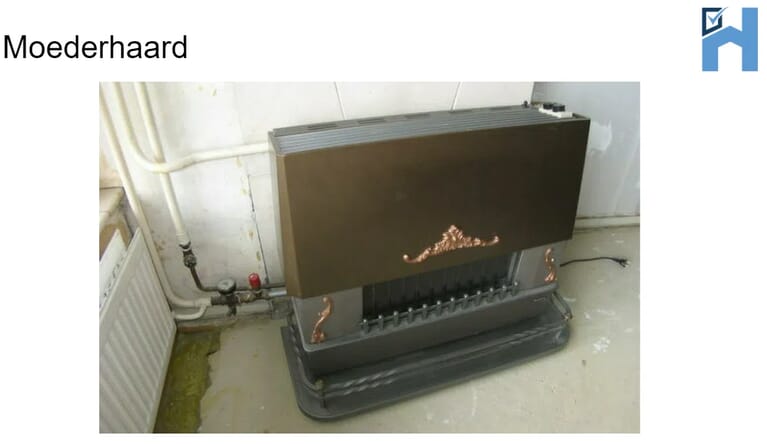
The home may still be equipped with a central heating system , which serves the same purpose as a central heating boiler: heating multiple rooms simultaneously. A gas fireplace or central heating system usually has an open combustion system. Open appliances are a relatively frequent cause of carbon monoxide incidents. This is because open appliances extract oxygen from the room in which they are located, allowing carbon monoxide to enter the living space directly.

  • It is important that the fireplace receives annual maintenance.
  • An annual maintenance service ensures that your fireplace remains safe and in good condition.


Would you like to make an appointment for a building inspection?

The cost of a building inspection (up to 250 m²) is only €489 including VAT. We'll conduct a comprehensive building inspection and you'll receive a building report. Do you have any questions? We're happy to help and can schedule an appointment with an expert inspector right away if you wish!

Recent articles

Een vrouw wijst naar een tablet die een man vasthoudt en een andere man kijkt mee
blog
13 February 2026
Hidden defects in a home
Hidden defects are not uncommon, especially in existing homes. They are often not immediately visible, but can have significant consequences for comfort, safety, and costs. This article explains how hidden defects are assessed and the role of investigation and inspection.
blazen plooien bitumen dak
video
13 February 2026
Common roof detail mistakes: what an inspection reveals
During roof inspections, problems often turn out to be not in the roofing itself, but in the details. In this practical case study, we demonstrate which installation errors are frequently encountered and why these, in particular, pose an increased risk of leaks and damage.
WhatsApp Image 2026-02-12 at 08.51.37
video
12 February 2026
Three Roof Eave Mistakes That Cause Leaks (And Are Often Overlooked)
Roof problems rarely arise suddenly. They usually start with a minor issue. In this inspection, we see how a torn lead flashing, improper installation, and a loose joint can all pose a serious risk. What should you look for—and how can you prevent them?