

Make an appointment Call now

All about toilet inspections

Maintaining a well-functioning restroom involves more than meets the eye, from ensuring proper toilet installation to optimizing ventilation for a healthy indoor environment. Discover the essential tips and solutions to common restroom issues that can save you from costly repairs, improve air quality, and enhance overall functionality. Dive in to learn how you can make your restroom both efficient and problem-free.

If a standing toilet is present: check the toilet's attachment to the floor and regularly check the area around the toilet for leaks. Leaks can occur at the sewer or water connection. If a wall-hung toilet is present: check the toilet's attachment to the wall and regularly check around and under the toilet for leaks. Leaks can occur at the sewer or water connection.

Ventilation in toilet

If the restroom has an extractor fan: Good ventilation improves the indoor climate . It prevents moisture and mold, and unpleasant odors are removed. A fan or extractor fan with a run-on time is essential in a restroom. Calculators are available to determine the correct extraction capacity. Ensure there are sufficient air intakes, for example, a gap under the door or a grille in the door.

If the restroom has natural ventilation/exhaust: natural ventilation is a method of ventilating a building that does not use forced or mechanical ventilation. Both supply and exhaust occur naturally. Examples of natural ventilation include air vents, self-regulating ventilation grilles, mop grilles in exterior walls, cracks, etc.

  • Inadequate ventilation creates an unhealthy indoor climate. Natural ventilation can work, but the homeowner must experience its effectiveness.
  • Depending on the year the house was built, natural ventilation is not uncommon; if it changes, mechanical ventilation/extraction may be more appropriate.
Homekeur-tegelwerk-badkamer-los-1.png

Tiling in toilet

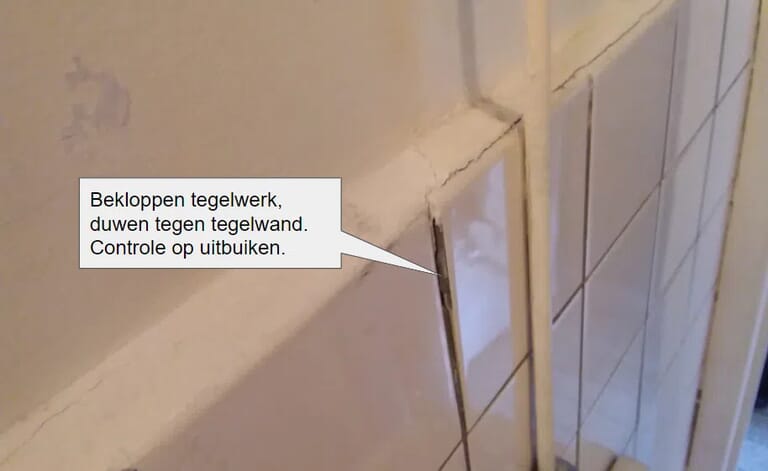
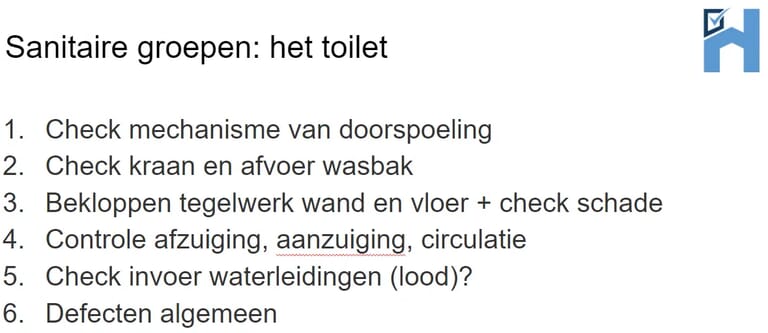
You can check the tile work in the toilet by tapping and listening to ensure it's properly secured. You can also easily visually inspect the grout and sealant. If the tile work on the walls and/or floors is loose or sounds hollow, the bond to the substrate is inadequate! Tensions in the underlying structure can also cause loose or dislodged tiles. The most common cause of such loose tiles is improper installation and poor adhesive during installation.

Repairing damaged grout isn't always necessary immediately. Since the toilet walls are dry, this won't cause any harm. Repairing it naturally is always better. Hard grout in corners is best replaced with flexible sealant; the remaining sealant should be in good condition by itself.

  • Good and beautiful caulking is a specialized job! Can't manage to do a neat job yourself? Then ask for local advice or contact a contractor who can assist you.
aandachtspunten-toilet-1.png

Other possible defects or comments regarding the toilet

Here is a list of possible defects that may apply to a toilet:

  • Defects or faults in the toilet bowl, defects in the toilet seat, defects in the wash basin.
  • If the flushing mechanism isn't working perfectly, this will limit its functionality and/or cause significant water loss unnoticed. In most cases, defective parts can be replaced and/or simply adjusted.
  • If the faucet is malfunctioning, stiff, or doesn't close properly, faucet parts such as rubber seals, grease, and washers are available at any hardware store.
  • If the tap is not functioning at all and repair is no longer possible, it will have to be replaced automatically.
  • The drainage may also function less or insufficiently, or there may be a leak or other defects.
  • What if the faucet isn't properly installed and is loose and/or leaking? These defects can usually be repaired, and the mounting can be improved. After prolonged use, a faucet is also subject to wear and tear. Some maintenance, such as replacing seals and washers, greasing all moving parts, and general upkeep, will get everything functioning properly again.
  • If there are any defects in the extraction system: have the system or unit inspected. Clean the grilles or intake/exhaust valves regularly. In the worst case, parts can be partially or completely replaced.
  • A toilet is of course connected to a sewer system. Read our blog about the causes of a blocked sewer here .

Improvement tips for possible ventilation

If there is no or insufficient ventilation: We recommend installing an electric toilet fan. Such a fan is available at any hardware store. When purchasing, check whether the fan has sufficient extraction capacity and a run-on time.

For proper ventilation, air intakes must also be present. For a toilet, a gap of about 1 cm under the door is usually sufficient. Sometimes smaller grilles are also placed at the bottom of the door. We usually recommend shortening the door slightly to ensure healthy and effective air circulation when using the extractor fan.

Would you like to make an appointment for a building inspection?

The cost of a building inspection (up to 250 m²) is only €489 including VAT. We'll conduct a comprehensive building inspection and you'll receive a building report. Do you have any questions? We're happy to help and can schedule an appointment with an expert inspector right away if you wish!

Recent articles

Een vrouw wijst naar een tablet die een man vasthoudt en een andere man kijkt mee
blog
13 February 2026
Hidden defects in a home
Hidden defects are not uncommon, especially in existing homes. They are often not immediately visible, but can have significant consequences for comfort, safety, and costs. This article explains how hidden defects are assessed and the role of investigation and inspection.
blazen plooien bitumen dak
video
13 February 2026
Common roof detail mistakes: what an inspection reveals
During roof inspections, problems often turn out to be not in the roofing itself, but in the details. In this practical case study, we demonstrate which installation errors are frequently encountered and why these, in particular, pose an increased risk of leaks and damage.
WhatsApp Image 2026-02-12 at 08.51.37
video
12 February 2026
Three Roof Eave Mistakes That Cause Leaks (And Are Often Overlooked)
Roof problems rarely arise suddenly. They usually start with a minor issue. In this inspection, we see how a torn lead flashing, improper installation, and a loose joint can all pose a serious risk. What should you look for—and how can you prevent them?