

Make an appointment Call now

Radiators and underfloor heating

Choosing between radiator and underfloor heating systems can be a daunting task, as each comes with its own set of advantages and challenges. Understanding the potential issues, like leaks and maintenance for radiators or oxygen diffusion in underfloor heating, can guide you towards making an informed decision that ensures comfort and efficiency in your home.

Radiators

  • If there are any defects and/or malfunctions in the radiator valves: individual parts can usually still be purchased, but in the worst case, some valves will have to be replaced.
  • If the radiator mounting isn't optimal, it can be improved. Proper wall mounting prevents leaks or other connection defects, which can have dire consequences.
  • It's also important to ensure that the pipework is properly secured to the walls. If, for example, the pipework isn't properly installed, it can emit annoying noises during heating and cooling. Furthermore, the pipework moves, posing a risk of loosening connections and causing leaks. Repairing and/or improving the mounting can be easily accomplished.
  • In case of leaks at the couplings : the leaks diminish as the pressure in the central heating system decreases. If the pressure in the central heating system decreases, malfunctions can occur. In combination boilers, hot water production will also stop. In short, leaks, whether large or small, must be repaired. A first repair attempt could be to tighten the couplings a little further. If that doesn't work, couplings can be replaced where necessary.
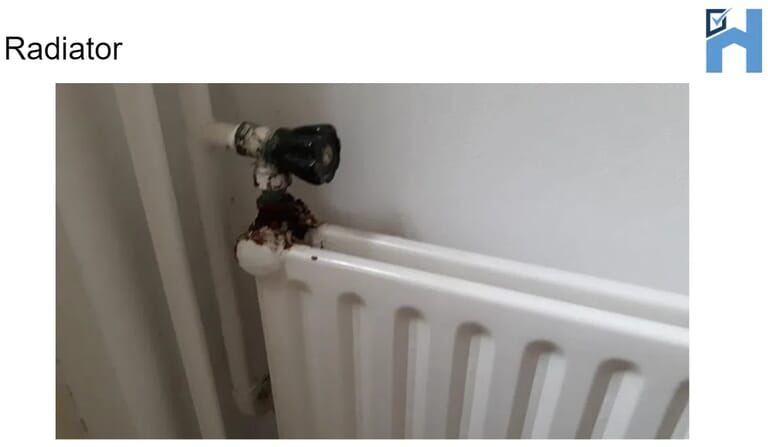
  • If there's rust on radiators, this deserves extra attention, especially where rust is present on the fittings or in wet areas. It's important to eliminate the causes, if possible, remove the rust, and protect the materials with a primer and a paint finish.
radiator-roest.png

Underfloor heating

Underfloor heating is a type of heating system built into the floor. When installed correctly, it provides consistent heat throughout the room, minimizing temperature stratification in the air. This creates a very comfortable temperature. The circuits are connected from the manifold.

  • The starting point is that all connected groups are functioning, if not, this will have to be reported to you by a seller or will become public at some point.
  • Heat exchangers with long pipes, in particular, often struggle to circulate properly. This often results in only part of the floor being heated.
  • If necessary, pipework can be made visible by means of thermography.
  • Underfloor heating in the house: 4 checkpoints

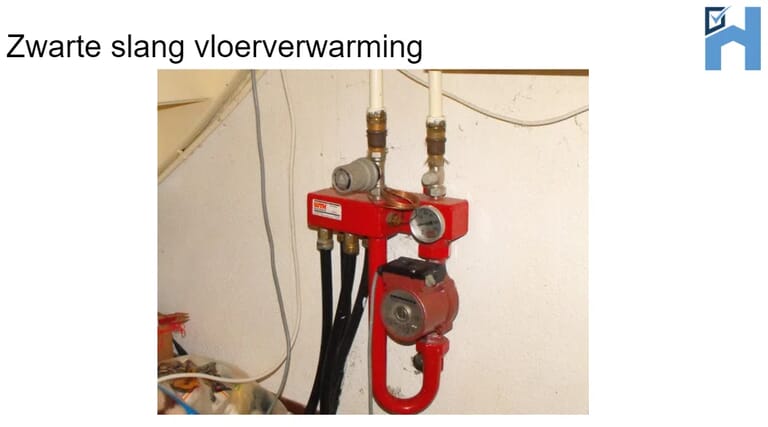
If older black hoses are used for the underfloor heating system, these are no longer used because they caused too many problems in the past. The disadvantage of these hoses is that they allow too much oxygen to pass through. Oxygen-poor water is very eager to absorb oxygen molecules and attracts them with enormous force (like a magnet). The water in the system continuously absorbs oxygen through various channels, including the pipes. This oxygen exchange is called oxygen diffusion .

zwarte-slang.png
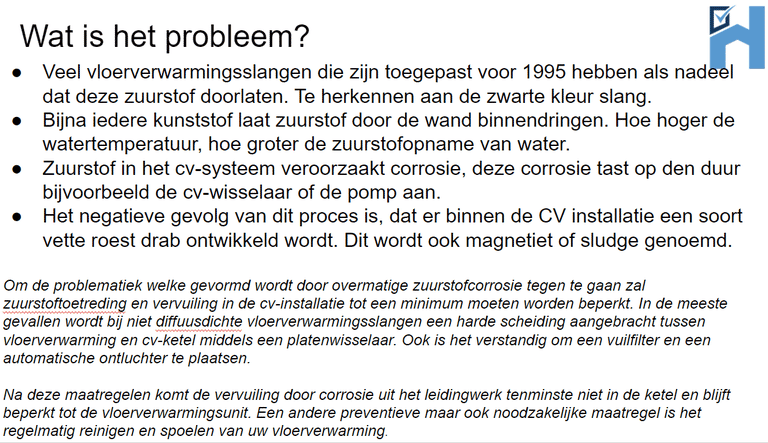
  • This oxygen diffusion can cause such a high level of oxygen to enter the system that, after just a few years, leaks or blockages can occur due to corrosion and the release of residual products in the pipework of the underfloor heating, pump, and central heating boiler.
  • If not already present, it is recommended to install a hydraulic separation system ( heat exchanger ) between the central heating system and the underfloor heating system. This will prevent corrosion contamination from the pipework from entering the boiler and will be confined to the underfloor heating unit . Another preventative, but also essential, measure is regularly cleaning and flushing your underfloor heating system.
  • No one can determine whether a system is contaminated, or whether pipes, etc., are in good condition, based on visual evidence. If you need certainty, a specialized installer should be involved to inform and advise you about this matter, its possibilities, and any necessary improvements.
zwarte-slang-wat-is-het-probleem

Would you like to make an appointment for a building inspection?

The cost of a building inspection (up to 250 m²) is only €489 including VAT. We'll conduct a comprehensive building inspection and you'll receive a building report. Do you have any questions? We're happy to help and can schedule an appointment with an expert inspector right away if you wish!

Recent articles

Een vrouw wijst naar een tablet die een man vasthoudt en een andere man kijkt mee
blog
13 February 2026
Hidden defects in a home
Hidden defects are not uncommon, especially in existing homes. They are often not immediately visible, but can have significant consequences for comfort, safety, and costs. This article explains how hidden defects are assessed and the role of investigation and inspection.
blazen plooien bitumen dak
video
13 February 2026
Common roof detail mistakes: what an inspection reveals
During roof inspections, problems often turn out to be not in the roofing itself, but in the details. In this practical case study, we demonstrate which installation errors are frequently encountered and why these, in particular, pose an increased risk of leaks and damage.
WhatsApp Image 2026-02-12 at 08.51.37
video
12 February 2026
Three Roof Eave Mistakes That Cause Leaks (And Are Often Overlooked)
Roof problems rarely arise suddenly. They usually start with a minor issue. In this inspection, we see how a torn lead flashing, improper installation, and a loose joint can all pose a serious risk. What should you look for—and how can you prevent them?