Make an appointment Call now

Floor finishing: Tiling and cast floors

Are you facing persistent issues with loose or cracked tiles on your floor? Understanding the underlying causes, from thermal movements to structural tensions, is crucial for effective solutions and can save you from costly repairs. Dive in to explore how to assess and address these common flooring problems to maintain a flawless and durable surface.

Tiling or paving stones

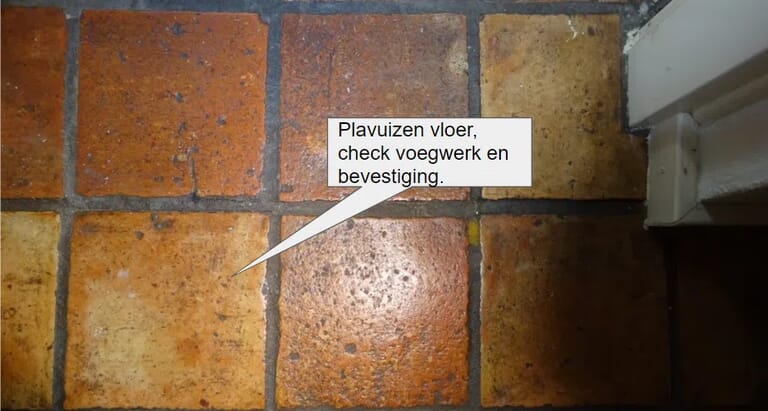
The floor may be partially covered with tile or flagstone. The presence and quality of this floor finish cannot be checked under rugs, furniture, or appliances.

A common problem with stone floors is that the tiles and/or flagstones laid on the floor are (partially) loose or sound hollow when tapped. This means the bond with the subfloor is insufficient! Tensions in the underlying floor can also cause tiles to become loose or come loose. Tensions in floors can be caused by weakening or defects in the floor structure, or by significant changes in the home's climate (for example, when insulation has been installed). Risky floors can also be a cause, such as a NeHoBo floor .

  • In very rare cases, it could be related to the floor structure. If this is the case and visible, you usually have a serious problem.
  • A common cause is thermal movement of the materials, which has no structural significance. Another cause could be that the base (substrate or underlying cement screed) is insufficiently stable. It could also be related to the installation and drying process. It's also possible that the entire tiled surface is too large and can't move properly. Adding an expansion joint can prevent new cracks from forming in such cases.
  • In case of recurring defects or loose tiles, the floor construction must be further examined.
  • When tiling on a wooden floor, movement in the floor can cause loose tiles and/or breakage. The stability of a wooden floor is never 100%.
  • Loose tiles or cracks in tiles on wooden and concrete floors can occur suddenly and in one go.
  • Which floor suits your situation?
Homekeur-vloerafwerking-plavuizen-1.png

Cast floor

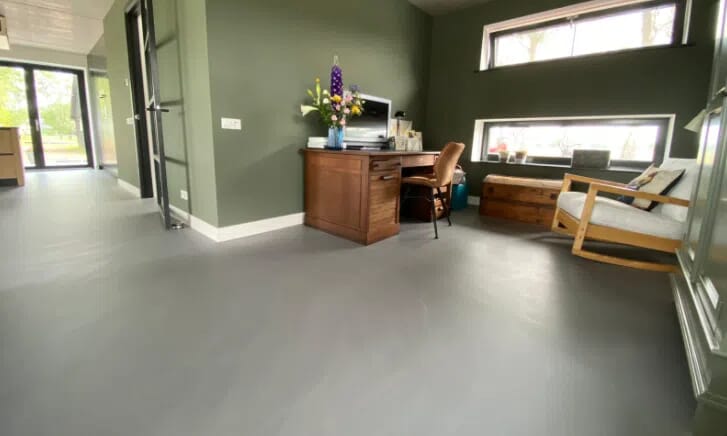
A cast floor is a finishing layer applied to a load-bearing floor by pouring a substance that hardens on the subfloor. Cast floors can be constructed of concrete (so-called "cast concrete"), but also of synthetic materials such as polyurethane (PU) or epoxy. Mixtures of cement and polyurethane are also used. A PU cast floor is elastic and is also used in residential buildings. A cast floor is fixed to the subfloor; if something happens there due to (thermal) action or settlement of materials, cracks can still form or spread. The cast floor is slightly elastic; thanks to this elasticity, small cracks in the subfloor do not immediately extend into the cast floor.

A cast floor can also be checked for adhesion to the subfloor by tapping it in several places. If a hollow and loose sound is heard, the subfloor is usually loose. The cast floor is fixed to the subfloor, so the subfloor is loose. This can eventually cause cracks in the cast floor.

A cast floor is often coated with a UV-resistant varnish. This was originally done to prevent discoloration. However, this varnish should be considered like sunscreen: after a while, its effectiveness diminishes, and discoloration still occurs. This varnish can also flake (a kind of peeling), making local repairs difficult and remaining visible. For such defects, applying a stronger and better topcoat may be considered. Consult a qualified specialist for further advice.

Homekeur-vloerafwerking-gietvloer-1.png

Cracks may appear in the cast floor; a cast floor cannot crack on its own! Because the cast floor is firmly attached to the substrate, we assume this is the cause of the cracking. As the crack in the substrate grows and the cast floor can no longer bridge the crack, it will continue to affect the cast floor and, worse still, even spread.

  • Expansion cracks always recur. An expansion crack is a boundary between two building components or surfaces. Both exert certain forces, thus creating the crack. In the case of an expansion crack, we recommend creating a joint using a profile so that any recurring stresses are automatically transferred to the profile, and the poured floor remains intact.
  • In the case of a relatively new house, cracking can also have other causes, such as drying, underfloor heating, settlement, etc.
  • The floor and floor finish must be free from the walls. If this is not the case, the screed cannot expand and shrink, and cracks will form.
  • Want to be certain about the technical condition and condition of your floor and eliminate any risks? Consider a building inspection .

Would you like to make an appointment for a building inspection?

The cost of a building inspection (up to 250 m²) is only €489 including VAT. We'll conduct a comprehensive building inspection and you'll receive a building report. Do you have any questions? We're happy to help and can schedule an appointment with an expert inspector right away if you wish!

Recent articles

Een vrouw wijst naar een tablet die een man vasthoudt en een andere man kijkt mee
blog
13 February 2026
Hidden defects in a home
Hidden defects are not uncommon, especially in existing homes. They are often not immediately visible, but can have significant consequences for comfort, safety, and costs. This article explains how hidden defects are assessed and the role of investigation and inspection.
blazen plooien bitumen dak
video
13 February 2026
Common roof detail mistakes: what an inspection reveals
During roof inspections, problems often turn out to be not in the roofing itself, but in the details. In this practical case study, we demonstrate which installation errors are frequently encountered and why these, in particular, pose an increased risk of leaks and damage.
WhatsApp Image 2026-02-12 at 08.51.37
video
12 February 2026
Three Roof Eave Mistakes That Cause Leaks (And Are Often Overlooked)
Roof problems rarely arise suddenly. They usually start with a minor issue. In this inspection, we see how a torn lead flashing, improper installation, and a loose joint can all pose a serious risk. What should you look for—and how can you prevent them?