
Make an appointment Call now

All about bathroom inspections

Outdated bathroom sealing and inadequate ventilation can lead to hidden damages such as moisture exposure and mold growth, compromising both the structural integrity and safety of your bathroom. Discover how to effectively inspect these issues, implement preventative measures, and understand when it's time for a complete bathroom overhaul to ensure a healthy and functional space.

All about bathroom inspections

Special appliances, fixtures, or applications in the bathroom cannot always be fully inspected, such as hot tubs, jacuzzis, whirlpools, all types of jets, shower enclosures with varying degrees of body jets and with or without sound (radio), sunshowers, special lighting, and infrared applications. Most appliances and facilities, as intended and described, can only be fully and properly checked in practice.

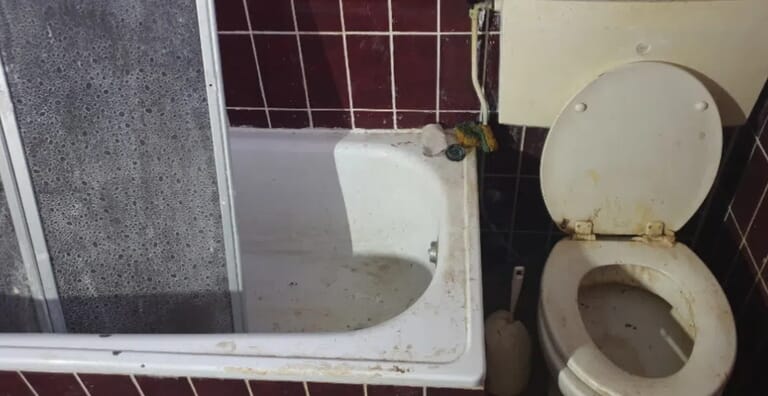
If the entire bathroom is in such poor condition that repairing the tiling and fixtures is no longer economically viable, it's best to replace it entirely. Bathroom fixtures are essential for occupancy!

Homekeur-hele-smerige-badkamer-1.png
  • Depending on the wishes and requirements placed on the new bathroom, the price of a new bathroom can vary considerably.
  • After removing the bathroom, defects may become visible on the surface such as walls and floors.
  • In the event of prolonged moisture exposure and poor sealing work, underlying wooden structures (such as a wooden floor) can become completely rotten.
  • View our blog with video about a bathroom inspection here
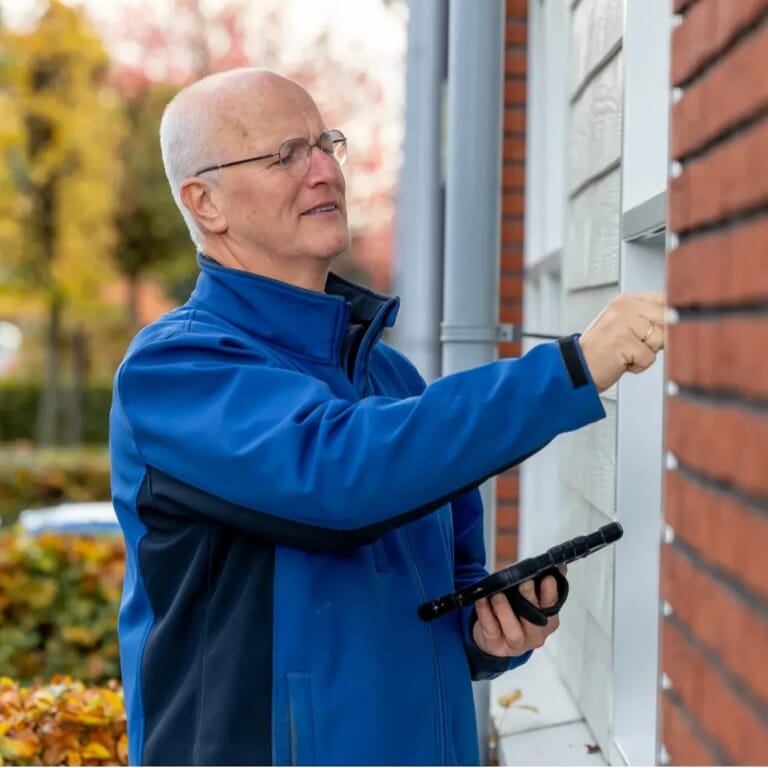
  • After inspection by a Homekeur inspector, you will receive a comprehensive building report

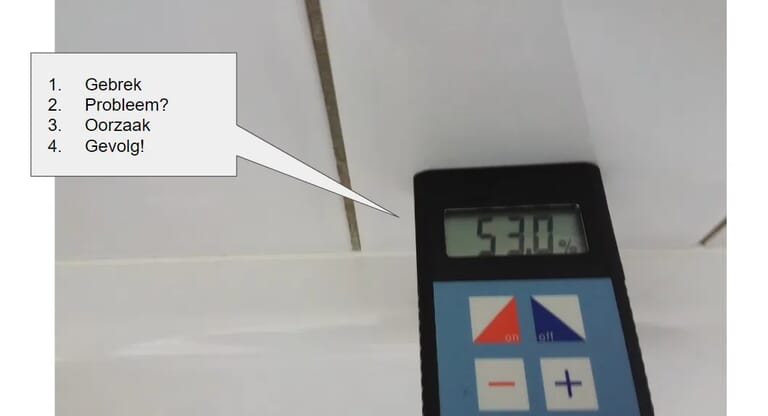
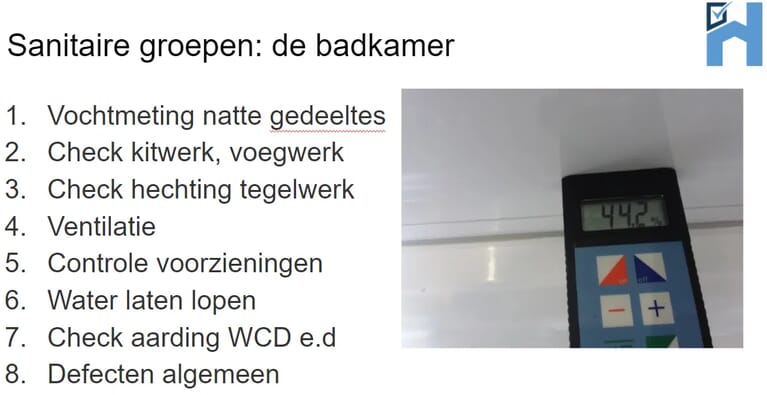
Moisture measurement bathroom

If the moisture content is too high, it could be due to prolonged moisture exposure (e.g., from poor sealing work), underlying (wooden) structures (e.g., a wooden floor or a plasterboard wall), which are completely rotten, moisture-damaged, or in such a condition that these components require replacement. It's also possible that moisture measurements don't provide any cause or indication of a defect; in that case, the measured percentages don't deviate significantly from the reference measurement, which should always be performed.

Homekeur-vochtmeting-badkamer-1.png
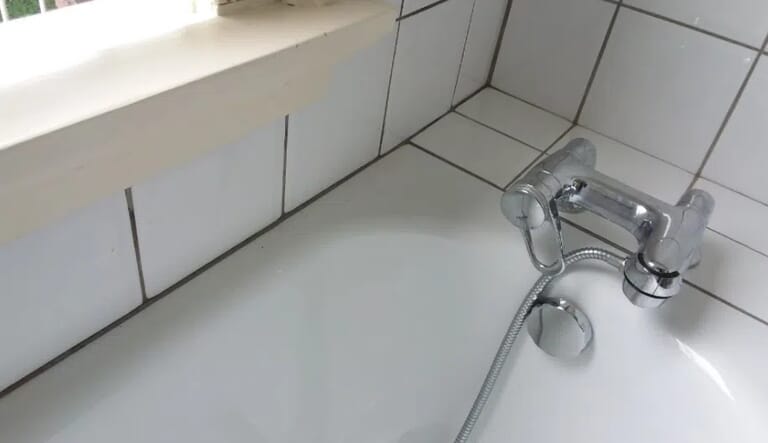
  • If an increased moisture content is measured around the tap, the cause is often that the connection between the wall plate and the tiles behind the tap's escutcheons is not sealed, or not properly sealed. Water flowing along the tiles also gets behind the escutcheons! It's likely that the seal between the tiles and the tap connector isn't fitted with a flexible, waterproof seal, or that an existing seal is no longer functional. Preventative or remedial measures can be easily implemented in this case. Remove the escutcheons and the old seal and apply a new, high-quality, flexible, waterproof seal.
  • The remaining sealant must also be in adequate condition. Constant moisture exposure softens the adhesives used for tiling and can cause loose tiles. A waterproof seal must then be created!
  • If excessive moisture is measured in wet areas, poor grout or defects in the grout may be the cause. These defects can usually be repaired by replacing the grout. However, it's important to consider whether this is still realistic. In such cases, it's better to replace the tiles immediately.
  • If the corners originally had a hard joint, we recommend applying a flexible sealant. The existing joints are cracked or partially missing, and in any case, this hard joint is not waterproof. We often recommend removing the hard joint and applying a flexible sealant.
Homekeur-badkamer-harde-voeg-in-hoeken-1.png
  • Also be alert to loose tiles; tapping the walls in various places with a dowel or your ring, for example, often quickly provides clarity.
aandachtspunten-badkamer-1.png

Points of attention when replacing sealant or replacing grout

  • Remove any old, damaged, or loose tiles, clean the surface thoroughly, and allow it to dry for a while, if necessary, after which new tiles can be applied.
  • Unfortunately, replacing grout isn't easy; the old grout would have to be removed. This poses a risk of damaging the tiled surface.
  • It's also possible to consider repointing only the damaged areas. The downside to this is a potential color difference.
  • The old sealant must first be removed, the surface must be thoroughly cleaned, after which the new sealant can be applied and the whole thing can function properly again.
  • An average price of €15 per linear meter can be assumed. For larger quantities of sealant, the price per meter can even decrease.
  • If only a very minimal amount of sealant work is required, the price per meter can still increase considerably.
  • Good and beautiful caulking is a specialized job! Can't manage to do a neat job yourself? Then ask for local advice or contact a contractor who can assist you.

Bathroom tiling

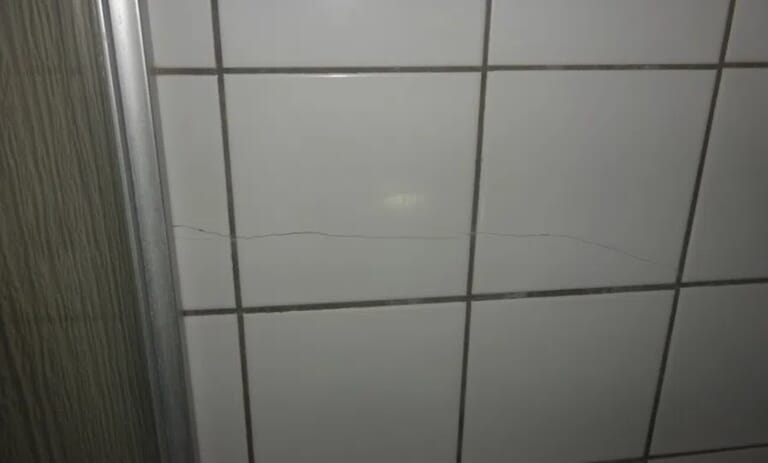
If any of the tiles on the walls and/or floors are loose or sound hollow when tapped, the bond to the substrate is inadequate! Tensions in the underlying structure can also cause loose tiles to become loose or come loose. The most common cause of such loose tiles is improper installation and poor adhesion during installation.

Homekeur-tegelwerk-scheurvorming-1.png

Bathroom ventilation

Bathroom ventilation must be well-regulated. There must be sufficient ventilation options to remove water vapor. This effective ventilation prevents condensation from forming on materials or surfaces, preventing mold growth, for example. User behavior is always a key element of effective ventilation.

If the bathroom's ventilation/exhaust system is controlled by natural ventilation, improper use poses a risk of mold growth on walls and ceilings. Effective ventilation in a bathroom is important and essential for both the user and the various bathroom and structural components. Condensation damages materials, can lead to mold growth, and creates an unhealthy environment for the user.

  • You can ventilate your bathroom naturally by using any existing ventilation grille in the window or by leaving the window slightly open for a while during and after showering. However, this isn't always possible or sufficient.
  • Inadequate ventilation creates an unhealthy indoor climate. Natural ventilation can work, but the homeowner must experience its effectiveness.
  • Depending on the year the house was built, natural ventilation is not uncommon; if it changes, mechanical ventilation/extraction may be more appropriate.
  • In some cases, people often opt for (additional) mechanical ventilation/extraction in the bathroom. Of course, you can always consider this later!
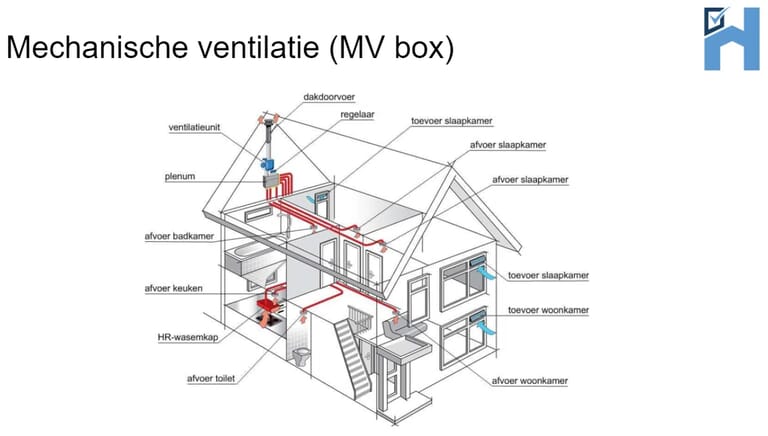
mv-box-1-1.png

If ventilation/exhaust in the bathroom is inadequate, this poses a risk of mold on walls and ceilings. Effective ventilation in a bathroom is important and essential for both the user and the various bathroom and structural components. Condensation damages materials, can cause mold growth, and creates an unhealthy environment for the user.

  • You can ventilate the bathroom naturally by installing a ventilation grille in the window or by leaving the window slightly open for a while during and after showering. However, this isn't always possible, which is why mechanical ventilation is often chosen for bathrooms.
  • Ventilation can be improved by installing a bathroom fan . This efficiently removes moist air, reducing humidity in the bathroom and allowing it to dry faster. Mold can't grow in a dry environment. Bathroom fans are inexpensive and easy to install.

Not only is the extraction system important, but also circulation. If there are insufficient ventilation intakes, a gap of at least 1 cm must be left under the door when the door is closed. You can also choose to install a grille in the door. The existing extraction system must be able to function properly! This is especially important for a bathroom; insufficient ventilation causes mold on ceilings, grout, and possibly even the walls. We therefore recommend shortening the bottom of the door slightly or installing a grille in the door to create circulation.

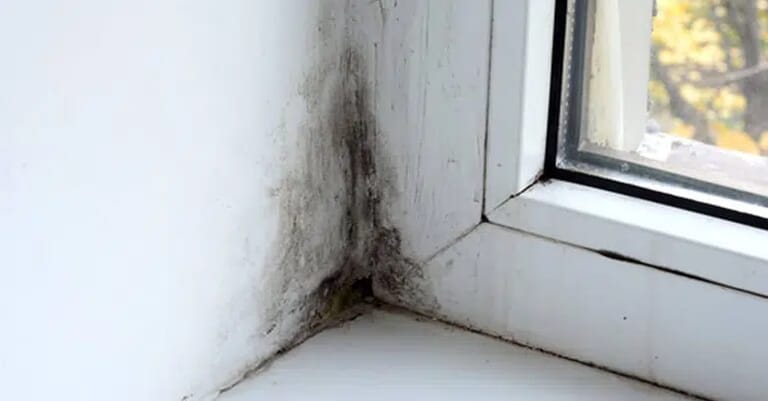
If mold is already present on the walls and/or ceilings in your bathroom, the only way to combat it is to improve ventilation. Furthermore, mold can be removed in various ways: with baking soda, chlorine bleach, or a special anti-mold product. If ventilation isn't improved, the mold will quickly return.

Verborgen-gebrek-woning-schimmel.jpg
  • In the bathroom, a lot of water vapor is produced during showering or bathing. If this vapor isn't sufficiently removed through natural or mechanical ventilation, it will quickly condense. Tiny water droplets then form on the wall, ceiling, window, or mirror.
  • Walls and ceilings are particularly susceptible to mold because their surfaces are often rough and somewhat porous, and can therefore absorb a certain amount of moisture. This makes them a good breeding ground for mold.
  • Mold can grow anywhere in the bathroom, as long as the areas remain damp for extended periods. Common locations include caulking (sink, bathtub, shower tray), the top of the wall, the ceiling, and the grout between tiles.

Other points of interest that are addressed during a bathroom inspection

A bathroom inspection is of course a standard part of a building inspection .

The faucet may be improperly installed, loose, and/or leaking. Minor defects can be repaired, and the mounting can be improved. After prolonged use, a faucet is also subject to wear and tear. Some maintenance, such as replacing seals and washers, greasing all moving parts, and general upkeep, will ensure everything functions properly again.

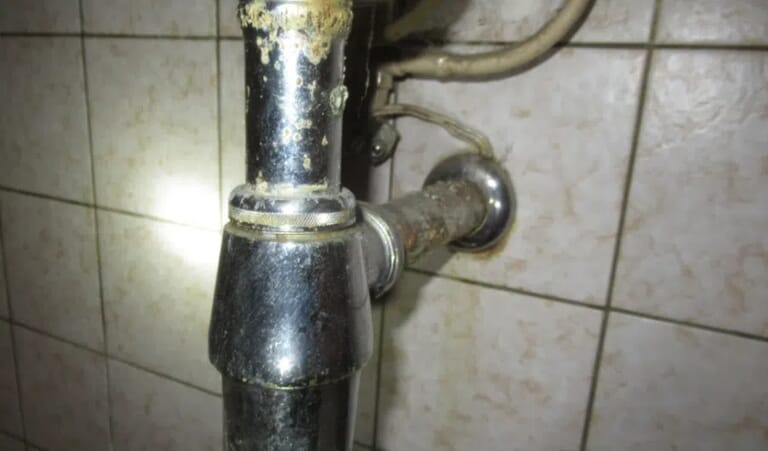
If the water doesn't drain smoothly through the drainage system: This could indicate the use of incorrect materials (for example, pipes that are too small in diameter), but more likely, the drain is contaminated. We recommend first removing and cleaning the entire siphon; this may solve the problem.

If a whirlpool malfunctions, repair costs can be quite high. It's impossible to provide an estimate, as it's unknown which parts may need to be replaced and how much they will cost.

If defects are found in fittings, they are often repairable, or it's better to consider replacing these parts. Completely replacing parts is usually cheaper and easier than finding, buying, and replacing them.

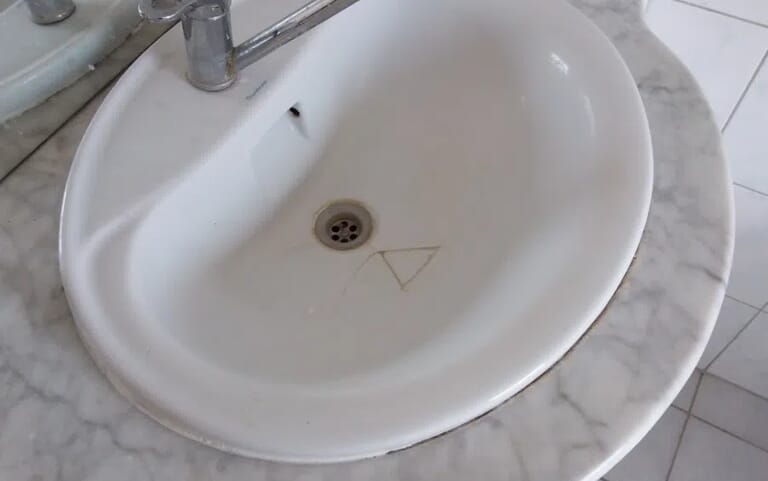
Homekeur-breuk-wastafel-1.png

Electricity and grounding in the bathroom

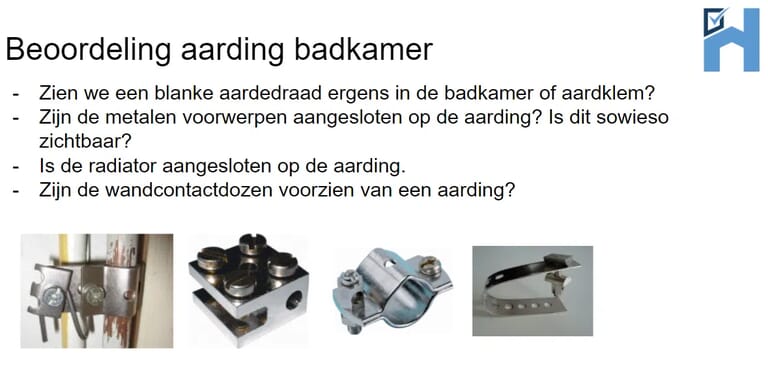
The bathroom should have a ground wire. It's naturally not visible whether all metal parts are properly grounded. Just as you can't see whether there's a grounding mat under any floor tiles, it's not always visible. According to NEN1010, all metal parts in a bathroom must be grounded. These parts can also be grounded behind a wall or tile finish. In a finished bathroom, this is difficult to check.

Homekeur-aarding-badkamer-wastafel-1.png

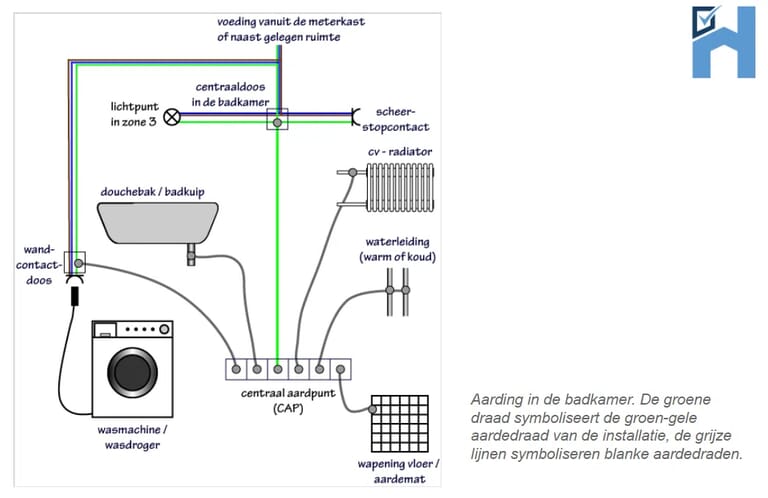
Where possible, a grounding terminal should be mounted in a visible or accessible location. The CAP (central grounding point) must be accessible. The CAP is usually mounted in a wall-mounted electrical box under the sink, in a box with a removable lid. If the CAP is not visible, this doesn't mean that objects are not grounded, but that you can't visually determine this. It's quite possible that grounding of objects behind tiles or other finishes is present.

aarding-badkamer-1.png
  • People in bathrooms usually have soaking wet skin or are immersed in water. Consequently, skin resistance is very low. A small touch voltage is enough to cause a dangerous and even fatal current to flow through the human body. Body resistance is also different in these areas because protective equipment such as footwear and other protective gear is often lacking. Therefore, additional requirements are placed on the electrical system in these areas.
  • A key component of bathroom electrical systems is the grounding of wall outlets and metal objects (such as a metal bathtub or radiator). These must be connected to the electrical system with a ground wire. This is because water is a good electrical conductor. Proper grounding ensures that a residual current device (GFCI) quickly interrupts the power supply, and the risk of injury is reduced if electrical voltage is encountered.
  • Grounding in a bathroom is important. Read our blog post about why grounding is important.
schema-aarding-badkamer-1.png

If there are wall sockets in the bathroom, check whether they are properly grounded. Ungrounded electrical outlets and light switches should not be used in bathrooms. If these are not grounded and therefore not connected to a circuit with a residual current device (RCD), we recommend seeking further advice from an electrician. Therefore, ungrounded electrical outlets and light switches should not be used in bathrooms. We therefore recommend disconnecting them or installing them outside the bathroom. Another solution is to install a ground wire and a grounded wall socket. Consult an electrician!

Would you like to make an appointment for a building inspection?

The cost of a building inspection (up to 250 m²) is only €489 including VAT. We'll conduct a comprehensive building inspection and you'll receive a building report. Do you have any questions? We're happy to help and can schedule an appointment with an expert inspector right away if you wish!

Recent articles

Een vrouw wijst naar een tablet die een man vasthoudt en een andere man kijkt mee
blog
13 February 2026
Hidden defects in a home
Hidden defects are not uncommon, especially in existing homes. They are often not immediately visible, but can have significant consequences for comfort, safety, and costs. This article explains how hidden defects are assessed and the role of investigation and inspection.
blazen plooien bitumen dak
video
13 February 2026
Common roof detail mistakes: what an inspection reveals
During roof inspections, problems often turn out to be not in the roofing itself, but in the details. In this practical case study, we demonstrate which installation errors are frequently encountered and why these, in particular, pose an increased risk of leaks and damage.
WhatsApp Image 2026-02-12 at 08.51.37
video
12 February 2026
Three Roof Eave Mistakes That Cause Leaks (And Are Often Overlooked)
Roof problems rarely arise suddenly. They usually start with a minor issue. In this inspection, we see how a torn lead flashing, improper installation, and a loose joint can all pose a serious risk. What should you look for—and how can you prevent them?