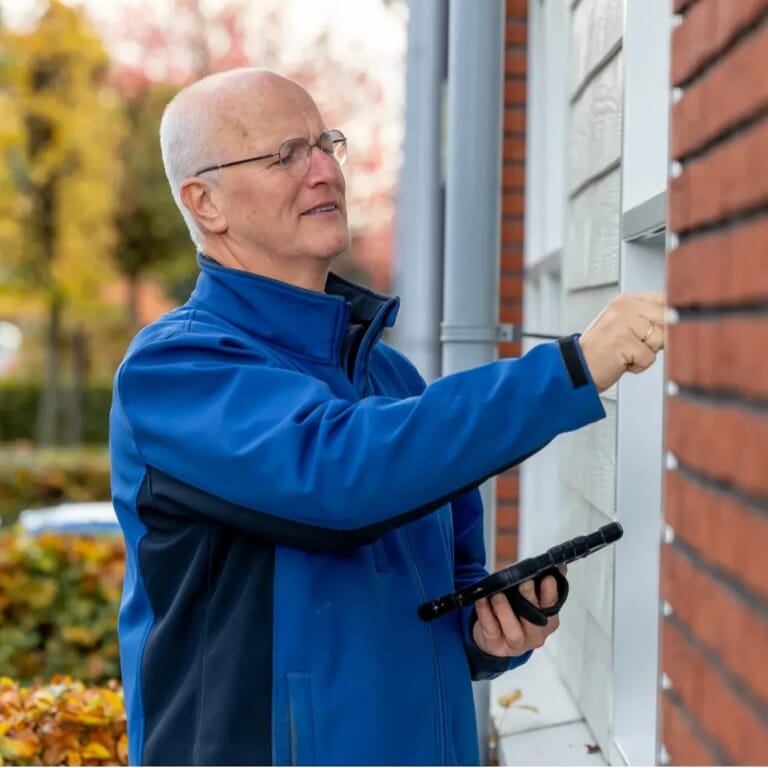
Points of interest and comments on facades
Alignment of the house
It's important to assess the horizontal and vertical alignment of a house. Look both horizontally and vertically along the facades for deviations and alignment. So, stand against the facade, look up, and look left and right for any visible deviations.
- If there are any deviations in the horizontal or vertical alignment of the house, further specialized foundation or soil investigation is recommended. This is especially important because it's possible that deviations are still active and not yet completed. The costs for such investigations can be high.
- With such a deviation, you must remain alert to any deviations or changes. A snapshot is no guarantee of future results.
- The possible causes are numerous, such as splash forces from the roof, a modified construction, a constantly changing soil structure, foundation defects, tree roots, and many other possible causes.
- Read a blog here about a facade inspection and points to consider during a building inspection.
General points of interest and/or comments regarding facades
Old metal in the facade (such as bolts, nuts, or other types of metal) should always be removed as soon as possible. Rusting metal can more than double in size. This corrosion process generates enormous forces that can cause damage (such as cracking or other types of damage). After removal, the damage can be repaired by, for example, sealing it with mortar, replacing bricks, or repairing the plaster.
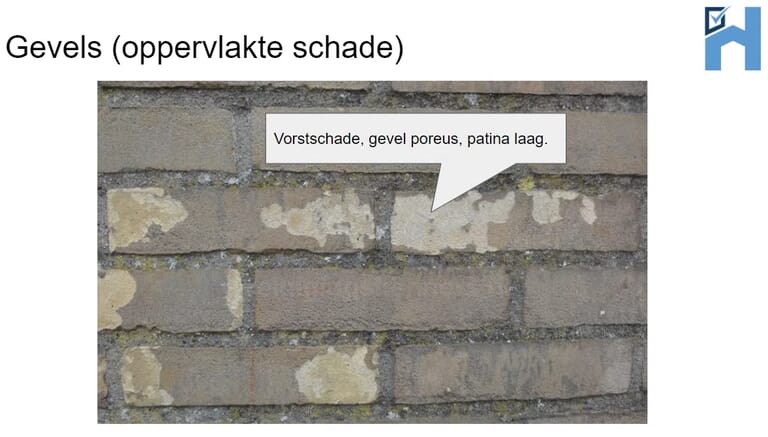
Stones flake
The quality of bricks is subject to factors such as weather influences. The quality of the mortar and the waterproofing of the facade are important. In some cases, bricks retain moisture; when frozen, they flake. Long-term exposure to moisture causes bricks to become brittle and flake. Several causes or combinations of causes can cause flaking. Once bricks are flaking to a greater or lesser extent, it's difficult to predict how this will develop further. The flaking process is unstoppable, and the flaking spot will increase in size annually.
- Preventive measures and periodic inspections are important. The mortar joints must be in good condition; if necessary, the facade can be treated with a water-repellent treatment.
- In all cases, seek expert advice, as sometimes measures taken can have unintended (bad) consequences.
Open butt joints that also serve as cavity ventilation must not be sealed (due to mortar joints or contamination). These open butt joints serve a purpose, preventing condensation within the cavity. The butt joints must be open! If they are sealed, you can easily improve this by drilling the joints back into the cavity using a longer masonry drill bit.
If the exterior wall (or parts of the facade) are painted: Multiple layers of paint have likely already been applied. It's important that all these layers were moisture-regulating (vapour-permeable), otherwise the exterior wall will be sealed. Sealing the exterior wall could cause flaking paintwork, for example. Moisture entering the walls from the house, cavity walls, the foundation, or the crawl space can ventilate dry with a vapor-permeable paint system. If the facade has been made vapor-tight (by all the aforementioned layers of paint), the moisture remains trapped and can lead to increased moisture levels in interior walls or strange, unexplained damp patches in interior walls.
- Choose a vapor-permeable wall paint specifically designed for exterior walls. This paint prevents moisture from seeping in while still allowing absorbed moisture from the walls to escape. This is important for preventing moisture problems.
- Even when retrofitting insulation through the cavity wall, it's essential to use a vapour-permeable paint. Insulating the cavity wall reduces air circulation, which is essential to keep moisture out of the walls. A vapour-permeable paint on the facade then provides an escape route for moisture.
- In the case of regular and unstoppable moisture problems, a vapour-tight paint system can, in the worst case, be removed by blasting the facades.
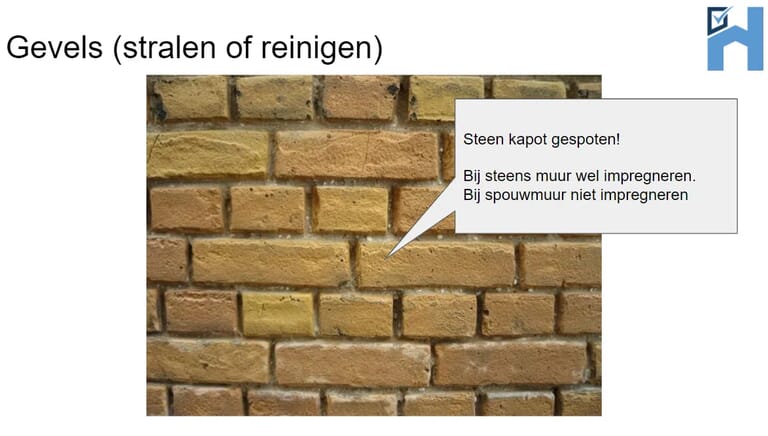
The brickwork's baking skin (also called a patina layer) can be affected . A brick develops a baking skin due to the baking process. This skin is harder than the rest of the brick and prevents excessive moisture and dirt from penetrating the brick. It is therefore important that this skin is preserved. Otherwise, the brick will age and weather more quickly. This baking skin is often affected by cleaning or blasting facades. In some cases, prolonged exposure to the facade (wind and rain) can also diminish or even eliminate this patina layer. To replace or improve the patina layer, the facade is sometimes treated with a water-repellent treatment.
- Unfortunately, this well-intentioned cleaning frenzy (blasting facades) has a downside. Virtually all cleaning methods chosen can cause (serious) damage to the treated facades. Once the brick skin is damaged, the weather and wind will affect the bricks more quickly, making them crumble more easily. The bricks become rougher due to the cleaning, meaning they often become soiled faster and more deeply. Therefore, the effect of facade cleaning is not long-lasting: many facades are dirty again within a few decades.
- After cleaning and grouting, a water-resistant layer, known as a hydrophobic coating, is often applied to the facade. This usually does more harm than good. While most hydrophobic coatings are breathable, they still impede moisture transport through a facade. Water that seeps into the facade from the inside of a building during the winter (for example, condensation of water vapor due to cooling air) has difficulty escaping, increasing the risk of frost damage. In addition, salt buildup can occur behind the hydrophobic coating due to salts dissolved from the masonry that remain after evaporation. It's common for bricks to be crushed behind a hydrophobic coating.
If the facade is (partially) covered with vegetation: opinions differ on whether this is harmful to a facade. We believe that a vegetated facade is undesirable (and therefore better removed).
- The facade becomes dirty and damaged, and if it ever needs to be removed, cleaning it will be very expensive.
- Pests are attracted to this and birds will nest in the vegetation.
- Vegetation can grow in through open butt joints or other openings, into the cavity wall, or even under the ceiling of the house.
If the facade is built above ground level and higher than usual (partly) on the ground: The facade behind this cannot be inspected now, and there is also an increased risk of damage and/or rot in the materials, moisture penetration and moisture uptake due to possible long-term moisture load.
- The advice is to improve this situation by, for example, removing the soil and creating a waterproof seal, or by improving the drainage.
If minor mechanical damage is observed on precast concrete elements, it is recommended to repair this damage and restore it to the same condition as the other concrete elements and/or structure. Because moisture can enter the structure through such damage, there is a limited risk of the reinforcement in the concrete rusting, potentially causing further damage.
- Cut away damage and loose material, derust and preserve any reinforcement.
- Repair concrete damage in accordance with the other concrete elements and/or structure.
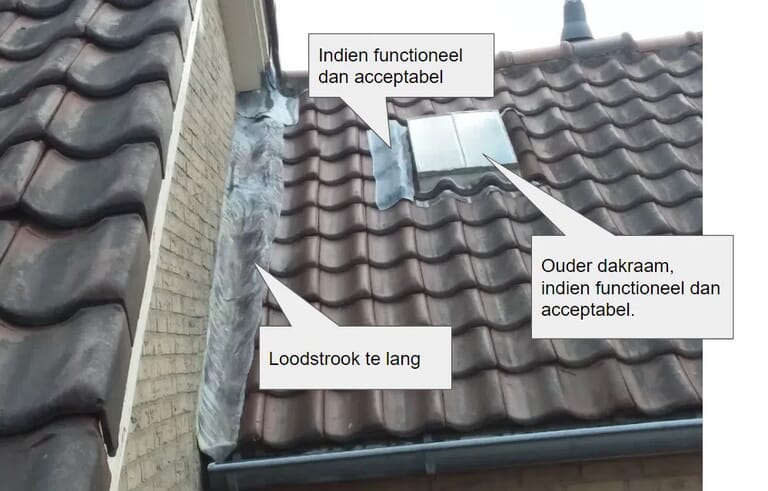
If the lead strips in the facade are too long: The strips may have a maximum length of 1 meter and must overlap by at least 8 cm. The materials are subject to weathering. If they are too long, there is insufficient space to accommodate the shrinking or expanding effects. This causes the material to crack more quickly, leading to defects. Once the lead has been applied in this way, there is little you can do other than accept it. This shortens the material's lifespan, and the lead will need to be replaced sooner than usual. If cracks are detected in the lead strip, they are usually easily repaired, after which the lead can function as intended for several more years. If defects are beyond repair, the lead strips must, of course, be replaced promptly.

- This repair can be easily done yourself. Repair kits for repairing lead cracks are available at any hardware store, as well as various types of tape and bitumen adhesive.
- If the lead flashing is defective, there is a risk of water ingress (and leakage). Ensure that any defects are repaired promptly.
- Installing and/or replacing a lead strip or lead flashing in a facade is usually not easy; have a professional carry out this repair!
The expansion joints present in the facade may need to be (partially) replaced periodically. Defects in the sealant joint can cause leaks, allowing water from the facade to flow freely into the structure. If reinforcement steel was used in the structure, it can now be affected by moisture, rusting, corroding, and causing (serious) concrete damage.
The ventilation grilles, which also serve to ventilate the crawl space (and possibly the cavity wall as well), may be blocked by materials, mortar, or contamination. These grilles play a vital role in the structure and some components of the house. It is recommended that the contamination or mortar be removed as soon as possible so that the ventilation grilles can function properly again. If one or more grilles in the facade are damaged, we recommend replacing them. These grilles are designed to block pests from entering the cavity wall and/or crawl space. If these grilles are damaged, pests can easily access the entire house through the crawl space or cavity wall.
Would you like to make an appointment for a building inspection?
The cost of a building inspection (up to 250 m²) is only €489 including VAT. We'll conduct a comprehensive building inspection and you'll receive a building report. Do you have any questions? We're happy to help and can schedule an appointment with an expert inspector right away if you wish!
Recent articles