
Make an appointment Call now

Facade coping stone-like

Maintaining the integrity of your facade's coping is crucial for protecting your walls from weather damage and structural issues. Regular inspections, cleaning, and repairs not only preserve the aesthetic appeal but also prevent costly future repairs, making it essential for homeowners to understand the significance of upkeep in extending the life of building materials.

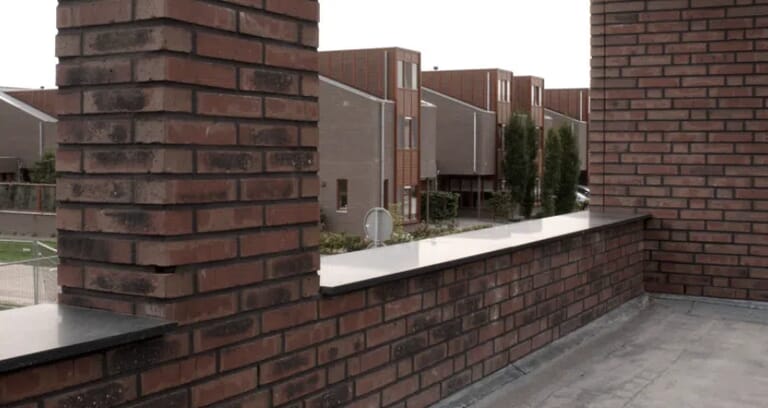
The facade can be (partially) finished at the top with a (brick) facing and/or coping. A coping is a covering for a wall that is not protected from rain by a roof surface. A coping is applied to, for example, a parapet, a gable, or a brick garden wall.

Homekeur-muurafdekker-steenachtig.png
  • If the facade/wall capping is contaminated with algae and/or moss growth, it's best to remove this contamination periodically and maintain the material. It's also important that this material remains waterproof. If the material is porous, moisture can penetrate, causing any existing reinforcement to rust, resulting in damage. Damage can even occur during frost.
  • If there is any other damage to the stone façade coping on the brick façade, this damage can almost always be repaired. Thoroughly remove the damaged area and any loose material. If reinforcement is visible, remove any rust and pre-treat it with a primer or red lead . The damage can then be repaired with a frost-resistant material.
    • Please note that not every ready-made mortar or cement bag from a hardware store is suitable for this; inquire about the possibilities.
    • Frost-resistant repair mortar is available from various manufacturers; search online for: frost-resistant repair mortar.
  • A flexible sealant joint may be present between the facade/wall capping elements: this sealant joint must be functional, and any defects must be repaired. If defects are present, it is recommended to remove the remaining sealant joints and replace them all. Take your time removing the old sealant and thoroughly clean and degrease the entire area. If not cleaned properly, the flexible sealant joint will quickly detach from the material.
  • If the attachment of the facade/wall cover is no longer in order: The attachment must be improved by lifting the cover slightly and applying an adhesive underneath.
Homekeur-muurafdekker-zink.png
  • Check the attachment of the wall coping; if any defects are found, they can usually be repaired.
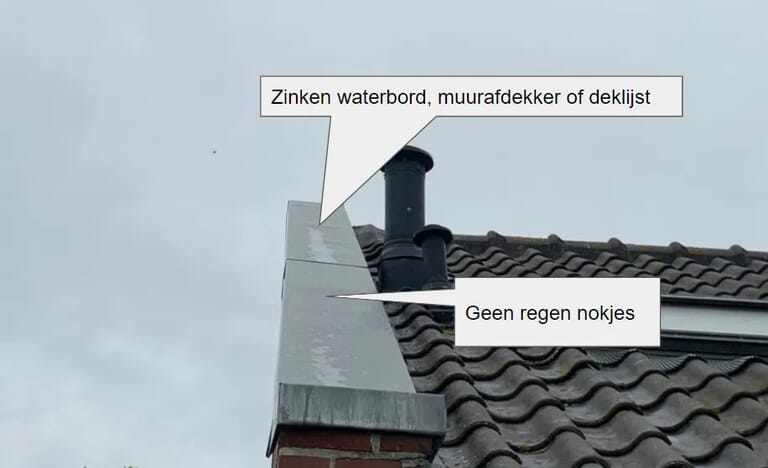
  • The solder joints on zinc coping boards often come loose. This is likely due to the length of the soldered material. Due to weather influences, the materials flex, cannot release their tension, and become vulnerable at the weakest points, such as the solder joint. In that case, a specialist can often repair the solder joint effectively, preferably by installing an expansion joint at the same time to prevent such defects in the future.
  • If a zinc coping has been installed in one piece for too long, the materials will move due to weather influences, and length changes, defects, or deformations may occur. We therefore recommend installing an expansion joint in the coping. This allows the materials to move independently without causing damage or leakage.
  • If there is a sealant joint between the wall coping elements, it should be functional and free of defects. If there are any defects, we recommend removing any remaining sealant and replacing them. Take your time removing the old sealant and thoroughly cleaning and degreasing the entire area. If not cleaned properly, the flexible sealant will quickly detach.
  • If the coping is dirty, algae and moss growth must be removed. Proper and regular maintenance will extend the life of the materials.
  • After the inspection, the building inspection report clearly shows the technical condition and state of the facade coverings, as well as any necessary maintenance actions.

Recent articles

Een laptop geopend met de website funda
blog
04 June 2026
7 signs of foundation problems during a viewing
Are you buying a home? Then naturally, you don't want to overlook any hidden defects. Foundation problems are among the most costly defects a home can have, with repair costs that can run into tens of thousands of euros. Fortunately, signs indicating foundation damage or subsidence are often visible during a viewing. In this article, we discuss seven important features to look out for before making an offer.
Fundering
blog
02 June 2026
Foundation problems in homes: risks, repair costs, and investigation
Foundation problems are a growing issue in the Netherlands. Due to soil subsidence, drought, and fluctuating groundwater levels, an increasing number of homes are experiencing subsidence and foundation damage. For homeowners and prospective buyers, this can have significant financial consequences. But which homes are most at risk? What does foundation repair cost? And how can you recognize or investigate foundation problems before purchasing? In this article, you will read everything you need to know about foundation problems in the Netherlands.
WhatsApp Image 2026-04-09 at 14.20.19
blog
09 April 2026
New valuation report includes a foundation assessment
As of April 1, 2026, the new Residential Property Valuation Report model applies in the Netherlands, in which foundation assessment plays a much larger role. This has direct consequences for buyers, sellers, and appraisers. Homekeur conducts foundation risk assessments in accordance with the new legislation.