Make an appointment Call now

Tiled roof: What do you need to know?

Roof tile maintenance is crucial for ensuring the longevity and structural integrity of your home, yet many homeowners overlook the potential issues that can arise from neglecting this essential task. Regular inspections and timely repairs not only prevent costly damage from leaks and broken tiles but also enhance the aesthetic appeal and value of your property. Dive deeper into this topic to learn how you can extend the life of your roof and safeguard your investment.

A roof tile is a roof covering made of baked clay or formed concrete, suitable for use on a sloped roof. Roof tiles can also be installed vertically, for which anchoring is essential. A wooden roof is often covered with a latticework of battens, the size of which matches the tiles, on which the tiles rest with a ridge. The tiles form a continuous whole. Because they overlap and are often fitted with end and side fasteners, a waterproof and windproof structure is created.

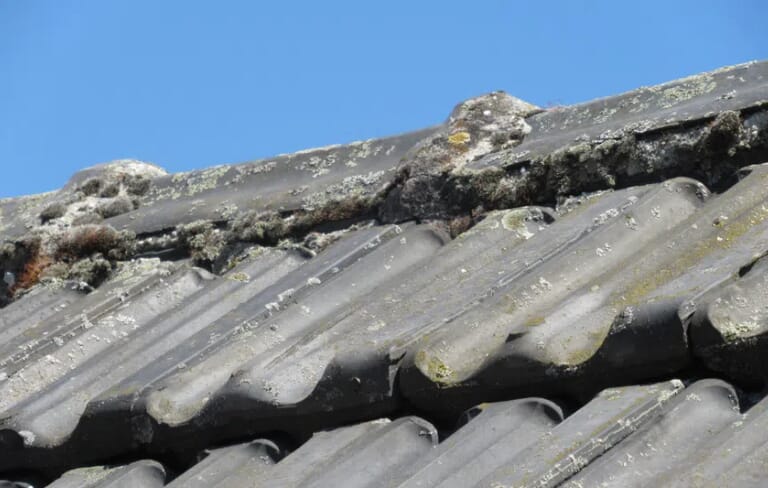
  • Annual maintenance: Algae and moss love to nest on (older) tiled roofs, especially if there are also leaves from trees near your roof.
  • By spending some time on your roof every year to remove all of this, you ensure that your roof remains in good condition for as long as possible.
  • The average lifespan of a concrete roof tile is 30 years.
  • The average lifespan of a ceramic pan is 50 years.
  • In favourable conditions, the lifespan of a pan can be up to 100 years, depending on maintenance.
keramische-pan.png

Other defects and points of attention regarding tiled roofs

If there's dirt or moss on the roof, it's usually easy to remove. If the roof tiles are still in good condition, a pressure washer can be used; a garden hose with a brush is also fine.

  • To prevent moss from returning quickly, we recommend rinsing the roof with (diluted) chlorine.
  • There are also various products available in every hardware store to remove moss or prevent it.
  • During the building inspection , extensive attention will of course be paid to the roof finish and underlying structure.

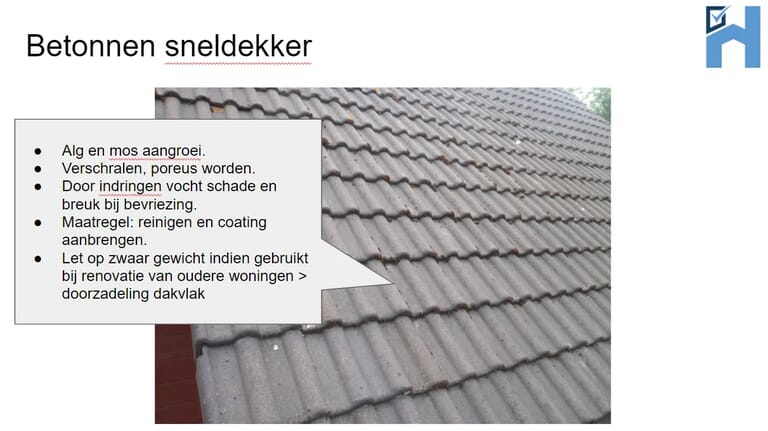
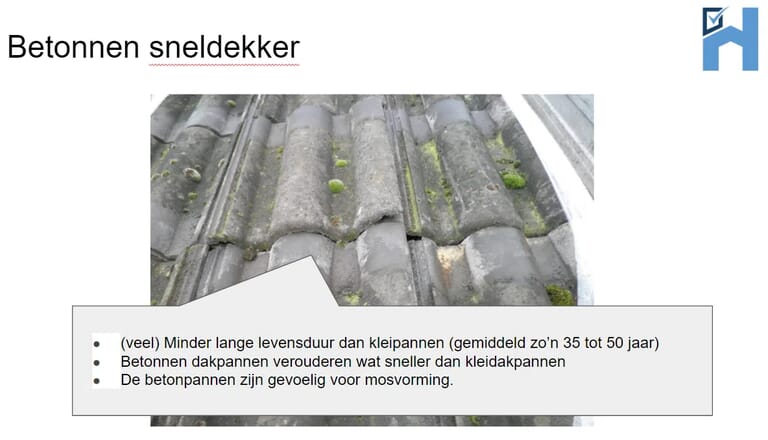
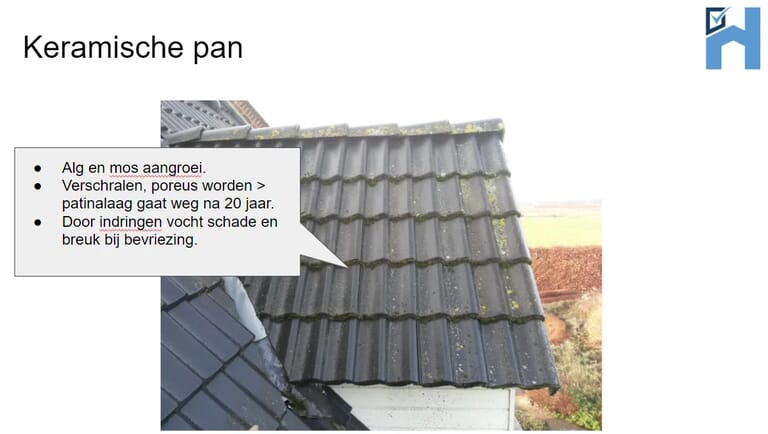
A roof can be covered with concrete tiles , which are pressed from concrete mix and then hardened. Because of their properties, they are also called quick-cover tiles. The tile is factory-applied with a protective layer that protects it from UV radiation, moisture, contamination, and other factors. This layer also gives the tile a certain appearance. If this protective layer wears off or even disappears completely, it needs to be replaced. The tile will then retain moisture, making it very susceptible to moss formation. If moisture freezes, the tiles will quickly break. If the tile is nearing the end of its lifespan, breakage will also occur spontaneously due to material stress and aging.

betonnen-sneldekker.png
levensduur-betonnen-sneldekker.png
  • In theory, concrete roof tiles have a limited lifespan, depending on maintenance, the location of the roof, and moisture load.
  • Periodic cleaning of the tiled roof by a specialist company is recommended.
  • It is best not to use a high-pressure sprayer as this may damage the top layer.
  • As a preventative measure, the tiled roof can be coated at any time. The tiles are first thoroughly cleaned and then coated with a special paint. After coating, the roof looks brand new and is protected against moss and algae growth for at least ten years. However, you should expect recurring maintenance costs for the tiled roof in the long term.

If your ceramic roof tiles are chipping or the glaze is flaking off, the quality is poor. It's very difficult to estimate when which tiles need replacing. Ceramic roof tiles should be inspected at least once a year. If the chipping becomes excessive, the entire tiled roof, or several tiles, will eventually need to be replaced. So keep in mind that this will incur costs in the future.

  • The risk of cracked tiles is higher in winter; this can also indicate insufficient ventilation under the tiles.
  • If a row of roof tiles has sagged, it's probably due to a broken batten. This can be replaced. Check the condition of some other battens.

Ridge tiles

  • Are there any defects in the ridge tiles? Check for cracks, alignment, leak risk, and connection to the tiled roof. Repair is recommended if there are any defects to prevent leakage or the risk of leakage.
  • If there's a gap in the connection between roof tiles and ridge tiles, repairs must be made. We recommend using a Flexim roof mortar. Flexim roof mortar is used for repairs and renovations, among other things. It's the perfect, storm-resistant finish for your roof. This roof mortar is particularly suitable for repairing old, weathered, and cracked cement tiles.
homekeur-nokpannen.png

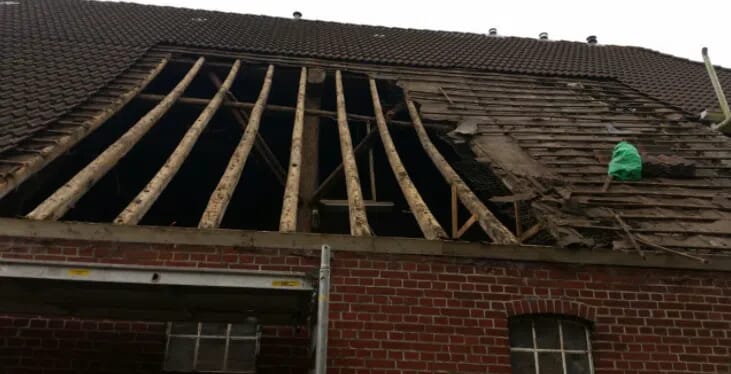
Wooden construction under the tiles

  • Have any defects been noticed in the roof battens? Some sections will need to be replaced and/or their attachment will need to be improved.
    • A roof batten is a horizontal batten used to support roof tiles. The battens are approximately 22x32 mm and are attached to the roof boarding with battens (the battens run vertically).
    • Sagging roof tiles are usually caused by defects in the roof battens.
  • If woodworm is found in the roof boarding and battens (woodworm is a debilitating process; the wood deteriorates over time), it must be treated!
    • You can remove woodworm yourself or have it done. These days, complete packages are available to treat woodworm in the roof or other wooden parts of your home. These packages include the chemical to kill the woodworm, gloves, a spray can, and plugs to apply the product deep into the wood.
  • Has wood rot been found in the roof sheathing? The cause could be a leak. It's recommended to replace some components or repair the wood rot in some way. Of course, any cause of the leak must first be addressed. Be alert for mold in persistent leaks.
  • In some cases, contamination under the roof tiles can prevent adequate ventilation in the space between the tiles and the roof boarding. This poses a risk of moisture-related wood rot, and these contaminated conditions are also ideal for other wood-destroying pests (woodworm). Therefore, the contamination must be removed to improve the condition under the roof tiles.
homekeur-dakbeschot-1.png

Would you like to make an appointment for a building inspection?

The cost of a building inspection (up to 250 m²) is only €489 including VAT. We'll conduct a comprehensive building inspection and you'll receive a building report. Do you have any questions? We're happy to help and can schedule an appointment with an expert inspector right away if you wish!

Recent articles

Een vrouw wijst naar een tablet die een man vasthoudt en een andere man kijkt mee
blog
13 February 2026
Hidden defects in a home
Hidden defects are not uncommon, especially in existing homes. They are often not immediately visible, but can have significant consequences for comfort, safety, and costs. This article explains how hidden defects are assessed and the role of investigation and inspection.
blazen plooien bitumen dak
video
13 February 2026
Common roof detail mistakes: what an inspection reveals
During roof inspections, problems often turn out to be not in the roofing itself, but in the details. In this practical case study, we demonstrate which installation errors are frequently encountered and why these, in particular, pose an increased risk of leaks and damage.
WhatsApp Image 2026-02-12 at 08.51.37
video
12 February 2026
Three Roof Eave Mistakes That Cause Leaks (And Are Often Overlooked)
Roof problems rarely arise suddenly. They usually start with a minor issue. In this inspection, we see how a torn lead flashing, improper installation, and a loose joint can all pose a serious risk. What should you look for—and how can you prevent them?