Dormer roofing
Dormer roofing
The roof of a dormer window can be covered with bitumen roofing. The bitumen of the dormer window can be covered with a gravel layer. Roof gravel is applied to roofs as ballast. With coarse gravel roofing, you must regularly remove moss and algae growth. Maintain a layer of coarse gravel of at least 3 cm. This will prevent it from blowing away and sinking into the subsoil.
- Buying a house with a dormer window? Pay extra attention to these 5 points!
- Clean the roof twice a year.
- A bitumen roof covering can last 20 to 40 years.
- The downside of roof gravel is that it gets dirty relatively quickly and moss grows. Cleaning it isn't easy. Consider using a leaf vacuum.
- The advantage is that the bitumen is protected from the elements and UV radiation. The lifespan of bitumen with gravel is longer than without gravel.
- Do not walk on a gravel roof in hot weather. The bitumen will be soft and there is a risk of the gravel being pressed into the bitumen, possibly causing a leak.
The dormer roof can be covered with a rubber (EPDM) roofing material. EPDM roofing is a commonly used roofing material for flat roofs. It's a synthetic rubber made from petroleum. The name "EPDM" stands for ethylene, propylene, diene, and monomer, the raw materials that make up this synthetic roofing material.
The advantage is that it's a lightweight material that's easy to apply. This is due to the product's high flexibility. EPDM roofing can be applied in sheets or membranes. An EPDM roof covering lasts approximately 50 years and is therefore a sustainable solution, especially when it's equipped with a green roof system. Because it's a root-resistant system, it's an ideal substrate for a green roof (see the result below).
- Clean the roof twice a year.
- A rubber (EPDM) roof covering can last approximately 30 years.
- Never walk on the roof in high or low temperatures.
The dormer roof may be covered with a plastic (PVC) roof covering . Due to heat/cold, expansion, and contraction, PVC roof coverings tend to wrinkle or bubble in changing weather conditions. These bubbles and folds can harden and become vulnerable due to weather influences (e.g., UV radiation).
- Clean the roof twice a year.
- A plastic (PVC) roof covering can last 25 to 35 years.
- Never walk on the roof in high or low temperatures.

The dormer roof can be covered with zinc. A zinc roof offers numerous advantages. For starters, both flat and pitched roofs can be covered with zinc; a pitch of only 3 degrees is required. Furthermore, zinc is a flexible and pliable material that is easy to work with. This makes it suitable for all roof shapes and offers a variety of architectural possibilities. Zinc is especially known for its extremely long lifespan. A zinc roof can last up to 100 years! Moreover, it is a natural material that is fully recyclable.
- Clean the roof twice a year.
- Never walk on the roof in high or low temperatures.
- A zinc roof covering can last up to 100 years (if properly maintained).
The dormer roof can be part of the prefabricated (polyester) dormer. Polyester has a lifespan many times longer than any other roofing material, but all synthetic materials are sensitive to ultraviolet radiation from sunlight (discoloration). You should specifically watch out for a risk associated with polyester materials: osmosis.
- Osmosis is a long process of moisture penetration, this moisture mixes with the chemical components present in the material > result in round bubbles.
- Maintenance is important, cleaning of the material should be carried out annually.
- Repair of osmosis spots is possible by removing them (grinding), filling them and finally coating them.
Defects, risks or comments regarding the roof covering
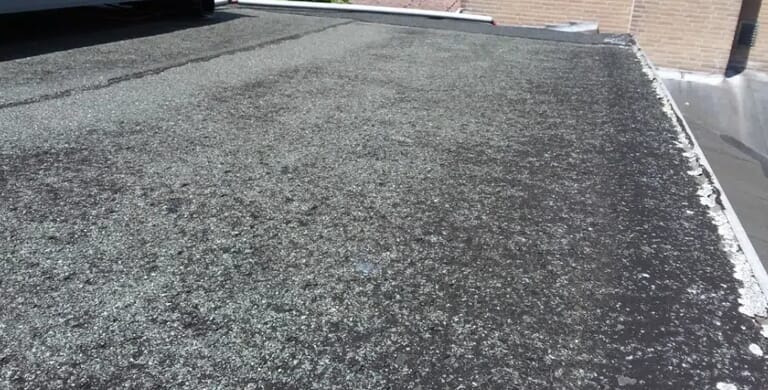
Crazing, or light cracking , occurs due to weathering of the bitumen roof covering under the influence of UV radiation and moisture. UV radiation combined with thermal stress causes the bituminous material to decompose, releasing the plastic (moldable) substances. This results in hairline cracks and a hardening of the top layer. As a result, the bitumen can no longer follow the movements of the substrate and subsequently cracks.
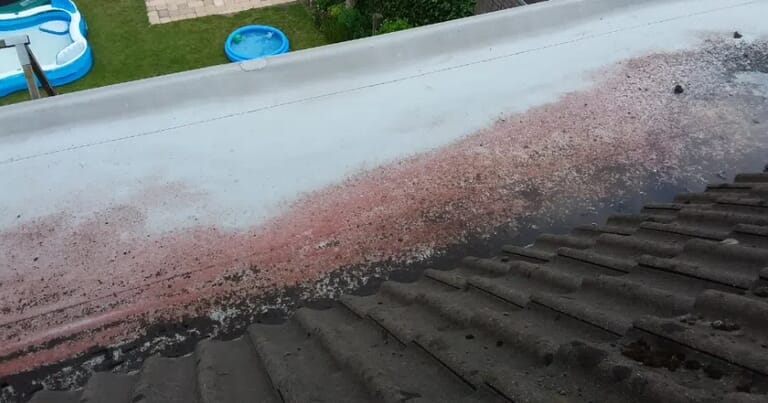
The bitumen roofing may be factory-fitted with a rolled-in slate layer , which protects the bitumen covering. Depending on the type of roofing, this slate layer will eventually come loose, causing the entire roof to deteriorate and offering less protection for the bitumen.
Blisters and/or wrinkles may be present under the bitumen . Blisters under the roof covering are a problem. Blisters indicate the presence of water vapor beneath the covering. This is usually a precursor to cracks. In a poorly fired roofing package, slight wrinkles may appear due to shrinkage and movement of the roofing membranes. In that case, it's best to contact an experienced roofer, who can best determine how the bitumen can be repaired.
- If the damage is localized, bubbles or cracks can usually be easily repaired using a rubber coating or rubber roofing paste.
- Another effective solution is to apply a new strip on top of the damaged area.
- In some cases, blisters and cracks can be an indication that the roof covering needs to be completely replaced.
Blisters and wrinkles can also be visible in EPDM roofing. Because EPDM is highly elastic and tear- and fracture-resistant, these wrinkles do not cause any further damage to the roofing material. Furthermore, this EPDM is equipped with an internal reinforcement mesh of fiberglass fibers. One cause of this wrinkling could be the adhesive used during installation. The most common installation method is full-surface bonding; if this is not applied with great care, blisters or wrinkles can occur.
- EPDM manufacturers are innovating and improving the material's composition and ingredients. A modern EPDM roof is already much better than one from 10 years ago.
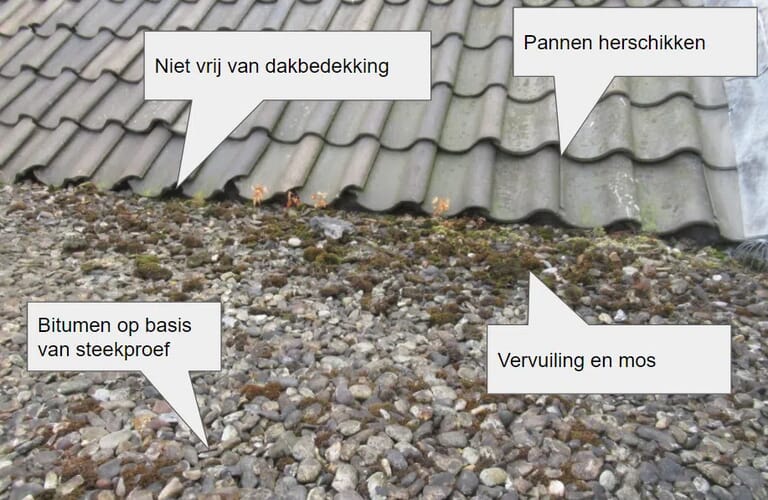
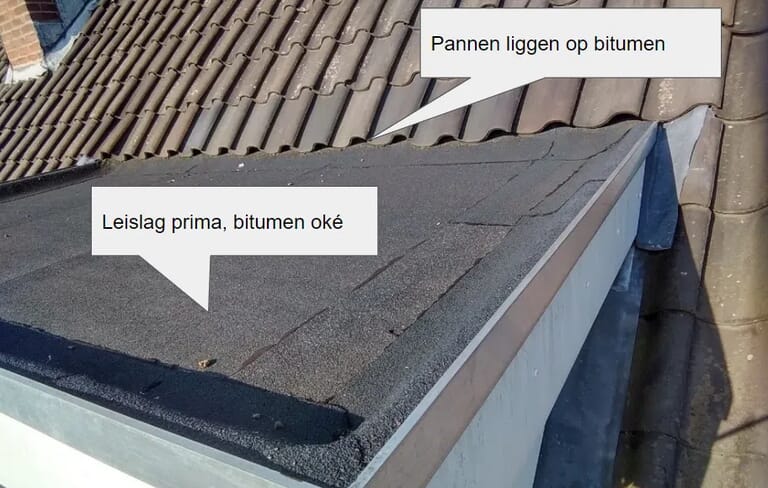
The roof tiles cannot be free from the roof covering . Roof tiles and roof covering should not be in contact with each other. Because the tiles may rest on the roof covering, damage will occur, resulting in leaks. The intended bottom row of roof tiles can be mounted higher and free from the roof covering by installing a sufficiently thick batten underneath the tiles.
- Be careful with this improvement, there may already be a leak but it may not be visible yet!
- If the tiles are already completely adhered to the roof covering, a defect in the roof covering may occur when removing the tile.
- Get well-informed about the different types of roofing. These days, we're increasingly seeing white bitumen roofing used for flat roofs. This type of roofing stays cooler in the summer, improves the efficiency of solar panels, and lowers the ambient temperature, resulting in cleaner air!
Would you like to make an appointment for a building inspection?
The cost of a building inspection (up to 250 m²) is only €489 including VAT. We'll conduct a comprehensive building inspection and you'll receive a building report. Do you have any questions? We're happy to help and can schedule an appointment with an expert inspector right away if you wish!
Recent articles