Maintenance around your home
Subsidence along the facade
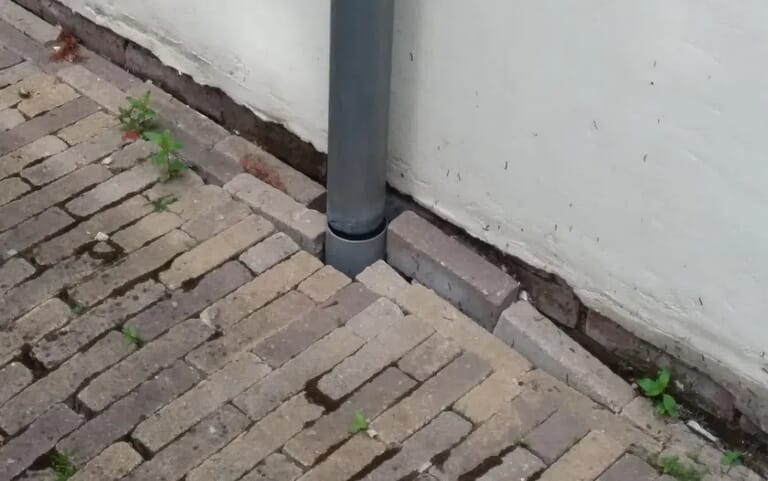
Subsidence may be visually noticeable along the facade. Sand along the facade is likely washing or sinking under the foundation into the crawl space. While a nuisance, it's not a major problem.
- If necessary, a preventive measure can be taken, for example, by adding sand to the crawl space.
- Or take advantage of this opportunity to cover the crawl space with a ground cover, which can also serve as insulation. This will significantly improve the comfort of your home.
- Subsidence along a facade does (at some point) pose a risk to sewers and rainwater drains, which can subside, break off and therefore no longer function properly.
- It is also important to repair the subsidence and to replace any existing paving that drains away from the facade to prevent sand from washing away.
Brickwork garden wall etc.
Cracks may appear in the masonry outside the house, often caused by an unstable base and soil structure. It is unlikely that a proper foundation has been installed. In short, this is a real and recurring risk for such masonry. Repair or replacement can, of course, be carried out if desired, but there is a risk of recurrence.
The masonry may also have subsided, likely due to the unstable base and soil structure. It's unlikely a proper foundation was used. In short, this is a real and recurring risk for such masonry. Further damage spread, cracking, or subsidence are also possible. Repair or replacement can be carried out if desired, but there is a risk of recurrence.
If there is mechanical damage to the masonry, it can be repaired at the (new) owner's discretion. In that case, there is nothing structurally wrong with the masonry.
The masonry pointing can be in moderate or even poor condition. This allows moisture to penetrate the masonry unhindered, and frost damage can occur. In such cases, we recommend repairing the pointing and replacing it where necessary.
If the remaining masonry is contaminated with algae and moss growth, it will damage the masonry and mortar. This growth will then retain moisture longer, accelerating the buildup of contamination and growth. Frost can also damage the masonry and mortar. Cleaning this masonry is recommended, as further damage may become visible after cleaning.
If, due to vegetation, the remaining masonry has not been assessed at all or only partially, you always run a risk. The invisible masonry is outside the scope of a building inspection.

Stairs outside the house
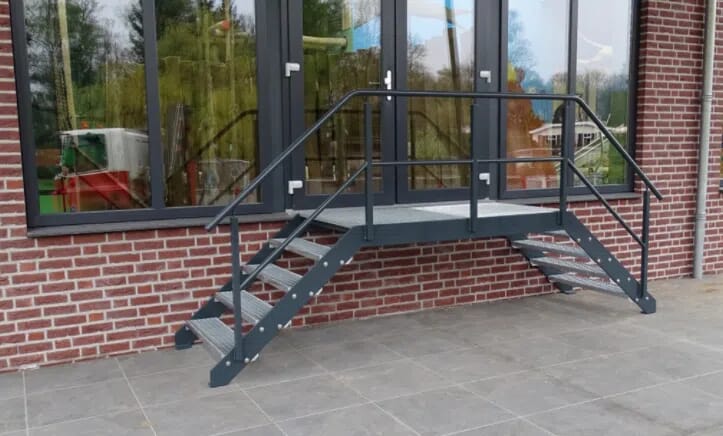
If there is a metal outdoor staircase , you can check its stability, attachment, and safety. The anchoring to the wall, any masonry around that anchoring, and the attachment to the ground should also be checked.
- If no comments or defects are noted, the stairs can function and be used safely and properly as intended.
- The staircase's paintwork can be in moderate to poor condition. To preserve the staircase and extend its lifespan, we recommend having the entire staircase painted.
- If there is rust on the metal parts of the stairs: This rust must be removed. It's best to sand it down to a bare surface, after which the material can be protected with a zinc primer. Afterwards, aesthetic painting can be applied.
- Some parts of the stairs may need to be replaced, check all parts.
- The staircase's attachment to the facade may be faulty and needs to be repaired. Check all attachment points!
- The ladder's mounting may be faulty at the bottom and may need to be repaired. Check all mounting points!
If a masonry or other stone-constructed outdoor staircase is present, it must be checked for stability, fastening, and safety. The anchoring or connection to the wall and the attachment/load-bearing capacity on the underside or ground must also be checked.
- If no comments or defects are noted, the stairs can function and be used safely and properly as intended.
- Some brickwork on the stairs may need to be improved/repaired. Where necessary, bricks can usually be replaced.
- The mortar joints on the stairs may be in poor condition. Local repairs are then necessary. Good mortar joints are important to prevent damage to the brickwork.
If a wooden outdoor staircase is present, it must be checked for stability, fastening, and safety. The anchoring to the wall, any masonry surrounding the anchoring, and the ground mounting should also be checked.
- If no comments or defects are noted, the stairs can function and be used safely and properly as intended.
- If the staircase paintwork is in moderate to poor condition, action must be taken. To preserve the staircase and extend its lifespan, we recommend carrying out the entire staircase painting job.
- Parts of the stairs may have wood rot. This rot must be repaired. Afterwards, aesthetic painting can be carried out.
- The staircase's attachment to the facade may be faulty and needs to be repaired. Check all attachment points!
- The ladder's mounting may be faulty at the bottom and may need to be repaired. Check all mounting points!
Would you like to make an appointment for a building inspection?
The cost of a building inspection (up to 250 m²) is only €489 including VAT. We'll conduct a comprehensive building inspection and you'll receive a building report. Do you have any questions? We're happy to help and can schedule an appointment with an expert inspector right away if you wish!
Recent articles