
Make an appointment Call now

Facade Pointing: Importance, Repair and Moisture Prevention

Is your home's facade silently suffering due to poor mortar joints? Discover why addressing this seemingly minor issue is crucial for preventing moisture problems and structural damage, and learn how a professional building inspection could save your property from costly repairs.

Facade Pointing: Importance, Repair and Moisture Prevention

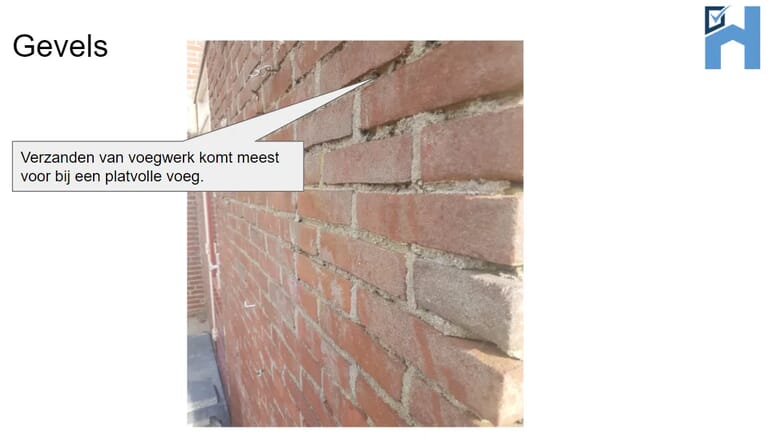
The mortar joints may be (partially) in poor condition. This poor mortar joint is detrimental to a facade, as excessive water absorption by the bricks can lead to moisture problems in the house. This can also lead to the bricks freezing, for example, and cracking. Poor mortar joints will eventually need to be replaced.

  • The old joints must be removed to a depth of at least 1 centimeter before new joints can be applied.
  • Good facade pointing is crucial and serves many technical and aesthetic purposes. Good pointing "breathes" and transports and drains water.
  • If desired, the facade can be waterproofed after the mortar joints have been repaired. (Waterproofing is the process of making water-repellent.)
voegwerk-platvol.png

If the mortar is in poor condition: this poor mortar is detrimental to the facade, as the bricks absorb too much water, potentially causing moisture problems in the house. This can also cause the bricks to freeze over at some point, for example, due to frost. The poor mortar must be replaced soon.

  • The old joints must be removed to a depth of at least 1 centimeter before new joints can be applied.
  • Good facade pointing is crucial and serves many technical and aesthetic purposes. Good pointing "breathes" and transports and drains water.
  • If desired, the facade can be waterproofed after the mortar joints have been repaired. (Waterproofing is the process of making water-repellent.)

Transom window

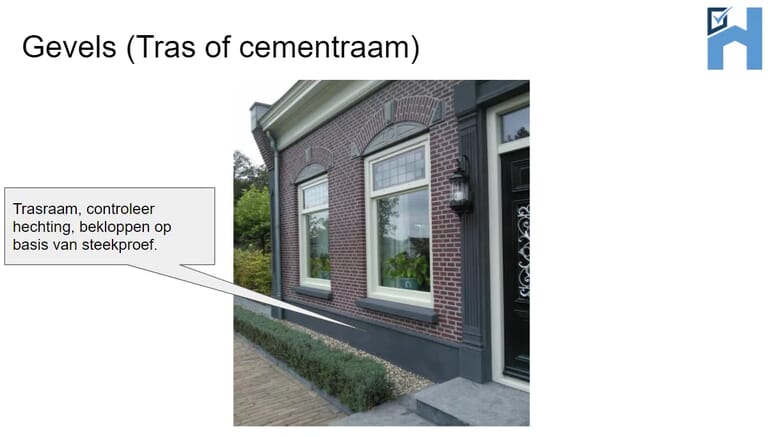
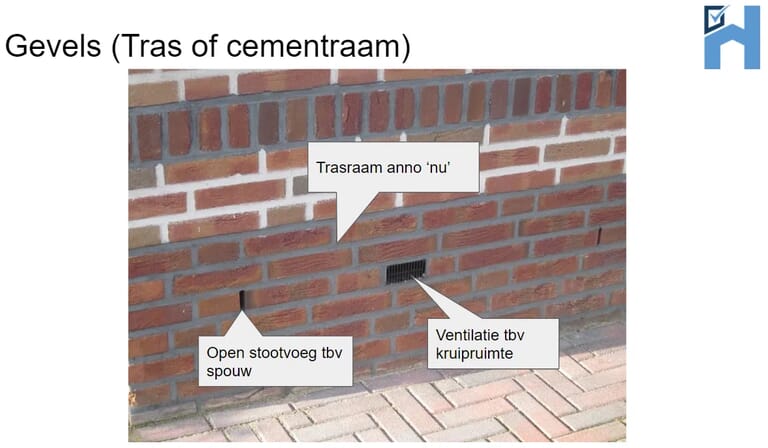
A transom window or cement window is the section of a masonry wall, usually ranging from 5 to 6 courses below ground level to 5 to 6 courses above ground level. It is constructed of hard stone (known as clinker) and hard mortar to prevent moisture from rising from the ground around a building.

cementraam.png

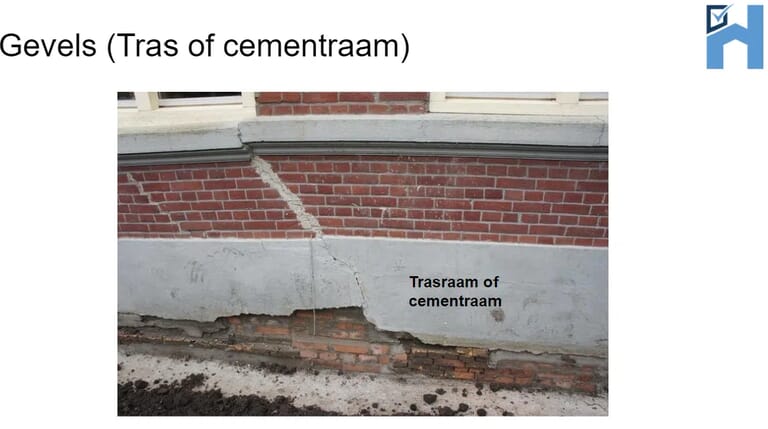
Damage and/or defects may exist in the cement window . Drainage water from the facade is then more likely to be absorbed by the underlying structure, potentially causing further damage due to freezing, for example. To reduce the risk of moisture problems in the home, these defects in the cement window must be repaired.

trasraam-verzakt.png

The mortar joint of the transom window may be in poor condition. Drainage water from the facade is then more likely to be absorbed by the masonry, potentially causing damage to the masonry due to freezing, for example. To reduce the risk of moisture problems in the home, the mortar joint of the transom window should be replaced.

  • Without a trass or cement frame, frost damage can occur in the lower bricks due to rising and freezing moisture.
  • If there is water in the stone and it freezes, the stones will break, because the volume of ice is greater than that of water.
trasraam-anno-nu.png

Would you like to make an appointment for a building inspection?

The cost of a building inspection (up to 250 m²) is only €489 including VAT. We'll conduct a comprehensive building inspection and you'll receive a building report. Do you have any questions? We're happy to help and can schedule an appointment with an expert inspector right away if you wish!

Recent articles

Een vrouw wijst naar een tablet die een man vasthoudt en een andere man kijkt mee
blog
13 February 2026
Hidden defects in a home
Hidden defects are not uncommon, especially in existing homes. They are often not immediately visible, but can have significant consequences for comfort, safety, and costs. This article explains how hidden defects are assessed and the role of investigation and inspection.
blazen plooien bitumen dak
video
13 February 2026
Common roof detail mistakes: what an inspection reveals
During roof inspections, problems often turn out to be not in the roofing itself, but in the details. In this practical case study, we demonstrate which installation errors are frequently encountered and why these, in particular, pose an increased risk of leaks and damage.
WhatsApp Image 2026-02-12 at 08.51.37
video
12 February 2026
Three Roof Eave Mistakes That Cause Leaks (And Are Often Overlooked)
Roof problems rarely arise suddenly. They usually start with a minor issue. In this inspection, we see how a torn lead flashing, improper installation, and a loose joint can all pose a serious risk. What should you look for—and how can you prevent them?