
Make an appointment Call now

Balcony steel outriggers

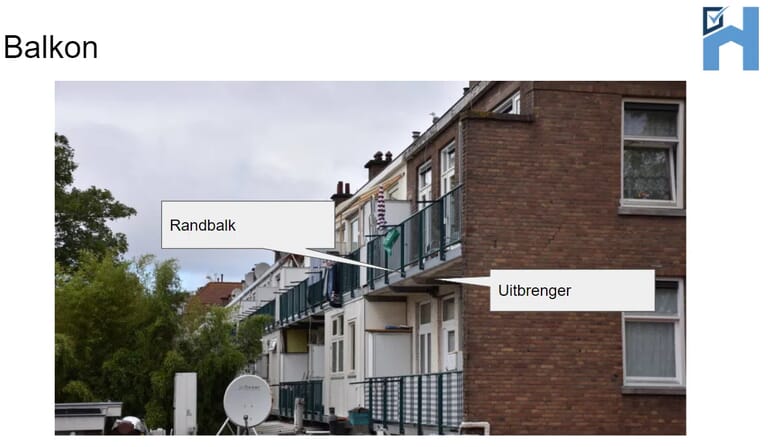
Steel balcony outriggers and edge beams are very important for the safety of a balcony, but are often susceptible to rust and lack of maintenance, especially in the most vulnerable areas.

Steel outriggers are usually profiles that protrude into the brickwork on the outside and support the balcony. On the inside, these outriggers extend between the ceiling and the floors of the structure. They are particularly vulnerable where they pass through the facade. Long-term moisture damage can corrode and weaken the material, especially at this point where it bears the most stress.

randbalk-en-uitbrenger.png
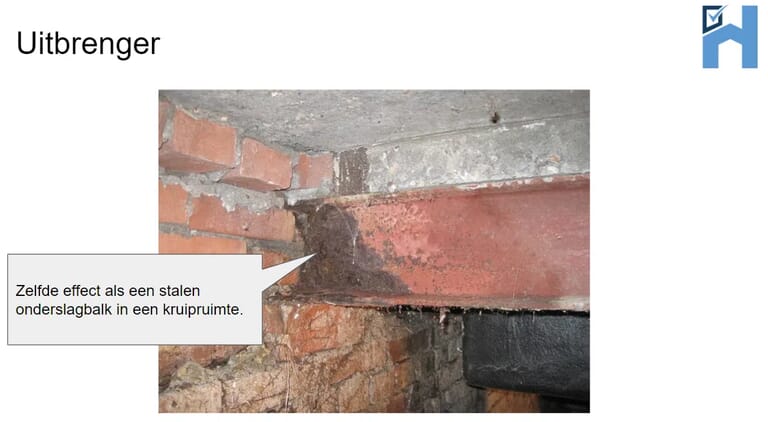
  • If there is rust on the steel spreaders, this indicates some deferred maintenance. The visible rust on the exterior can usually be treated, but the non-visible sides of the material can also rust and unfortunately cannot be treated. It is crucial to maintain the floor, any edge beams, and the spreaders of such balconies very well. Poor maintenance can lead to significant repair costs (in the long run). The material that "disappears" into the facade cannot be inspected. If you want to be certain, you will have to remove a stone at the facade opening (this is not covered by the building inspection ).
    • Step 1: Remove loose paint, bubbles, and imperfections.
    • Step 2: Remove the rust down to the core of the metal.
    • Step 3: Pre-treat with a primer or red lead.
    • Step 4: Prime the material and finish with a suitable paint system.
roest-uitbrenger.png
  • If severe rust formation is present on the steel extensions, this indicates a significant lack of maintenance. The visible rust on the exterior can be treated; the non-visible sides of the material can also rust and are no longer treatable. It is crucial to maintain the floor, any edge beams, and the extensions of such balconies very well. Poor maintenance can significantly increase repair costs (in the long term). The material that "disappears" into the facade cannot be checked; if certainty is desired, a stone at the facade opening will have to be removed. Furthermore, an attempt can be made to stem the tide by making a last-ditch effort to stop or at least slow down the rusting process.
  • The steel shims were once made of untreated steel and finished with tar and/or red lead. Poor maintenance can also weaken the structure because the shims have started to rust. Repair is no longer recommended. In that case, it's better to replace the shims with hot-dip galvanized steel. It's likely that the material that's not visible, especially at the facade penetration, isn't in the best condition.
  • To replace the runners, the masonry surrounding these openings will need to be removed. This type of work has a broader scope than just replacing the runner. There are plenty of companies specializing in balcony renovation and are happy to provide a detailed quote.
    • The more balconies participate at the same time, the more favorable the price will be.
    • If there is a homeowners' association , these costs will be borne by the association.
  • It's also possible that a balcony and its structure are so poorly maintained that safety poses a direct risk to residents and the public present in and around the balcony. In that case, the balcony must be renovated or replaced entirely. Until then, we recommend taking supporting measures, such as placing supports (supports) under the balcony structure.

Balcony steel edge beam

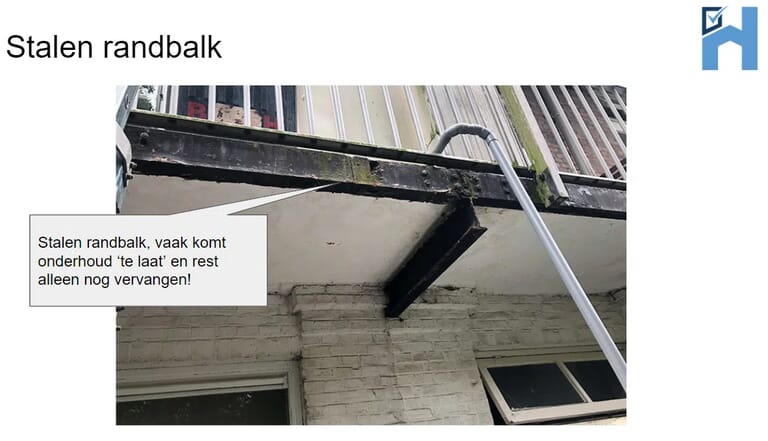
There is a steel edge beam around the floor of the balcony.

roest-stalen-randbalk.png
  • If rust is present on the steel edge beam, this indicates some deferred maintenance. The visible rust on the exterior can be treated; the non-visible sides of the material can also rust and are no longer treatable. It is crucial to maintain the floor and edge beams of such balconies very well. Poor maintenance can significantly increase repair costs (in the long run).
    • Step 1: Remove loose paint, bubbles, and imperfections.
    • Step 2: Remove the rust down to the core of the metal.
    • Step 3: Pre-treat with a primer or red lead.
    • Step 4: Prime the material and finish with a suitable paint system.
  • The edge beams were once made of untreated steel and finished with tar and/or red lead. Poor maintenance can also weaken the structure because the beams have started to rust. Repair may still be possible, but is no longer recommended. In that case, it's better to replace the edge beam with a hot-dip galvanized steel edge beam. This usually causes damage to the floor, and the scope of the work is broader than just replacing the edge beam. There are plenty of companies specializing in balcony renovation and are happy to provide a detailed quote.

Would you like to make an appointment for a building inspection?

The cost of a building inspection (up to 250 m²) is only €489 including VAT. We'll conduct a comprehensive building inspection and you'll receive a building report. Do you have any questions? We're happy to help and can schedule an appointment with an expert inspector right away if you wish!

Recent articles

Een vrouw wijst naar een tablet die een man vasthoudt en een andere man kijkt mee
blog
13 February 2026
Hidden defects in a home
Hidden defects are not uncommon, especially in existing homes. They are often not immediately visible, but can have significant consequences for comfort, safety, and costs. This article explains how hidden defects are assessed and the role of investigation and inspection.
blazen plooien bitumen dak
video
13 February 2026
Common roof detail mistakes: what an inspection reveals
During roof inspections, problems often turn out to be not in the roofing itself, but in the details. In this practical case study, we demonstrate which installation errors are frequently encountered and why these, in particular, pose an increased risk of leaks and damage.
WhatsApp Image 2026-02-12 at 08.51.37
video
12 February 2026
Three Roof Eave Mistakes That Cause Leaks (And Are Often Overlooked)
Roof problems rarely arise suddenly. They usually start with a minor issue. In this inspection, we see how a torn lead flashing, improper installation, and a loose joint can all pose a serious risk. What should you look for—and how can you prevent them?