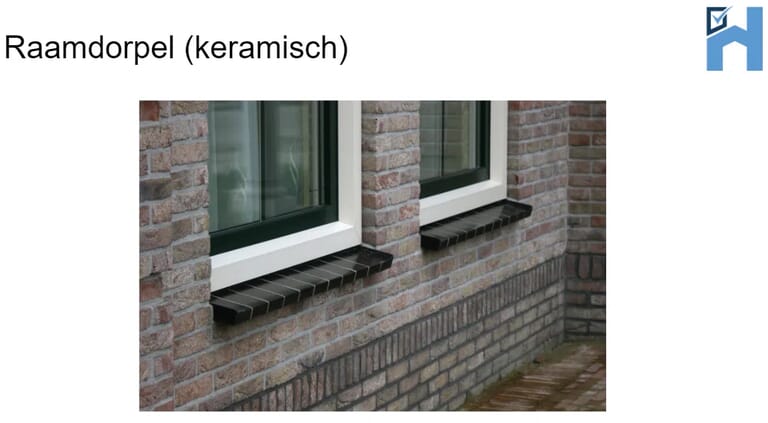
Window sills (ceramic)
- Window sills slope downwards and project slightly beyond the brickwork.
- A window sill, also known as a water hammer, is a device beneath a window that prevents (rain) water from dripping directly onto or into the wall.
- Flashings protect the top of the outer leaf (brickwork) against water ingress at the bottom of the window.
If window sill stones are loose, they should be replaced, after which the mortar joint can be repaired. If the mortar joint between the window sill stones is also in moderate to poor condition, it will need to be repaired or replaced to prevent water ingress. The old mortar joints can be ground out if necessary.
If the window sill stones are contaminated with algae and/or moss, we recommend cleaning and maintaining them. Such contamination damages the material, also retains moisture, and can subsequently cause frost damage (for example, during freezing) or even breakage.
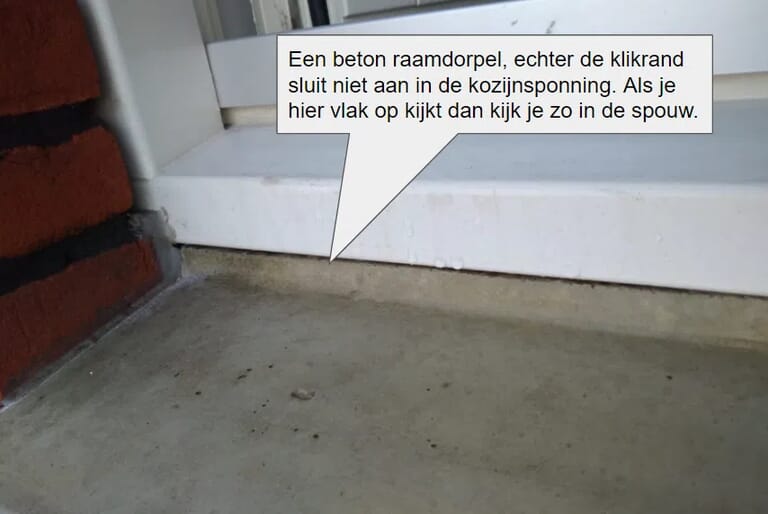
It's also possible that the connection between the bottom of the frame and the window sill (water hammer) is not optimal. The best seal and connection is achieved when the raised edge (high click) of the window sill is mounted in a drip sill at the bottom of the frame. In case of rain, driving rain, or wind-driven drainage, water ingress can occur. It is recommended to check all water hammer for this and make improvements where necessary and possible.
- The purpose of a window sill is to prevent rainwater from seeping in and splashing up.
- The window sill or drip edge must have a correct overhang of at least 4 cm, with a water groove at the bottom or a drip edge.
- The ideal angle of inclination for fitted window sills or flashings is approximately 15 degrees.
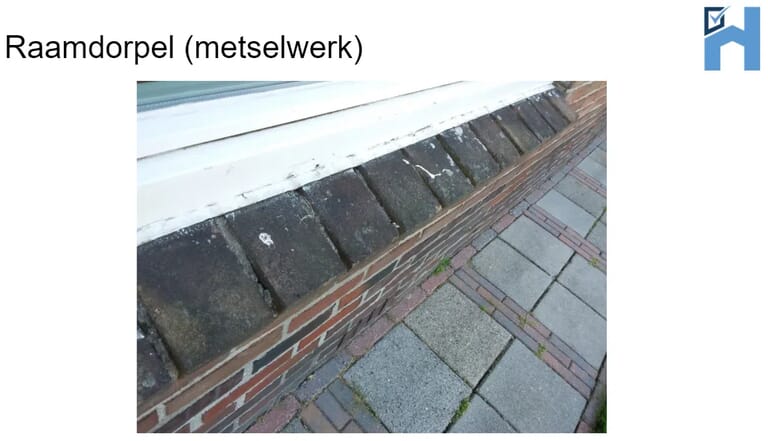
Brickwork window sills
- A disadvantage of bricks is that they are porous and become dirty quickly.
- The brick window sills slope diagonally and project slightly beyond the brickwork.
If masonry window sills are loose, they should be replaced, after which the mortar joints can be repaired. If the mortar joints between the masonry window sills are also in moderate to poor condition, they will need to be replaced to prevent water ingress. The old mortar joints can be chipped or ground out if necessary.
If the masonry window sills are contaminated with algae and/or moss, we recommend cleaning and maintaining them. Such contamination corrodes the material, also retains moisture, and can subsequently cause frost damage to the masonry (for example, during freezing) or even breakage.
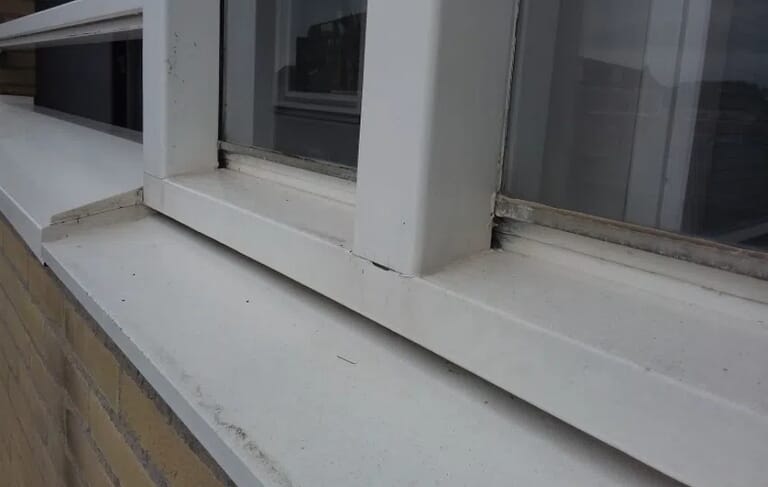
Plastic or metal window sills
Plastic flashings are provided with a drip edge at the bottom.
- The flashings run diagonally and project slightly beyond the masonry.
- A water hammer is a device under a window that prevents (rain) water from entering the wall directly.
- Flashings protect the top of the outer leaf (brickwork) against water ingress at the bottom of the window.
If the window sills are poorly maintained, we recommend that you maintain and clean these sills yourself.
The best seal and fit are achieved when the raised edge (high click) of the window sill is mounted in a drip sill at the bottom of the frame. During rainfall, driving rain, or wind-driven drainage, water ingress can occur. It is recommended to check all drips for this and make improvements where necessary and possible. If the fastening is not optimal, it can easily be improved with, for example, a "Poly Max" or "Fix All" kit.
Such flashings must be fitted with a bulkhead at the ends where they meet the wall. If this is missing, there is a risk of water ingress. The connection between the facade and the flashings can be improved by applying a sealant.
Due to the movement of materials and weather influences, they can expand and contract, distorting the original profile. If this is the case, it may be possible to improve the mounting or create a space between the components to allow them to "move," expanding and/or contracting.
Natural stone and/or concrete window sills
Solid bluestone, natural stone, or concrete window sills give a home a solid appearance. These window sills also have the advantage of being extremely durable.
- The window sills slope downwards and project slightly beyond the brickwork.
- A water hammer is a device under a window that prevents (rain) water from entering the wall directly.
- Flashings protect the top of the outer leaf (brickwork) against water ingress at the bottom of the window.
Often, a flexible sealant is applied between the various elements of these window sills (the connection between one sill and the other). This sealant needs to be replaced every 10 years or so. The old sealant can be cut out, the surfaces cleaned, and new flexible sealant applied.
If a window sill is loose or there are defects that require part of the window sill(s) to be refitted: this can be done relatively easily by applying, for example, tile adhesive between the sill (bottom) and the brickwork.
The window sill material may be worn and/or damaged to such an extent that repairs are required. Applying an epoxy repair mortar can easily repair this.
If a window sill is cracked, this can generally be easily repaired by applying a weatherproof, flexible sealant . If there are multiple cracks, replacement may be an option.
If the window sills are contaminated with algae and/or moss, we recommend cleaning and maintaining them. Such contamination damages the material, also retains moisture, and can subsequently cause frost damage (for example, during freezing) or even breakage.
A window sill(s) under the window frames should have a water groove. If one isn't present, we recommend adding one! However, this isn't practical; the sills would then have to be dismantled and returned to the manufacturer or supplier. Such window sills without a water groove pose a risk to the facade's drainage and can cause a damp problem.
- A water groove is a groove (slot, channel) at the bottom of the sill that ensures that rainwater drips off the sill and does not run down the facade, making it more difficult for it to enter the facade.
- Without a water groove, rainwater will enter the wall along the underside of the window sill, which is undesirable (the wall section will remain damp for a long time).
- Adding a water groove to a fixed sill is much more difficult; even if it is technically possible, the finish will likely be less attractive and less sleek.

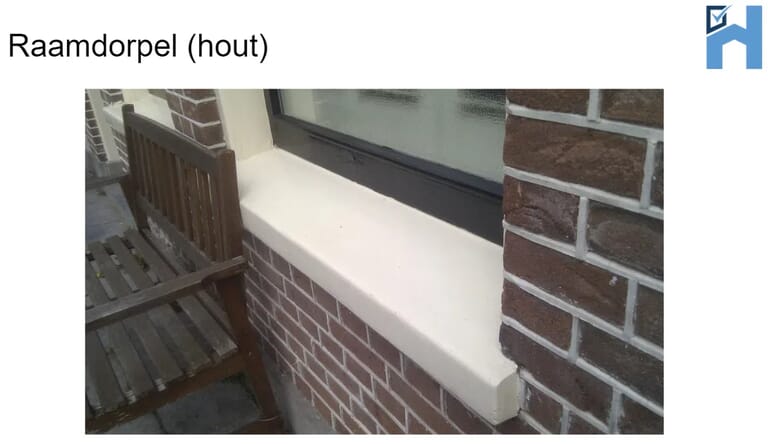
Wooden window sills
- Painting wooden window sills requires extra attention; always apply an extra coat of paint to such vulnerable sills!
Wood rot may be present, and this must be repaired to prevent further damage. Repairs may reveal more wood rot than is currently visible. In such cases, wood rot cannot be completely repaired, and sills must be replaced. Replacing such sills isn't always easy! We recommend having this done by a specialist. Painting must also be carried out after replacement.
If the (original) wooden sills beneath the window frames are clad or paneled with a material that obscures the original sill, it's likely that this finish wasn't applied for luxury, and that the underlying material is in poor condition and may actually require complete replacement. Such a finish might still be functional. Also, check for a water groove on wooden window sills; this is even more important in a wooden sill than in a bluestone sill (see the previous paragraph).
Would you like to make an appointment for a building inspection?
The cost of a building inspection (up to 250 m²) is only €489 including VAT. We'll conduct a comprehensive building inspection and you'll receive a building report. Do you have any questions? We're happy to help and can schedule an appointment with an expert inspector right away if you wish!
Recent articles