Specific points of attention and risks for extensions, conservatories and outbuildings
Extension is sagging in relation to the house
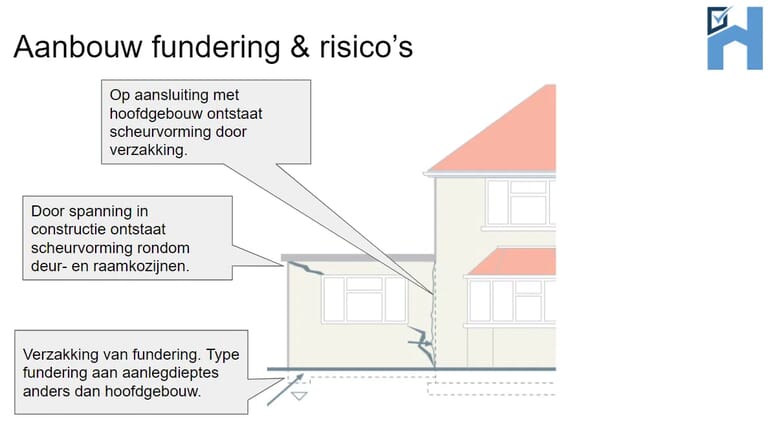
Statement: The extension appears to be subsiding relative to the house. First, examine the horizontal and vertical alignment between the house and the extension. There may be nothing wrong here, but it's also possible that the extension has a different foundation than the house, resulting in this effect. This should be investigated or further investigated. Then, it can be determined whether the movement of the extension/conservatory is active or stabilized, and therefore acceptable.
The soil structure under an existing house is different from that under an extension; if no pile foundation has been used, uneven settlement almost always follows.
Piling has been installed under the house, but not under the extension. In this case, too, uneven settlement almost always occurs, or even worse, the extension sinks away from the house. Foundation repair or stabilization of the soil structure may be a possible solution.
Nowadays, several repair methods are available to provide an extension with a foundation with piles.
Outbuildings, extensions, conservatories, etc.
There are specific points of attention that need to be taken into account if an extension has been constructed
- Facade connection of house (lead) to roof.
- Cold bridge original facade
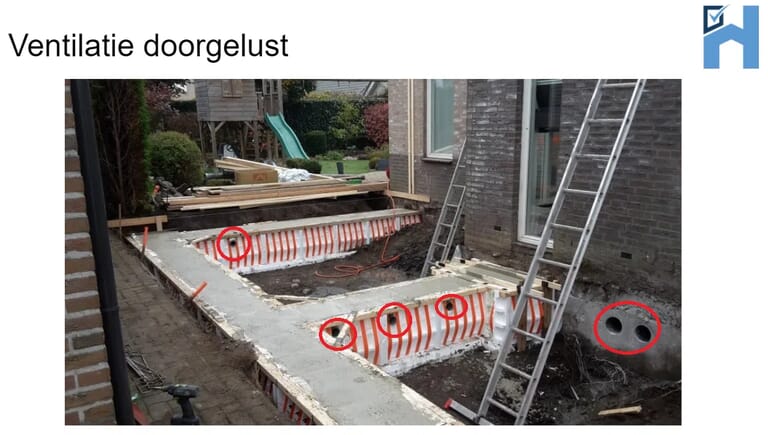
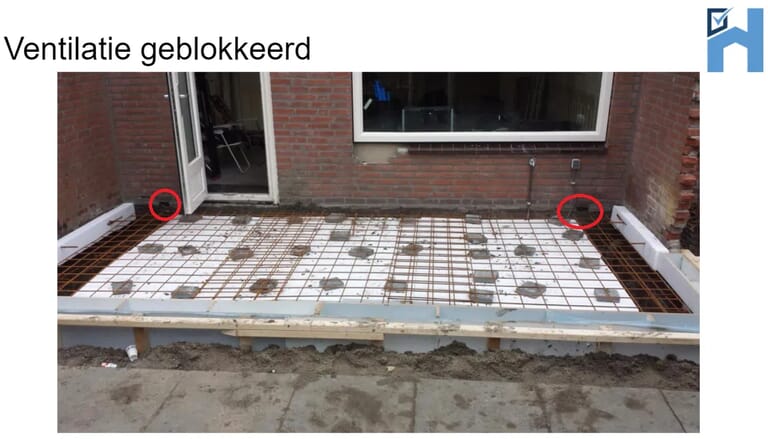
- Is the existing crawl space ventilation routed to the new facade or is it blocked?
- Extension subsidence in relation to the house
- In the case of an outbuilding, more attention is paid to asbestos applications and, for example, wood-damaging substances.
- Want more certainty? You might consider a building inspection .
If the extension appears to be subsiding relative to the house, there must be visually observable deviations in the horizontal and vertical alignment between the house and the extension. The extension may be based on a different foundation than the house. If this is the case, further investigation or inquiry should be conducted. This will determine whether the movement of the extension/conservatory is active or stabilized and therefore acceptable.
Cold bridge present (usually in a conservatory, etc.)
If there are no visible thermal bridges connecting the conservatory to the house, this means the conservatory isn't properly insulated and could lead to moisture problems on the interior walls (formerly facades). For a clear moisture measurement and solution, contact a professional.
Is repair and improvement necessary? Roof repairs can be done in several ways! We recommend involving a qualified contractor who can weigh the various options and advise you further.
- A thermal bridge is, in practical terms, a connection in a structure that conducts the "cold" from outside to the inside of the structure. Moisture from the facade can also easily enter the home this way.
- If moisture affects the walls for a long period of time, plasterwork may come loose at some point and/or structural elements present in the wall may be damaged.
- In many cases, a solution or improvement can be achieved. For example, by retrofitting a lead strip or waterproofing a facade.
Crawl space ventilation blocked by new extension
We often encounter this situation: a beautiful extension is built, but the existing crawl space ventilation isn't connected to the new exterior wall. The result is that the existing crawl space no longer ventilates, with all the risks that can arise.
Would you like to make an appointment for a building inspection?
The cost of a building inspection (up to 250 m²) is only €489 including VAT. We'll conduct a comprehensive building inspection and you'll receive a building report. Do you have any questions? We're happy to help and can schedule an appointment with an expert inspector right away if you wish!
Recent articles