
Make an appointment Call now

6 Smart Ways to Secure Your Home

A key aspect of a (new) home is burglary protection. You can partly ensure your own security by always properly locking your home, installing an alarm, or installing a security camera. The other aspect involves factors such as the windows, doors, and locks. Are these still in good condition? A building inspection can provide valuable insight into burglary protection.

1. Always lock your house

Burglars also seize their opportunity, perhaps especially when you're just "quickly out," if something isn't properly locked. A burglar will quickly notice that one unlocked window. Therefore, always lock your house carefully, even when making the slightest detour.

Also, make sure there are no dumpsters near your house. Some burglars use these to access an upper floor from outside.

2. Installing an alarm

An alarm in your home can serve two purposes: deterring a burglar, and (if you wish) immediately calling the police. Often, the latter isn't even necessary: the sound and light of the alarm are often enough to deter a burglar.

3. Approved SKG hinges and locks

Properly functioning locks and hardware are essential for keeping burglars out. This includes locks with core pull protection, which makes it impossible for burglars to pull a cylinder out of a lock. A quality mark for locks is the Foundation for Quality Facade Construction (SKG).

An SKG 2-star lock is independently burglar-resistant, and an SKG 3-star lock is highly burglar-resistant. By checking the locks in your (future) home for the SKG quality mark, you'll know exactly where you can improve your security.

4. Anti-theft claws

Anti-burglary devices are an addition to good hinges and locks. This form of burglar protection is often installed in doors. It consists of a cylinder that slides into a tube when the door is closed. This protection prevents thieves from opening a door or window via the hinges.

5. A timer for the lighting in the house

A timer is especially useful if you're away for an evening or on vacation. By setting the timer, the lights in your house will turn on at a specific time. Besides making it look like someone is home, burglars generally don't like lights.

6. Security cameras in your home

There are increasingly more possibilities in the field of camera security, even in private homes. Security cameras are becoming increasingly affordable and provide insight into what's happening in your home. Plus, a camera always deters burglars!

A building inspection provides clarity

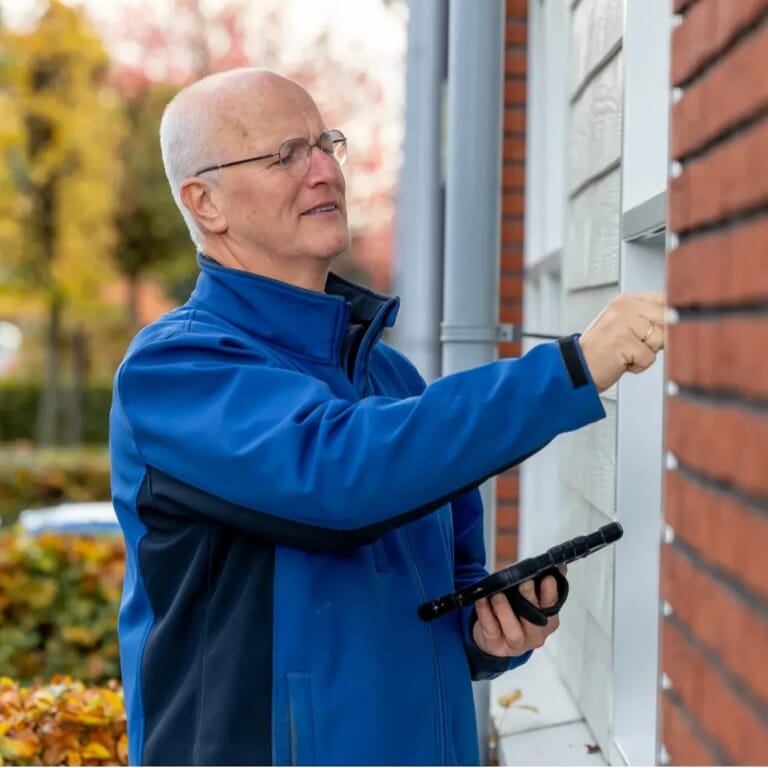
The condition of your windows and doors is particularly important when it comes to keeping burglars out. After a thorough building inspection by Homekeur, you'll receive a building report detailing the condition of your home's hardware, any renovations you can make, and the estimated costs. Feel free to contact us.

Would you like to make an appointment for a building inspection?

The cost of a building inspection (up to 250 m²) is only €489 including VAT. We'll conduct a comprehensive building inspection and you'll receive a building report. Do you have any questions? We're happy to help and can schedule an appointment with an expert inspector right away if you wish!

Recent articles

Een vrouw wijst naar een tablet die een man vasthoudt en een andere man kijkt mee
blog
13 February 2026
Hidden defects in a home
Hidden defects are not uncommon, especially in existing homes. They are often not immediately visible, but can have significant consequences for comfort, safety, and costs. This article explains how hidden defects are assessed and the role of investigation and inspection.
blazen plooien bitumen dak
video
13 February 2026
Common roof detail mistakes: what an inspection reveals
During roof inspections, problems often turn out to be not in the roofing itself, but in the details. In this practical case study, we demonstrate which installation errors are frequently encountered and why these, in particular, pose an increased risk of leaks and damage.
WhatsApp Image 2026-02-12 at 08.51.37
video
12 February 2026
Three Roof Eave Mistakes That Cause Leaks (And Are Often Overlooked)
Roof problems rarely arise suddenly. They usually start with a minor issue. In this inspection, we see how a torn lead flashing, improper installation, and a loose joint can all pose a serious risk. What should you look for—and how can you prevent them?