
Make an appointment Call now

PVC Roofing: Maintenance, Lifespan and Advice

PVC and EPDM roofing materials face unique challenges due to weather-induced expansion and contraction, leading to potential wrinkles, blisters, and eventual brittleness. This guide highlights the importance of regular maintenance and professional inspections to ensure the longevity and integrity of your roof, providing valuable insights into preventive measures and repair strategies for both PVC and EPDM roofing.

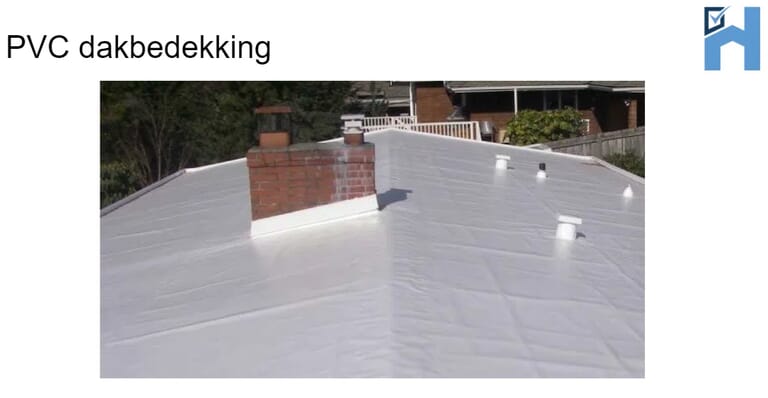
Due to heat/cold, expansion, and contraction, PVC roofing tends to wrinkle or blister in changing weather conditions. These blisters and folds can harden and become brittle due to weather influences (e.g., UV radiation). If cracks and/or blisters develop, replacement is recommended. Consult a professional.

pvc-dakbedekking-1.png
  • Clean the roof twice a year.
  • A PVC roof covering can last up to 30 years.
  • Never walk on the roof in high or low temperatures.
  • Check the lead strips for defects between the facade and roof connection

Other defects or comments on PVC roofing

  • Have any defects been noticed in the PVC roofing? Repairs can be carried out quite easily by an expert.
  • Are there visible blisters and wrinkles in the PVC roofing? One possible cause of these wrinkles could be the adhesive bonding during installation.
  • The most commonly used installation method is full bonding. If this is not applied with great care, bubbles or wrinkles may occur.
  • It is unknown how bubbles and folds will develop in the future and/or whether the material will indeed not suffer technically as a result.
  • If there is any contamination on the roof, it must be removed.

EPDM Roofing

  • Clean the roof twice a year.
  • An EPDM roof covering can last up to 40 years.
  • Never walk on the roof in high or low temperatures.
  • Check the lead strips for defects between the facade and roof connection
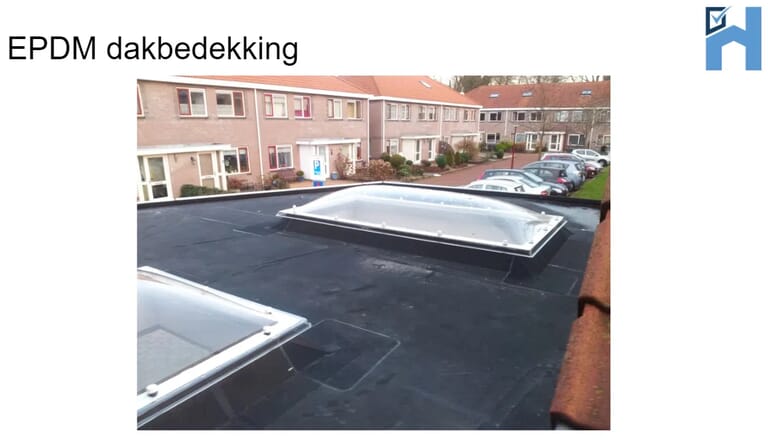
EPDM-dakbedekking.png

Photo courtesy of www.budgetdak.nl

Other defects or comments on EPDM roofing

  • Have any defects been noticed in the EPDM roofing? Repairs can usually be carried out quite easily by an expert.
  • EPDM roofing is provided with an internal reinforcement mesh of fibreglass threads.
  • EPDM manufacturers are innovating and improving the material's composition and ingredients. A modern EPDM roof is already much better than one from 10 years ago.
  • If folds are present in the EPDM roof covering: it is unclear how the bubbles and folds will develop in the future and/or whether the material will indeed not suffer technically as a result.
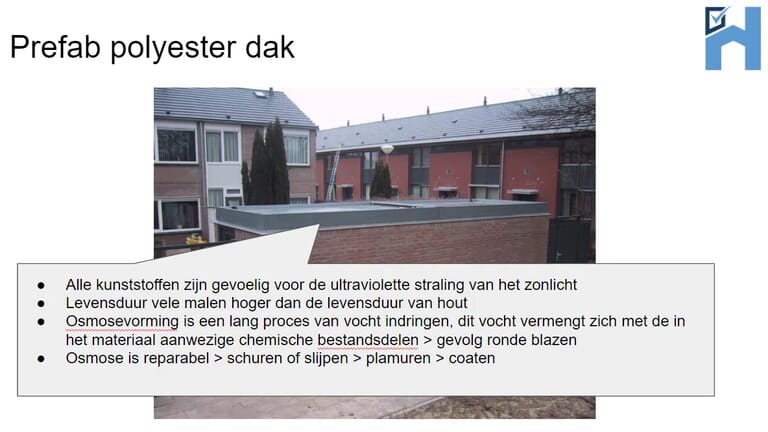
polyester-dak.png

Would you like to make an appointment for a building inspection?

The cost of a building inspection (up to 250 m²) is only €489 including VAT. We'll conduct a comprehensive building inspection and you'll receive a building report. Do you have any questions? We're happy to help and can schedule an appointment with an expert inspector right away if you wish!

Recent articles

Een vrouw wijst naar een tablet die een man vasthoudt en een andere man kijkt mee
blog
13 February 2026
Hidden defects in a home
Hidden defects are not uncommon, especially in existing homes. They are often not immediately visible, but can have significant consequences for comfort, safety, and costs. This article explains how hidden defects are assessed and the role of investigation and inspection.
blazen plooien bitumen dak
video
13 February 2026
Common roof detail mistakes: what an inspection reveals
During roof inspections, problems often turn out to be not in the roofing itself, but in the details. In this practical case study, we demonstrate which installation errors are frequently encountered and why these, in particular, pose an increased risk of leaks and damage.
WhatsApp Image 2026-02-12 at 08.51.37
video
12 February 2026
Three Roof Eave Mistakes That Cause Leaks (And Are Often Overlooked)
Roof problems rarely arise suddenly. They usually start with a minor issue. In this inspection, we see how a torn lead flashing, improper installation, and a loose joint can all pose a serious risk. What should you look for—and how can you prevent them?