
Make an appointment Call now

Lead connections roof

Roof maintenance is crucial to prevent water ingress and prolong the lifespan of your structure, especially when dealing with lead flashing, which requires proper installation and care. Understanding the importance of professional intervention and the environmental impact of lead can save time, money, and the environment, making a building inspection a wise investment.
  • Defects in the main roof may be noticeable, particularly in the leadwork. Repairs or improvements can usually be made to these, after which the entire structure can function properly again as intended.
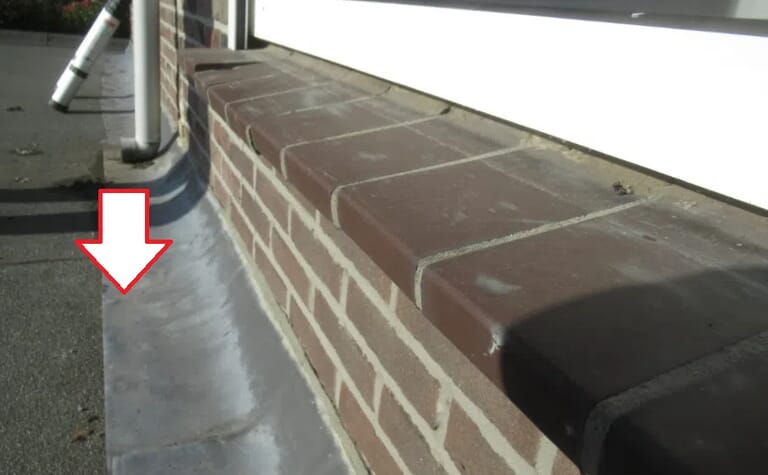
  • The flashing (the part visible from the brickwork) may be incorrectly installed on the horizontal roof surface. Due to creep and capillary action of water remaining on the roof, there is an increased risk of water ingress and/or leakage into the cavity or at this connection. Correcting this is easily accomplished by shortening the flashing.
    • Lead can easily be cut and 'torn off' with a utility knife.
    • Always place a piece of board under the lead to be cut, this prevents you from accidentally cutting the bitumen.
Homekeur-Lood-veel-te-hoog.png
  • Can the lead strips (the part visible from the brickwork) be too long? The strips may have a maximum length of 1 meter and must overlap by at least 8 cm. Materials are subject to weathering; if they are too long, there is insufficient space to accommodate the shrinkage or expansion. This causes the material to crack more quickly, leading to defects. Once the lead has been applied in this way, there's little you can do other than accept it. This does shorten the material's lifespan, and the lead will need to be replaced sooner than usual. If you ever decide to replace it, seek expert advice! Replacement against the inner wall of a cavity wall is essential. Simply grinding in a lead flashing is not a viable solution.
  • Replacing lead flashing isn't easy! Strips of masonry must be removed to properly repair the flashing. Call in a professional.
  • Simply clamping the foot lead and closing a joint is not a proper repair.
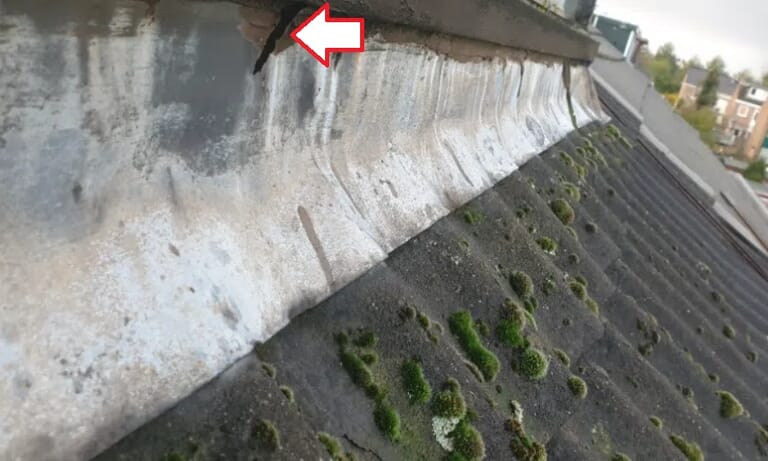
  • If there are any cracks in the lead, you can apply self-adhesive bitumen tape, available at any hardware store. As long as repairs are possible, we recommend postponing replacement.
Homekeur-Lood-onder-kozijn-dakkapel.png

What is lead?

In the 1980s and 1990s, it became clear that lead was harmful to the environment, leading to restrictions on its use. Lead was replaced in car fuels by other substances, and lead pipes were replaced by pipes made of plastic, (galvanized) steel, or copper. Lead is harmful to the environment, which is why its use has been reduced. However, its use is (again) permitted in the construction industry in the Netherlands due to its recyclability.

Would you like to make an appointment for a building inspection?

The cost of a building inspection (up to 250 m²) is only €489 including VAT. We'll conduct a comprehensive building inspection and you'll receive a building report. Do you have any questions? We're happy to help and can schedule an appointment with an expert inspector right away if you wish!

Recent articles

Een vrouw wijst naar een tablet die een man vasthoudt en een andere man kijkt mee
blog
13 February 2026
Hidden defects in a home
Hidden defects are not uncommon, especially in existing homes. They are often not immediately visible, but can have significant consequences for comfort, safety, and costs. This article explains how hidden defects are assessed and the role of investigation and inspection.
blazen plooien bitumen dak
video
13 February 2026
Common roof detail mistakes: what an inspection reveals
During roof inspections, problems often turn out to be not in the roofing itself, but in the details. In this practical case study, we demonstrate which installation errors are frequently encountered and why these, in particular, pose an increased risk of leaks and damage.
WhatsApp Image 2026-02-12 at 08.51.37
video
12 February 2026
Three Roof Eave Mistakes That Cause Leaks (And Are Often Overlooked)
Roof problems rarely arise suddenly. They usually start with a minor issue. In this inspection, we see how a torn lead flashing, improper installation, and a loose joint can all pose a serious risk. What should you look for—and how can you prevent them?