

Foundation of the house
The most common and well-known method for founding a house is a pile foundation . If the house has a pile foundation, the foundation is fixed to these piles. The most common and well-known method for founding a house is a concrete pile foundation, the foundation being fixed to these piles. The pile has a calculated fixed length, and the pile tip rests on the solid (sandy) ground.
- It is estimated that approximately 400,000 homes in the Netherlands may experience foundation problems. This is a rough estimate. Foundations are not visible, and changing environmental factors also affect their condition.
- The estimate of 400,000 homes is a combination of the number of homes on wooden piles that are at risk and the number of homes on steel piles that are expected to have problems.
- Wooden pile foundations were mainly used in the construction period up to 1970. In the Netherlands, approximately 750,000 houses date from this period.
- Wooden pile foundations can be vulnerable, especially in less load-bearing soil areas.
- A third party may have or develop a foundation problem.
- This mainly concerns homes in peat and clay areas.
- That number could rise if measures are not taken.
Wooden pile foundation
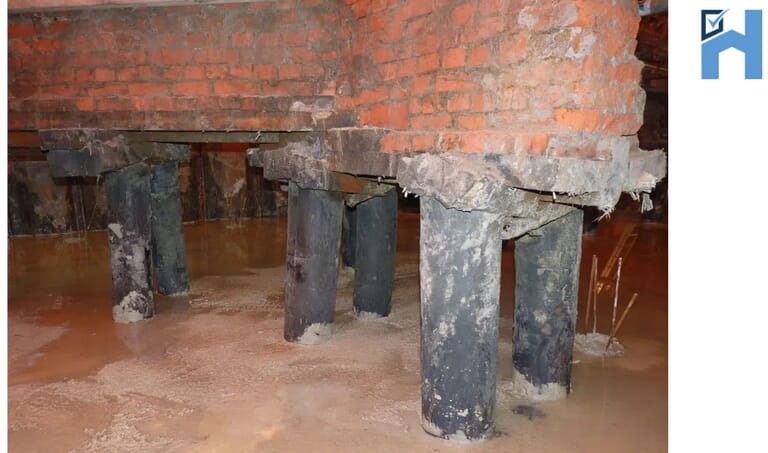
The most common and well-known method for building a house is a pile foundation. If the house has wooden piles , the foundation is fixed to these piles. The pile has a calculated fixed length, and the pile tip rests on the firm (sandy) ground. There are several types of wooden pile foundations!
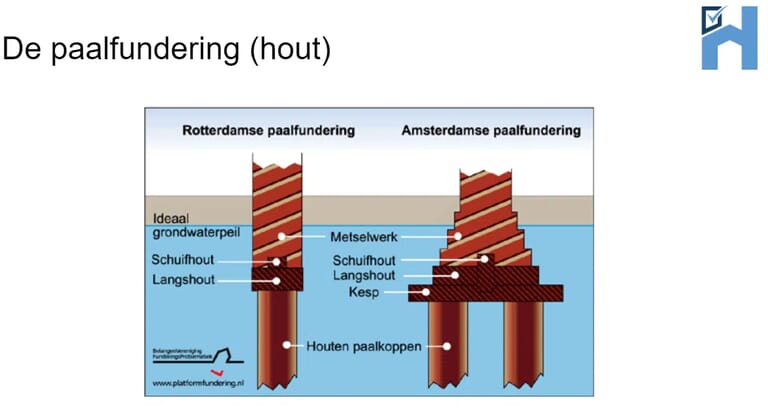
- There are two variations on the wooden pile foundation : the Amsterdam and the Rotterdam . This designation doesn't mean that this type of foundation is exclusive to these cities. Rotterdam also has houses with an Amsterdam foundation type, and Gouda, for example, can have a Rotterdam pile foundation.
- In Amsterdam pile foundations, a horizontal wooden beam (also called a cap ) sits on the wooden piles, with the longitudinal timber above it. In Rotterdam pile foundations, only the longitudinal timber is present. Above that, a concrete beam is placed, supporting the load-bearing wall or the load-bearing wall itself. Wooden pile foundations were primarily used in the construction period up to 1970.
Steel foundation
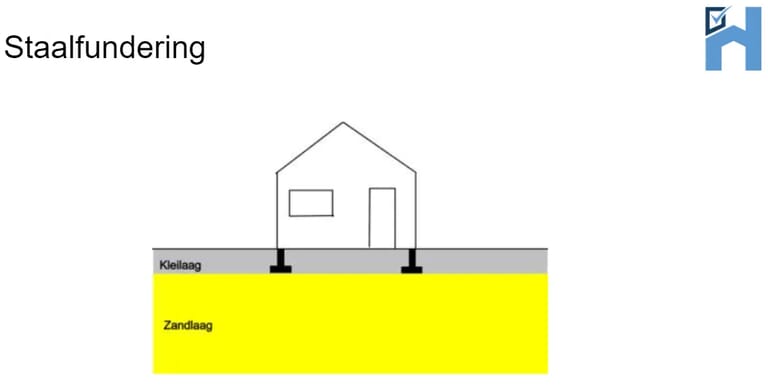
A steel foundation (steel foundation) means that a building stands on a layer of sand. The solid ground here is the sand layer, which is so hard and stable that piling is not necessary. The foundation rests directly on this sand layer, at least 80 cm below ground level to avoid the frost line. A steel foundation is only possible on sandy and marl soils. It is common knowledge that houses with a steel foundation have a greater risk of subsidence , settlement , or cracking in the masonry. This can be caused by changes in the surrounding soil structure .
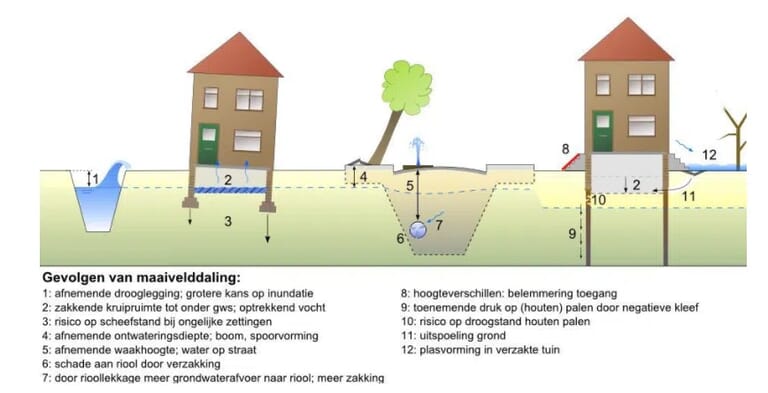
- Throughout the Netherlands, the ground is subsiding and shifting, which can be partially visualized by searching online for " soil subsidence map ." There are areas where the ground is subsiding by 3 millimeters, or in some areas even 10 millimeters, per year. This subsidence can eventually cause sagging facades, uneven thresholds, cracks in walls, flooding, and damage to gardens, paving, and sewers.
- Homes with a pile foundation generally experience less nuisance from soil subsidence than homes with a steel foundation.
- Governments are aware of this subsidence and are investigating appropriate measures, but a definitive solution seems impossible. Therefore, the focus is primarily on the groundwater level, which has a major impact on subsidence. Researchers also say that climate change is a significant factor. Prolonged droughts can cause cracks and subsidence.
- Damage to homes and buildings due to subsidence can occur spontaneously and at any time, be present already, or worsen in the future. Such damage cannot be foreseen during the building inspection, is at your own risk, and excludes any liability.
It is estimated that approximately 300,000 homes in clay areas have a foundation on steel foundations. Some of these homes are slowly sinking, sometimes more than 1 cm per year. Therefore, 150,000 of these homes are possibly being rebuilt.
The house can also be equipped with a so-called slab foundation , which is a horizontal reinforced concrete slab that serves as a load-bearing structural element for the entire remaining superstructure. Slab foundations are used exclusively for less "heavy" buildings. A slab foundation means that the building rests on a single large reinforced concrete slab in load-bearing sand. The foundation itself is called a foundation slab or also a floor slab . A slab foundation means that a building stands on a layer of sand. The solid ground in this case is the sand layer, which is so hard and stable that piling is unnecessary. The (slab) foundation rests directly on this sand layer and below ground level because of the frost line.
- It's common knowledge that homes with these foundations are at greater risk of subsidence, settlement, or cracking in the masonry. This can be caused by changes in the surrounding soil structure .
Defects in the foundation
- Suppose a foundation suffers mechanical damage ; this damage is not the result of a foundation problem, but rather of an incident (for example, during construction work). Repairing this damage is not necessary.
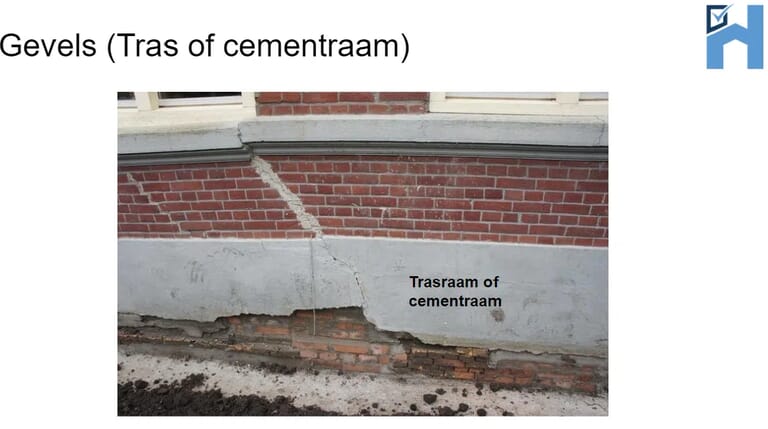
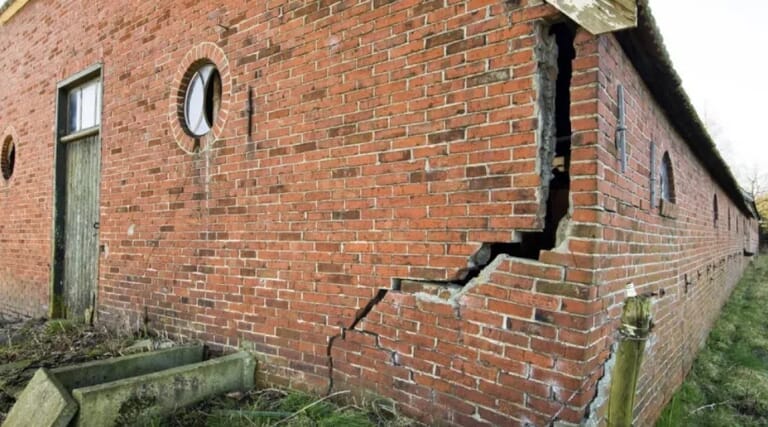
- A foundation can only be partially viewed. If cracks are visible in the foundation, this could indicate that changes have occurred in the soil structure, either recently or in the past. The foundation may have (possibly) settled again.
- Regularly check the facade of the house for new cracks or the spread of existing cracks and settlements .
- If there is any active movement or modification to the property, you will at some point need to have further investigations carried out into the condition and state of the foundation and the stability of the soil structure.
- Minimal cracking isn't necessarily a problem, especially in older homes, but it's often related to the movement and settlement of materials or potential changes to the building due to renovations. Thermal activity, temperature fluctuations, material variations, or rusting iron can all cause cracking.
- If you have any doubts about the stability of your foundation, we recommend further, specialized investigation. The additional costs of a specialized investigation are outweighed by the uncertainty that could potentially have serious consequences. To gain a better understanding of any potential issues and explore a possible solution, we recommend having a supplementary foundation investigation performed.
- Uneven subsidence in particular causes settlement differences in the building that can lead to cracks.
- Subsidence of the subsoil due to lowering of the water level or shrinkage of the foundation can also lead to settlement in brick structures.
- Settlement can also occur when foundation structures lose their load-bearing capacity.
- The costs for a foundation investigation can be very high.
- A potential foundation subsidence can have several causes. A key cause is a drop in the groundwater level, which causes the ground to settle and the building's foundation to (partially) sink. This movement often results in a typical damage pattern inside or outside the home.
- Subsidence or tilt in the foundation may indicate recent or past changes in the soil structure. The foundation may have (possibly) settled again.
- Regularly check the facade of the house for new cracks or the spread of existing misalignments and subsidence .
- If there is any active movement or modification to the property, you will at some point need to have further investigations carried out into the condition and state of the foundation and the stability of the soil structure.
- During a building inspection , and if possible, extra attention will be paid to the foundation.
Foundation on cowhides
Foundations on cowhides are an urban legend; the story seems indestructible; such a foundation has never been found. The origins of these stories are unclear. In all likelihood, texts from the past have been misinterpreted. From a geotechnical and technical perspective, a cowhide or oxhide obviously has no load-bearing function. A soft leather sheet, even if applied in multiple layers, is unsuitable for building a house, let alone an old medieval church.
Would you like to make an appointment for a building inspection?
The cost of a building inspection (up to 250 m²) is only €489 including VAT. We'll conduct a comprehensive building inspection and you'll receive a building report. Do you have any questions? We're happy to help and can schedule an appointment with an expert inspector right away if you wish!
Recent articles