
Make an appointment Call now

Fascia Boards: Wood Rot, Delamination and Maintenance

Fascia boards are crucial elements of a home's exterior, often prone to wood rot and delamination, which can lead to significant structural issues if not addressed. Regular professional inspections and maintenance are vital to prevent damage and ensure the longevity of these components, offering peace of mind and protecting your investment.

Points of interest

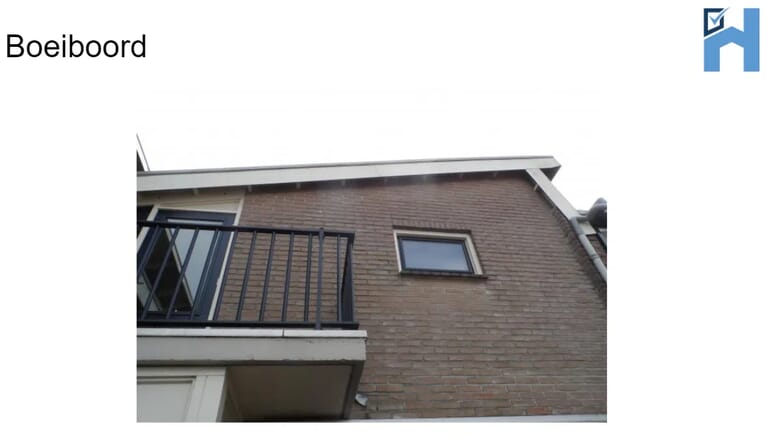
A house may have fascia boards. A fascia board is a finishing touch to a gutter, and may also be a roof edge finish (for a flat roof).

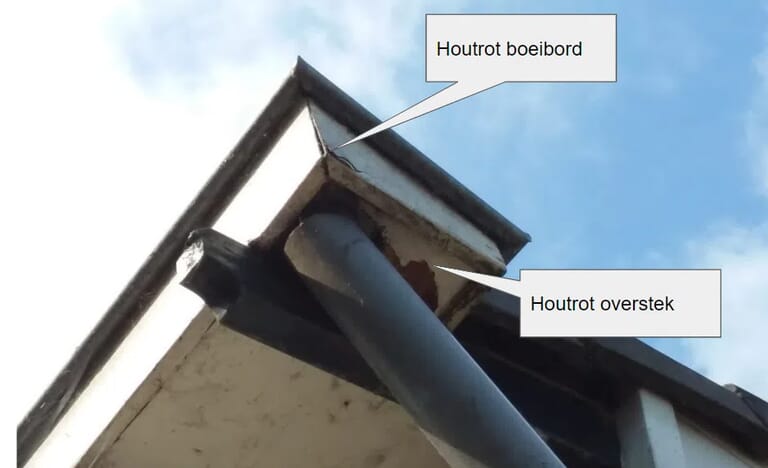
  • The fascia boards may be affected by wood rot. Wood rot should always be professionally repaired, after which the paintwork (in some areas) should be reapplied.
    • Note: Wood rot can still be present in invisible places! Wood rot can also become visible when removing layers of paint.
    • Wood rot may have been professionally repaired in the past, or wood rot may have been deliberately hidden, either professionally or not.
    • Regular, expert, and proper maintenance is therefore essential! Pay particular attention to connections, corners, and seams to ensure they are sealed and moisture cannot penetrate.
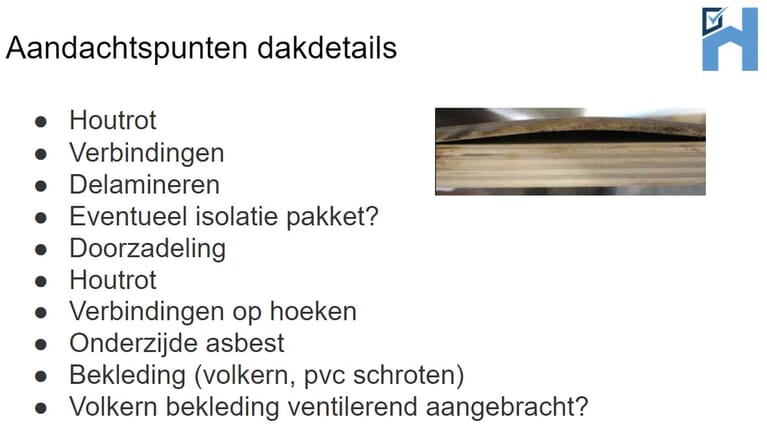
  • Parts of the fascia woodwork can delaminate. Delamination is the loss of cohesion between the layers of a multi-layered material. This can be caused by poor adhesion between the layers due to a manufacturing defect or a gradual loss of adhesion due to the effects of moisture or air on the adhesive, etc. Delamination of woodwork cannot be repaired; at some point, parts of the woodwork will have to be replaced.
homekeur-boeibord-houtrot.png
  • The original fascia boards may be covered (fully or partially) with a (solid core) material. The solid core material cannot be installed with ventilation, as it cannot ventilate between the different materials, and there is a high risk of condensation, resulting in damage to/wood rot of the underlying woodwork. If the solid core material is not installed with ventilation, we recommend removing the solid core material covering the overhang and reapplying it professionally (on rubber pads) with ventilation.
    • After removal of the Trespa (or solid wood), defects in the underlying woodwork may become visible.
    • The advantage of this covering is that painting is unnecessary.
  • If such cladding was applied later to the original woodwork, a zinc bead and/or roof trim (from the roof or gutter) cannot be installed over this later-applied material. The detail can no longer function as intended due to the applied cladding. The bead is intended to make the whole thing attractive and sturdy, but (like roof trim) it also has a lesser function. Water that tries to drain towards the bead/roof trim is now obstructed and can get behind the cladding. With insufficient ventilation or cold installation of the cladding, this can cause wood rot, etc., to the underlying structure, or it may already be present.
    • If such a (roof) detail is covered or panelled, this detail should also be improved in the bead/roof trim.
boeiboord.png
opletten-bij-dakdetails.png

Would you like to make an appointment for a building inspection?

The cost of a building inspection (up to 250 m²) is only €489 including VAT. We'll conduct a comprehensive building inspection and you'll receive a building report. Do you have any questions? We're happy to help and can schedule an appointment with an expert inspector right away if you wish!

Recent articles

Een vrouw wijst naar een tablet die een man vasthoudt en een andere man kijkt mee
blog
13 February 2026
Hidden defects in a home
Hidden defects are not uncommon, especially in existing homes. They are often not immediately visible, but can have significant consequences for comfort, safety, and costs. This article explains how hidden defects are assessed and the role of investigation and inspection.
blazen plooien bitumen dak
video
13 February 2026
Common roof detail mistakes: what an inspection reveals
During roof inspections, problems often turn out to be not in the roofing itself, but in the details. In this practical case study, we demonstrate which installation errors are frequently encountered and why these, in particular, pose an increased risk of leaks and damage.
WhatsApp Image 2026-02-12 at 08.51.37
video
12 February 2026
Three Roof Eave Mistakes That Cause Leaks (And Are Often Overlooked)
Roof problems rarely arise suddenly. They usually start with a minor issue. In this inspection, we see how a torn lead flashing, improper installation, and a loose joint can all pose a serious risk. What should you look for—and how can you prevent them?