Make an appointment Call now

Settling and cracking (masonry)

Cracks in masonry often occur due to subsidence, temperature differences or a lack of space for movement in the facade.

Cracks may appear in the masonry facade. Cracks in masonry have many different causes, including:

  • Foundation problems (settlement/subsidence)
  • Thermal effect
  • Insufficient or rusty anchors
  • Insufficient or no dilations
  • The lack of (properly) functioning lintels
  • Other constructive causes

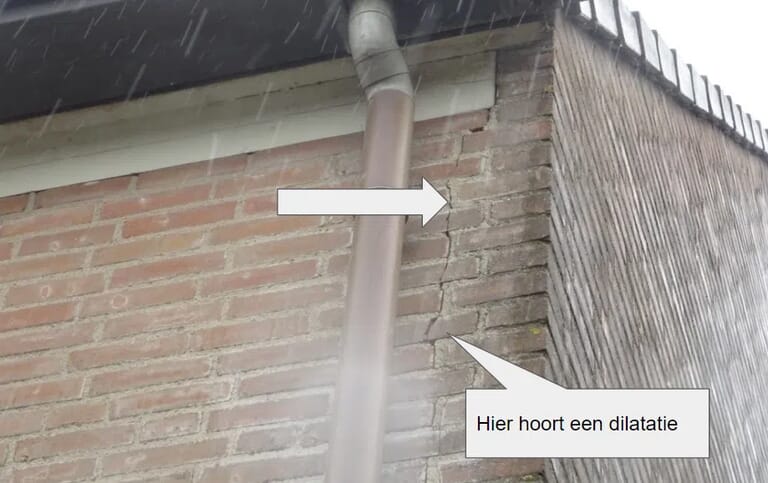
In some cases, the cause of cracking can be attributed (partly or entirely) to insufficient freedom of movement in the masonry . Because the forces exerted cannot be adequately dissipated, cracking can occur. Consider, for example, insufficient expansion joints in the masonry.


Homekeur-gevel-geen-dilatatie.png
  • When repairing cracks in masonry facades, the masonry can be repaired in various ways. Depending on the situation, it may be necessary to re-teeth the masonry. This involves removing sections of the masonry and rebuilding them. It is recommended to use this in conjunction with a system like the TotalWall system, which allows the cracked masonry to be repaired virtually invisibly by adding reinforcement to the joints, thus allowing it to absorb further movement without immediately causing further damage. However, it is important to only carry out repairs when the situation is stable. If in doubt, monitoring the cracks can be considered.
  • Cracks due to insufficient freedom of movement in the masonry are often caused by thermal influences. As a facade heats up and cools, the brick expands and/or contracts. This movement is usually accommodated by an expansion joint. In addition to repairing the visible damage, it is recommended to install a vertical expansion joint in the appropriate places.
  • In some cases, existing cracks can be improved with an expansion joint. This solution offers at least a 60% financial advantage because the facade isn't repaired, but the existing cracks are used as an expansion joint. Consult an expert for advice!
  • However, it can never be ruled out that new cracks may form elsewhere in the masonry at some point.

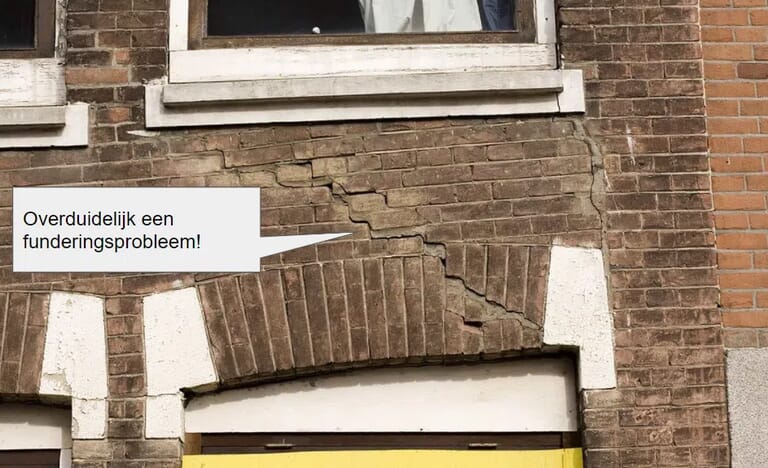
In some cases, the cause of cracking can be attributed (partly or entirely) to the foundation technique used and the soil structure beneath the house . This is a fact and characteristic of the house that is difficult, if not impossible, to prevent. Changes in the soil structure cause settlement, resulting in cracking.

Homekeur-funderingsprobleem.png
  • Soil structure improvements are possible but expensive, and still don't offer complete certainty and stability. You can check out the website https://www.uretek.nl/
  • However, it can never be ruled out that new cracks may form elsewhere in the masonry at some point.
  • During a building inspection , the inspector will discuss the cause, consequences and repair options with you in detail.

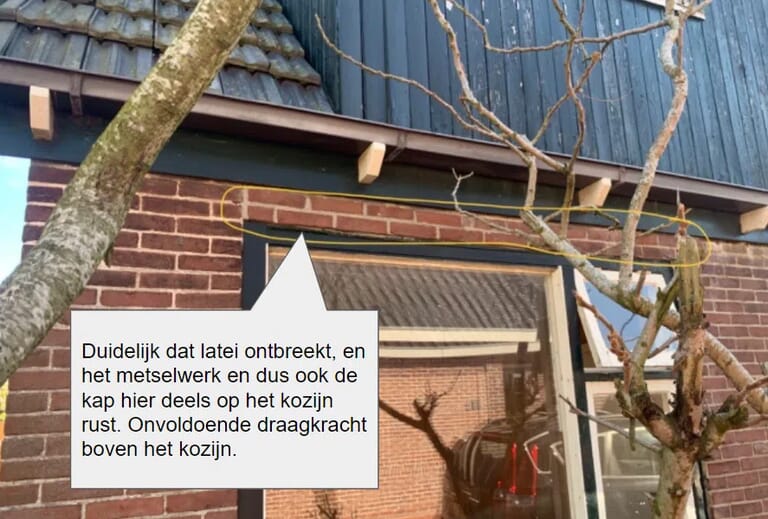
In some cases, the cause of the cracking can be attributed (partly or entirely) to the lack of sufficient load-bearing capacity of the masonry above the window frames. Because the forces released cannot be sufficiently transferred, cracking can occur.

  • Cracks above openings (window frames and/or doors) are often caused by a lack of a sufficiently strong lintel. To create sufficient load-bearing capacity above an opening, either a corner line can be incorporated into the brickwork or a virtually invisible solution can be chosen with the TotalWall system.
Homekeur-onvoldoende-draagkracht-boven-kozijn.png

When repairing cracks in masonry facades, the masonry can be repaired in various ways. Depending on the situation, it may be necessary to re-teeth the masonry. This involves removing sections of the masonry and rebuilding them. We recommend using this in conjunction with the Total Wall system, which allows the cracked masonry to be repaired virtually invisibly by adding reinforcement to the joints, thus allowing it to absorb further movement without immediately causing further damage. However, it is important to only carry out repairs when the situation is stable. If in doubt, monitoring the cracks can be considered.

Cracks above openings (frames and/or doors) are often caused by a lack of a sufficiently strong lintel . To create sufficient load-bearing capacity above an opening, either a corner line can be incorporated into the brickwork or a virtually invisible solution can be chosen with the Total Wall system.

If a cause cannot be immediately identified, we recommend conducting a further investigation into the condition of the foundation and/or soil structure before carrying out repairs. The cause could potentially be related to a structural problem or abnormality that is not easily identified.

Would you like to make an appointment for a building inspection?

The cost of a building inspection (up to 250 m²) is only €489 including VAT. We'll conduct a comprehensive building inspection and you'll receive a building report. Do you have any questions? We're happy to help and can schedule an appointment with an expert inspector right away if you wish!

Recent articles

Een vrouw wijst naar een tablet die een man vasthoudt en een andere man kijkt mee
blog
13 February 2026
Hidden defects in a home
Hidden defects are not uncommon, especially in existing homes. They are often not immediately visible, but can have significant consequences for comfort, safety, and costs. This article explains how hidden defects are assessed and the role of investigation and inspection.
blazen plooien bitumen dak
video
13 February 2026
Common roof detail mistakes: what an inspection reveals
During roof inspections, problems often turn out to be not in the roofing itself, but in the details. In this practical case study, we demonstrate which installation errors are frequently encountered and why these, in particular, pose an increased risk of leaks and damage.
WhatsApp Image 2026-02-12 at 08.51.37
video
12 February 2026
Three Roof Eave Mistakes That Cause Leaks (And Are Often Overlooked)
Roof problems rarely arise suddenly. They usually start with a minor issue. In this inspection, we see how a torn lead flashing, improper installation, and a loose joint can all pose a serious risk. What should you look for—and how can you prevent them?