Make an appointment Call now

Extension lead connections

Navigating the complexities of lead flashing repairs on your home's extension can be daunting, with the risk of water ingress and structural damage looming if not handled properly. This blog delves into the essential practices for managing these issues, offering valuable insights to ensure your property remains watertight and structurally sound.

Extension lead connections

Lead strips present

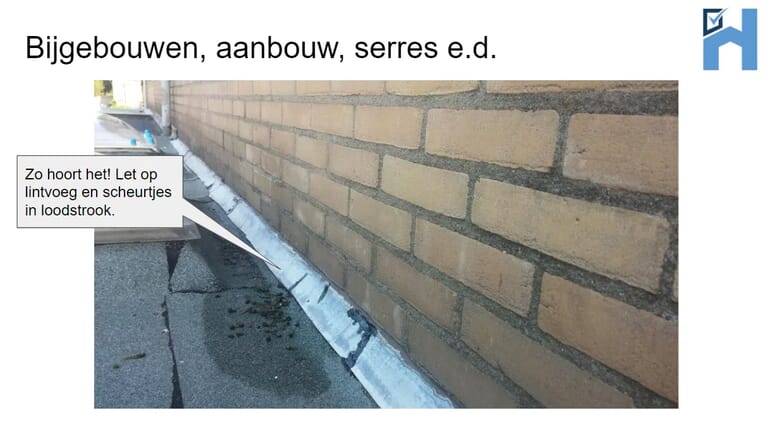
There's usually a connection between the roof of the extension and the facade of the house. This connection is made watertight with a lead strip (foot lead). This lead extends all the way through the cavity wall of the facade and is attached to the inner leaf.

  • The free-hanging portion on the outside must not exceed 80 mm in width (height). Otherwise, the creep effect (with the risk of cracking and water ingress) will be too great.
  • A strip of foot lead may be a maximum of 1 m long and must overlap by at least 8 cm.
lood-aanbouw-onderkappen.png

Statement: "There are repairable defects in the bed joint above the lead strip between the facade and the roof of the extension." In that case, we recommend maintaining the current situation and repairing the bed joint. Where necessary, deepen the joint sufficiently, remove debris and loose material, and repair the joint in accordance with the existing work.

Statement: "The lead flashing must be (partially) replaced." Replacing such a lead flashing is not easy! In masonry, the best solution is to remove strips of brick so that the flashing can be installed in the cavity against the inner leaf. Another solution could be to grind the flashing at least 4 cm deep into a joint. If installing under a window frame, a professional is recommended.

Statement: "The lead flashing needs to be (partially) repaired ." This can be done by patching cracks in the flashing with self-adhesive bitumen tape, available at any hardware store. As long as repairs are possible, we recommend postponing replacement.

  • Simply clamping the foot lead and closing a joint is not a proper repair.
  • The lead must normally be fitted through the cavity up to the inner leaf.
  • Replacing lead flashing isn't easy! Strips of masonry must be removed to properly repair it.

lood-aanbouw-reparatie.png

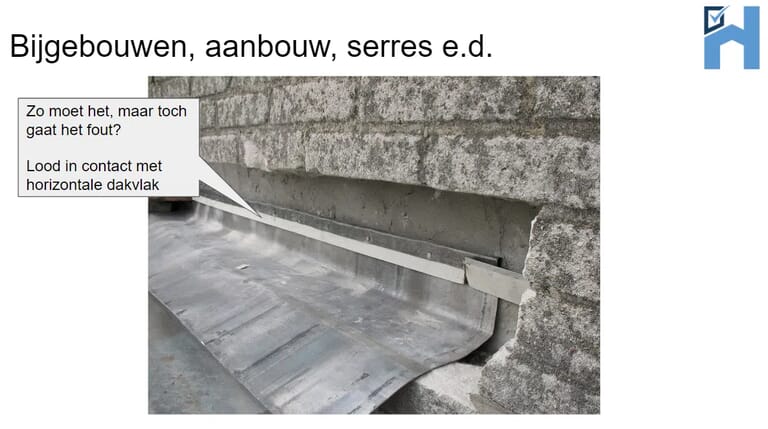
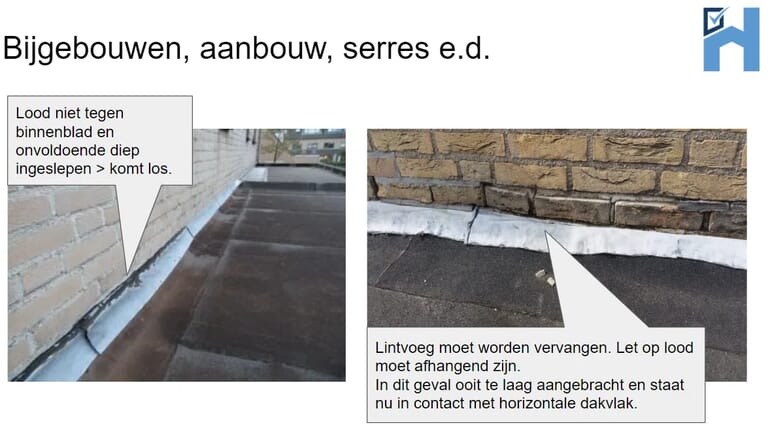
Statement: "The lead flashing (the part visible from the brickwork) is too high and hangs (or rests) too much on the horizontal roof surface." Due to creep and capillary action of water remaining on the roof, there is an increased risk of water ingress and/or leakage in the cavity or at this connection. Correcting this is easily achieved by shortening the height of this lead flashing.

  • Lead can easily be cut and 'torn off' with a utility knife.
  • Always place a piece of board under the lead to be cut, this prevents you from accidentally cutting the bitumen.

Statement: "The lead strips (the part visible from the brickwork) are too long." The strips may have a maximum length of 1 meter and must overlap by at least 8 cm. The materials are subject to weathering. Because they are too long, there is insufficient space to accommodate the shrinkage or expansion. This causes the material to crack more quickly, leading to defects. Now that the lead has been applied in this way, there's little you can do other than accept it. This does shorten the material's lifespan, and the lead will need to be replaced sooner than usual.

lintvoeg-aanbouw.png

Lead strip not present

Outside becomes inside > then repair is necessary

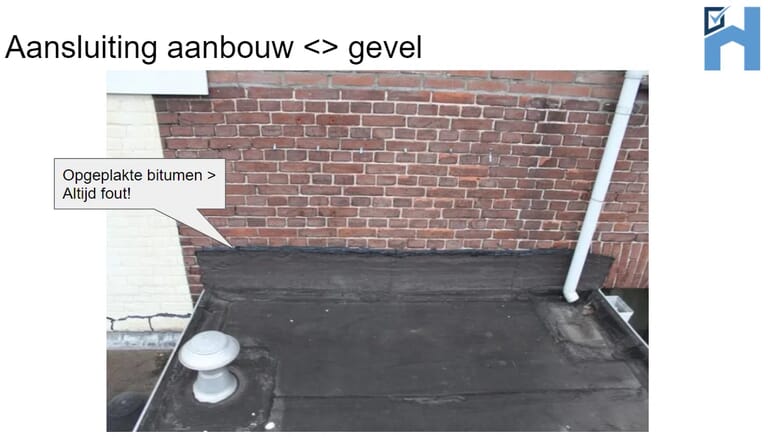
There's a connection between the roof of the extension and the facade of the house. This connection is usually made waterproof with a lead strip (flood seal). This lead runs through the cavity of the facade and is attached to the inner leaf. Rainwater absorbed by the facade and seeping down is thus forced out. If the bitumen is glued down (or a compression strip is used), this water can get behind the bitumen and cause leaks or other defects in the house. The flood seal, as described above, must then still be installed.

  • Replacing lead flashing isn't easy! The best solution is to remove strips of masonry to make a proper repair.
  • Another acceptable solution is to grind the joint deeply (6 cm) and apply the lead to the maximum depth, after which it can be filled in.
  • Simply clamping the foot lead and closing a joint is not a proper repair.
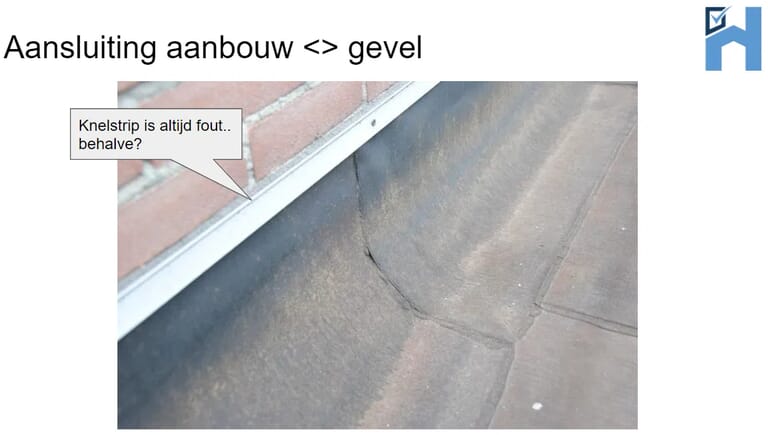
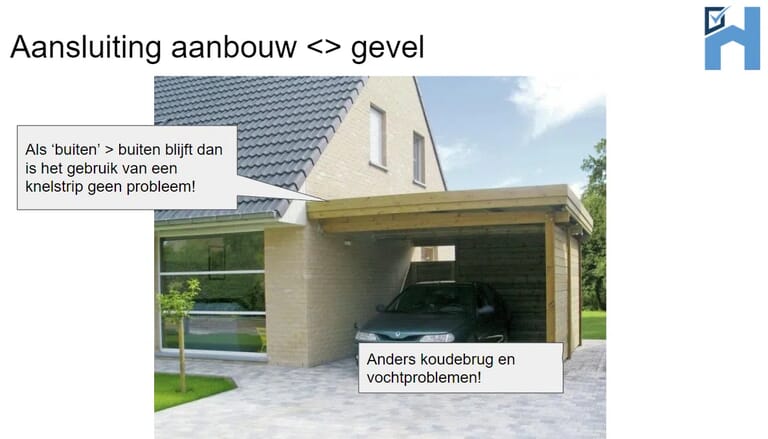
  • Applying a lead strip with a clamping strip is also not a proper repair.

Outside stays outside > recovery not necessary

There's a connection between the roof of the extension and the facade of the house. This connection is usually made waterproof with a lead strip (foot lead). This lead runs through the cavity of the facade and is attached to the inner leaf. Rainwater absorbed by the facade and seeping down is thus forced out. In this case, a compression strip (or other form of seal) has been used, and the intended drainage will therefore not function optimally.

  • If the extension or conservatory is considered an outdoor space, no improvement is necessary. The current situation can remain as it is. However, it must be taken into account that moisture (absorbed by the facade) at this connection will not be directed outside and can enter the room. Technically, this is not a defect that could cause damage.
  • If outside remains outside, it is not necessary to apply a lead flashing.
  • If outside becomes inside, good drainage is essential. For brick walls, the lead flashing is often recessed approximately 4 cm. For cavity walls, the best solution is to attach the lead flashing to the inner wall.
  • The exposed portion of the lead on the outside must not exceed 80 mm in width (height). Otherwise, the creep effect (with the risk of cracking and water ingress) will be too great.
  • A strip of foot lead may be a maximum of 1 m long and must overlap by at least 8 cm.
knelstrip-aanbouw-altijd-fout.png
knelstrip-aanbouw-goed.png
bitumen-aanbouw-opgeplakt-altijd-fout.png

Would you like to make an appointment for a building inspection?

The cost of a building inspection (for homes up to 1000 m³) is only €369.00 including VAT. We'll conduct a comprehensive building inspection , and you'll receive a building report . Do you have any questions? Call us during office hours (Monday to Friday, 9:00 AM to 5:00 PM) at 085-0653675 . We're happy to help and can schedule an appointment with a qualified inspector right away, if desired!

Make an appointment

Would you like to make an appointment for a building inspection?

The cost of a building inspection (up to 250 m²) is only €489 including VAT. We'll conduct a comprehensive building inspection and you'll receive a building report. Do you have any questions? We're happy to help and can schedule an appointment with an expert inspector right away if you wish!

Recent articles

Een vrouw wijst naar een tablet die een man vasthoudt en een andere man kijkt mee
blog
13 February 2026
Hidden defects in a home
Hidden defects are not uncommon, especially in existing homes. They are often not immediately visible, but can have significant consequences for comfort, safety, and costs. This article explains how hidden defects are assessed and the role of investigation and inspection.
blazen plooien bitumen dak
video
13 February 2026
Common roof detail mistakes: what an inspection reveals
During roof inspections, problems often turn out to be not in the roofing itself, but in the details. In this practical case study, we demonstrate which installation errors are frequently encountered and why these, in particular, pose an increased risk of leaks and damage.
WhatsApp Image 2026-02-12 at 08.51.37
video
12 February 2026
Three Roof Eave Mistakes That Cause Leaks (And Are Often Overlooked)
Roof problems rarely arise suddenly. They usually start with a minor issue. In this inspection, we see how a torn lead flashing, improper installation, and a loose joint can all pose a serious risk. What should you look for—and how can you prevent them?