Differences in energy labels within the same apartment complex explained
Many people think that all apartments in a building automatically receive the same energy label . In practice, however, this often turns out not to be the case. Even within a single complex, labels can vary significantly: from A to C or even worse. Why is that? And what can you do to make your home more energy-efficient?
Why do energy labels differ per apartment ?
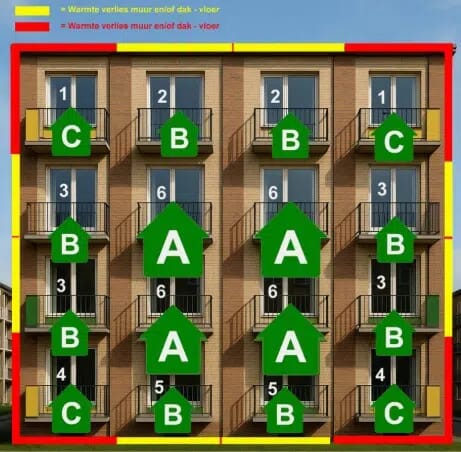
An apartment's energy rating is determined not only by the building services or the type of glass, but also by its location within the complex . Each apartment loses heat through its front and rear facades , but some apartments also have additional heat loss areas:
- Corner apartments (e.g. no. 1 & 4): lose heat through a side wall and often also through the roof or floor → label C.
- Top apartments (e.g. no. 2): lose additional heat through the roof → label B.
- Ground floor (e.g. no. 5): heat losses through the floor → label B.
- Mid-rise apartments (e.g. no. 6): are fully enclosed, have no additional loss surfaces and therefore often score the best → label A.
In short: the position in the building largely determines the energy performance.
Factors that influence the energy label of an apartment
In addition to location, other construction and technical factors play a role:
- Insulation
- Roof insulation, floor insulation and wall insulation are crucial to limit heat loss.
- Glass and frames
- HR++ glass or triple glazing offers a significant improvement over single glazing.
- Heating and installations
- A high-efficiency boiler, hybrid heat pump or full heat pump significantly improves the label.
- Ventilation
- A good ventilation system provides fresh air without unnecessary heat loss.
Why is a good energy label important?
A favorable energy label has several advantages:
- Lower energy costs: less heat loss means lower heating costs.
- Greater living comfort: less draught and a more constant indoor temperature.
- Value increase: a better label increases the value and rentability of the apartment.
- Sustainability: reduced energy consumption contributes to lower CO₂ emissions.
Tips to improve your energy label
Even if your apartment has a disadvantage due to its location (for example, on the ground floor or under the roof), you can still achieve significant gains with smart measures:
- Install floor insulation or roof insulation .
- Replace single glazing with HR++ or triple glazing .
- Consider a heat pump or solar panels if technically possible.
- Check for cracks and seams and improve air and gap tightness .
Conclusion
Within the same apartment building, different energy labels can be used. This is mainly due to the structural layout: a corner apartment or an upstairs apartment loses more heat than a terraced apartment. However, residents can reduce their energy consumption and improve their energy label through targeted measures.
A good energy label is therefore not only beneficial for your wallet, but also for your living comfort and the future value of your home.
Easily request an energy label for your home
The cost of an energy label (up to 190 m²) is only €349 including VAT. A certified energy advisor will visit you, inspect the property, and officially register the energy label in EP-online. If the property is larger than 190 m², we charge €0.65 per additional square meter. Do you have any questions? We're happy to help and, if desired, can schedule an appointment with a certified advisor right away!
Recent articles