
Bitumen roof shingles
Bituminous shingles are a roof covering consisting of individual overlapping elements made of bitumen-impregnated or soaked felt or a fiberglass mat. Bituminous shingles are covered with bitumen on both sides and are usually provided with a protective layer of mineral granules on the top.
The elements are roughly rectangular and are laid in rows. A single layer can be used for a waterproof finish. The bituminous shingles are laid from bottom to top, with the top row partially overlapping the bottom row of shingles, without continuous seams between the overlapping rows. Shingles must be laid on a level, load-bearing substrate.
If the shingles are in good technical condition, they can still last for years. A precise expected lifespan is difficult to predict and also depends on various factors, such as weather conditions. If the shingles are in moderate condition, the bitumen can last another 2 to 5 years. If the shingles are in poor condition, the covering should be replaced immediately. The risk of leakage is very real, which will cause further (consequential) damage.
- A bitumen shingle roof covering can last 15 to 25 years.
- Clean the roof twice a year.
- Never walk on the roof in high or low temperatures.
- Check the lead strips for defects between the facade and roof connection to prevent defects.
Points of attention, defects or comments
- Do you need minor repairs to your bitumen shingled roofing? This is simple, but be sure to have the repairs carried out by a qualified roofer. They have the right materials and tools and also offer a warranty on the repair. Trying to patch or repair a shingled roof with a sealant or repair kit from a hardware store is usually pointless and ineffective.
- If a single bitumen shingle roof covering needs replacing, keep the following in mind: it is very labor-intensive, and it is recommended to replace the entire roof.
Bitumen roofing
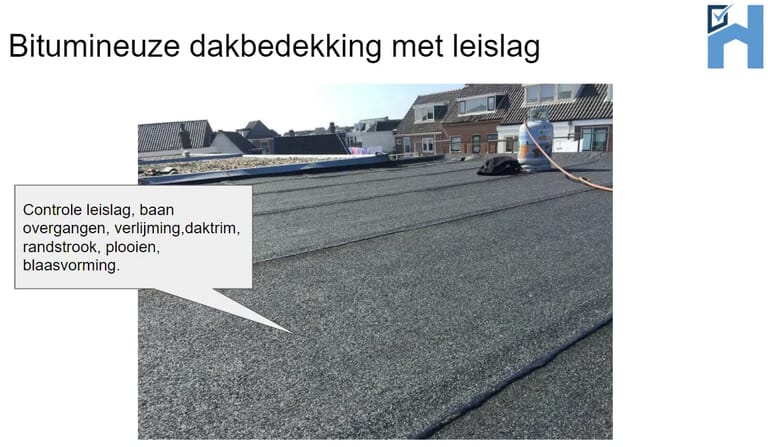
If the roof has a gravel layer: roof gravel is applied to roofs as ballast. If the roof is covered with coarse gravel, you must regularly remove moss and algae growth. Maintain a layer of coarse gravel of at least 3 cm. This will prevent it from blowing away and sinking into the subsoil.
- The downside of roof gravel is that it gets dirty relatively quickly and moss grows. Cleaning it isn't easy. Consider using a leaf vacuum.
- The advantage is that the bitumen is protected from the elements and UV radiation. The lifespan of bitumen with gravel is longer than without gravel.
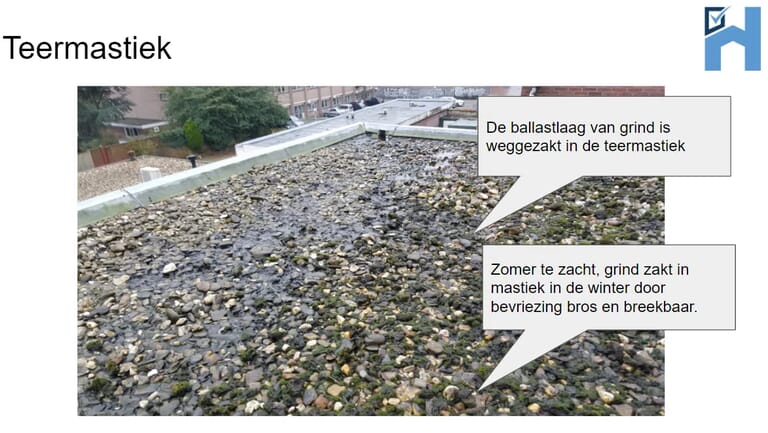
- Do not walk on a gravel roof in hot weather. The bitumen will be soft and there is a risk of the gravel being pressed into the bitumen, possibly causing a leak.
- Get well-informed about the different types of roofing. These days, we're increasingly seeing white bitumen roofing used for flat roofs. This type of roofing stays cooler in the summer, improves the efficiency of solar panels, and lowers the ambient temperature, resulting in cleaner air!
- Clean the roof twice a year.
- Check the lead strips for defects between the facade and roof connection
Points of attention, defects or comments
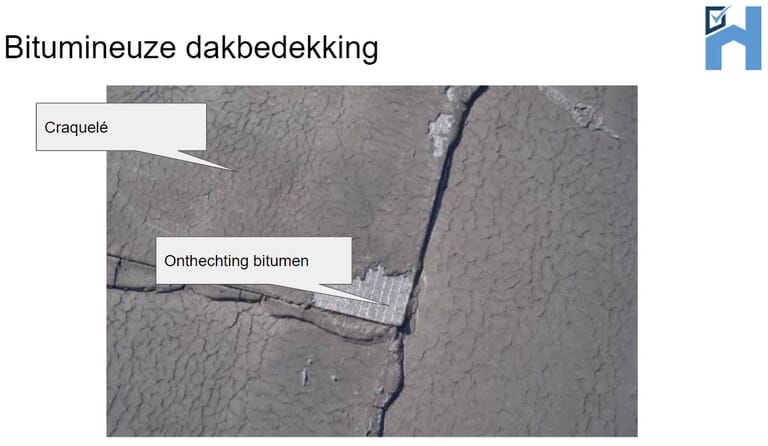
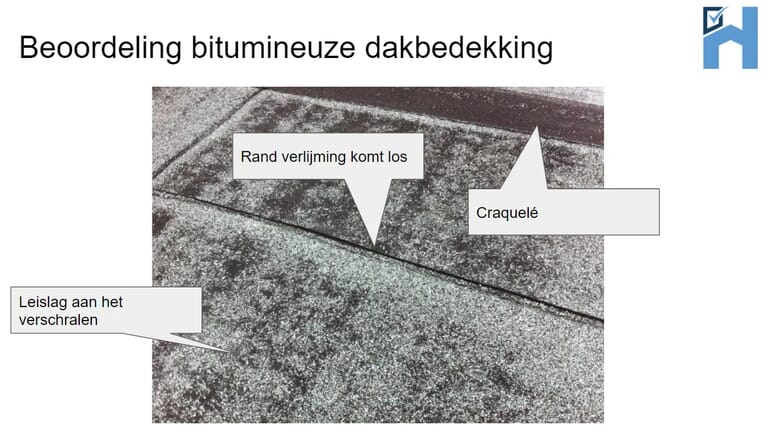
- Crazing may be present in the bitumen roof covering. Crazing, or slight cracking, occurs due to weathering of the bitumen roof covering under the influence of UV radiation and moisture. UV radiation combined with temperature stress causes the bituminous material to decompose, bringing the plastic (moldable) substances to the surface. This results in hairline cracks and a hardening of the top layer. As a result, the bitumen can no longer follow the movements of the substrate, and the material subsequently cracks.
- The bitumen roofing may be factory-fitted with a rolled-in slate layer, which protects the bitumen covering. Depending on the type of roofing, this slate layer will eventually detach, causing the entire roof to deteriorate and offering less protection for the bitumen.
- If blisters and/or wrinkles are visible under the bitumen: Blisters under the roof covering are a problem; they indicate the presence of water vapor beneath the covering. This is usually a precursor to cracks. In a poorly fired roofing package, slight wrinkles may appear due to shrinkage and movement of the roofing membranes. In that case, it's best to contact an experienced roofer, who can best determine how the bitumen can be repaired.
- If the damage is localized, bubbles or cracks can usually be easily repaired using a rubber coating or rubber roofing paste.
- Another effective solution is to apply a new strip on top of the damaged area.
- In some cases, blisters and cracks can be an indication that the roof covering needs to be completely replaced.
- Contamination may be present on the roof, which is naturally undesirable and poses various risks. Contamination on the roofing and around the drains must be removed.
- If the gravel is contaminated, it must be cleaned. Use a leaf blower or vacuum. This maintenance is best carried out in the spring when the weather is not too warm. The roof must be completely dry before carrying out this maintenance. Do not use chemical cleaning agents!
- With a zinc edge finish, solder joints may be loose or have already been repaired improperly, posing a risk of water ingress and leakage. Using the right materials and pretreatment, such defects can still be repaired by a qualified professional.
- Don't start covering seams with tape or the like; these are just 'band-aids' and will hardly have any function after less than a year.
- Soldering zinc is a specialized job; not every plumber has this expertise yet.
Mastic roofing
In the past, mastic was used as a roofing material for flat roofs. Mastic was a kind of tar-like roofing material. Therefore, there weren't many other solutions available for applying mastic roofing to a flat roof. Mastic had advantages but also many disadvantages. In the summer, the mastic became semi-liquid, and in the winter, it became brittle and vulnerable. Mastic roofing was difficult to repair, and combined with the first emerging roof insulation, it was a particularly bad combination. When it later became apparent that mastic was also harmful to health, the use and installation of mastic roofs was discontinued in the late 1970s. However, mastic roofs are still regularly found in the Netherlands, often in an advanced state of decomposition.
- Replace the Mastic roof covering within 0 to 5 years.
- Never walk on the roof in high or low temperatures.
Would you like to make an appointment for a building inspection?
The cost of a building inspection (up to 250 m²) is only €489 including VAT. We'll conduct a comprehensive building inspection and you'll receive a building report. Do you have any questions? We're happy to help and can schedule an appointment with an expert inspector right away if you wish!
Recent articles