

Make an appointment Call now

Inspection of a barrel vault floor

Exploring the structural integrity of historic trough vault floors, often found in early 20th-century buildings, reveals a hidden risk due to the potential corrosion of steel beams that support these elegant architectural features. To preserve their aesthetic and structural value, proactive inspections and timely interventions by experts are crucial to prevent further damage and ensure safety.

Trough vault floor

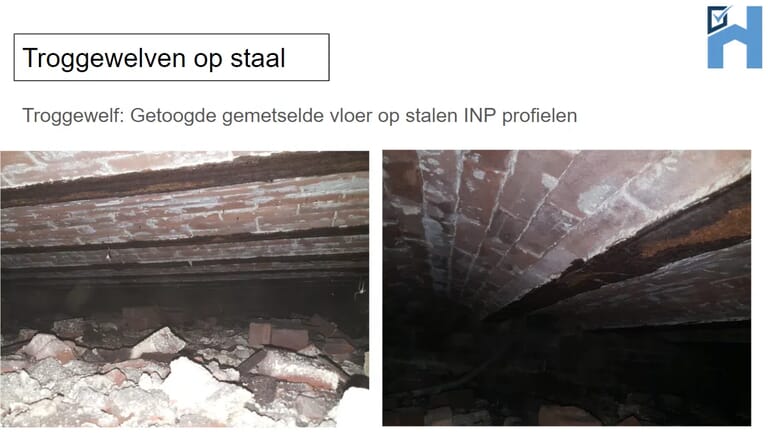
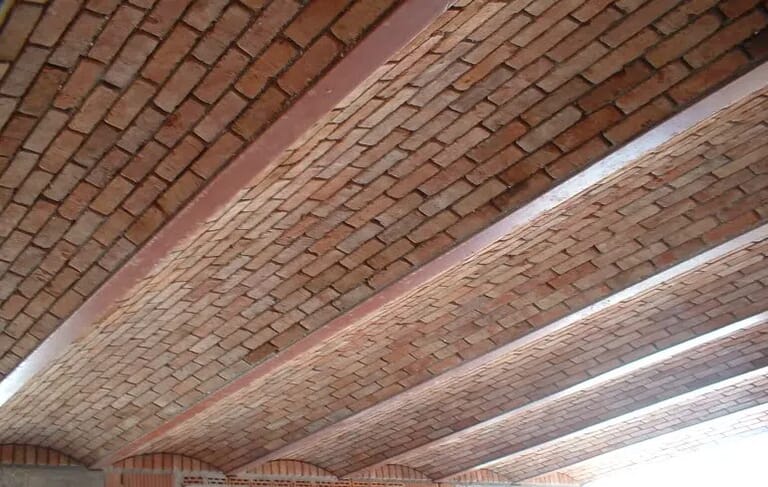
A trough vault is a brick vault consisting of segmental arches. Inverted, a trough vault resembles a trough or drinking trough. The vaults in a trough vault consist of a smaller section of a semicircle. These trough vaults are placed on a steel span and form (wholly or partially) the structural floor.

  • Assessing such a floor is difficult; if you want more certainty, further investigation should always be carried out.
  • This floor construction concerns a so-called risk floor!
  • If there are risks, or if you would like more information or more certainty, you can consider a follow-up inspection.
  • Trough vault floor: authentic, but always inspect!
trog-1.png

Defects, comments or points of interest

  • The steel girders of the trough vaults, and of course the brickwork, are points of concern. Note that more metal is not visible than was assessed.
  • If there is damage to the masonry of the trough vaults, this masonry can be repaired after repairing corrosion on the steel beams (INP profiles).
  • If the steel beams (INP profiles) are rusting, this can cause damage to the foundation or the trough vaults if it worsens. It is recommended to remove this rust, after which the steel can be treated with a rust-resistant red lead or a specially formulated paint system.
    • Ensure that conditions remain favourable, such as good ventilation and no moisture or condensation on the steel.
    • Have your floor checked periodically; if in doubt, always invite an expert for a comprehensive floor inspection.
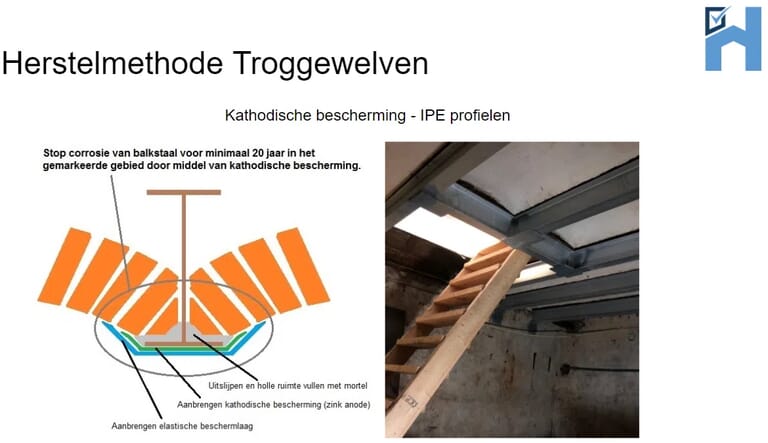
  • If the steel beams (INP profiles) are severely rusting, this can damage the foundation or the barrel vaults, and the floor's load-bearing capacity will also decrease. (Partly preventative) measures may be necessary to prevent potential worsening. Repairing a barrel vault floor is usually not easy, as the steel is largely invisible. Repairs should therefore be carried out promptly by a professional company, where the corrosion of the beam steel can be addressed through cathodic protection and the application of a flexible protective layer.
  • In the case of extensive rust and damage, we recommend further investigation. There are too many uncertainties regarding the steel INP profiles. The span of an INP profile and the type of INP profile are decisive in the assessment. Sometimes an INP profile with extensive corrosion can still be sufficiently load-bearing, while other times an INP profile with minor corrosion can be rejected. This depends on the INP size used.
  • A building inspection will immediately give you more clarity about the risk floor.
trog-2.png
trog-3.png

Inspection of a barrel vault floor

The Toogjesvloer (or barrel vault floor) is a floor construction with a slightly curved vault. These floors were used in homes around 1900. This type of floor has an artistic appearance and was often used in historic buildings, primarily in basements or rooms with a relatively small span. Initially, the construction was a brick arch supported by two wooden beams. The arching action of the vault transfers pressure to the wooden beams. Due to developments in the steel and iron industry, these vaults were eventually constructed with steel beams called INPs.

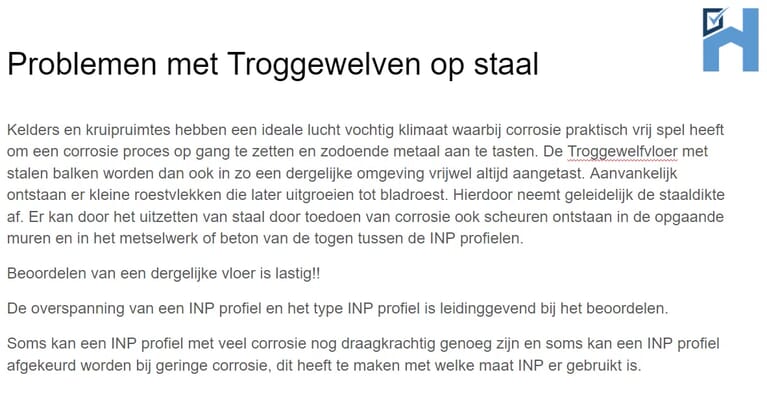
These steel beams are usually embedded in a masonry foundation, which allows moisture to pass through or rise through capillary action. Cellars and crawl spaces (where these floors are typically installed) have a humid climate, causing the materials to condense or be continuously exposed to moisture. Corrosion therefore has virtually free rein to initiate a corrosion process and thus corrode the metal.

The steel beam trough vault floor is almost always affected in such a humid environment. Initially, small rust spots develop, which later develop into flaking rust. This gradually reduces the steel thickness. The expansion of the steel due to corrosion can also cause cracks in the rising walls and in the brickwork or concrete of the arches between the INP profiles.

troggewelf-1.png

In the past, safety margins regarding load-bearing capacity were slightly higher than they are today, allowing more leeway to repair a barrel vault floor without completely depreciating it. However, this doesn't mean that prompt action is still required at the first signs of corrosion.

Only 15% of the steel profile is visible, with most of the steel being laid in and above the vaults. The corrosion is visible, primarily across the entire bottom flange of the steel, and works its way upward (not visible) towards the entire profile. As soon as cracks are visible in the masonry, the steel is likely (extensively) corroded.

Preventive measures are only useful if no damaged bricks are visible yet. Localized derusting and priming usually don't have a long lifespan. Applying additional steel or cathodic protection can halt corrosion for at least 20 years. Other preventive measures are always beneficial, such as a dry and well-ventilated area.

Would you like to make an appointment for a building inspection?

The cost of a building inspection (up to 250 m²) is only €489 including VAT. We'll conduct a comprehensive building inspection and you'll receive a building report. Do you have any questions? We're happy to help and can schedule an appointment with an expert inspector right away if you wish!

Recent articles

Een vrouw wijst naar een tablet die een man vasthoudt en een andere man kijkt mee
blog
13 February 2026
Hidden defects in a home
Hidden defects are not uncommon, especially in existing homes. They are often not immediately visible, but can have significant consequences for comfort, safety, and costs. This article explains how hidden defects are assessed and the role of investigation and inspection.
blazen plooien bitumen dak
video
13 February 2026
Common roof detail mistakes: what an inspection reveals
During roof inspections, problems often turn out to be not in the roofing itself, but in the details. In this practical case study, we demonstrate which installation errors are frequently encountered and why these, in particular, pose an increased risk of leaks and damage.
WhatsApp Image 2026-02-12 at 08.51.37
video
12 February 2026
Three Roof Eave Mistakes That Cause Leaks (And Are Often Overlooked)
Roof problems rarely arise suddenly. They usually start with a minor issue. In this inspection, we see how a torn lead flashing, improper installation, and a loose joint can all pose a serious risk. What should you look for—and how can you prevent them?