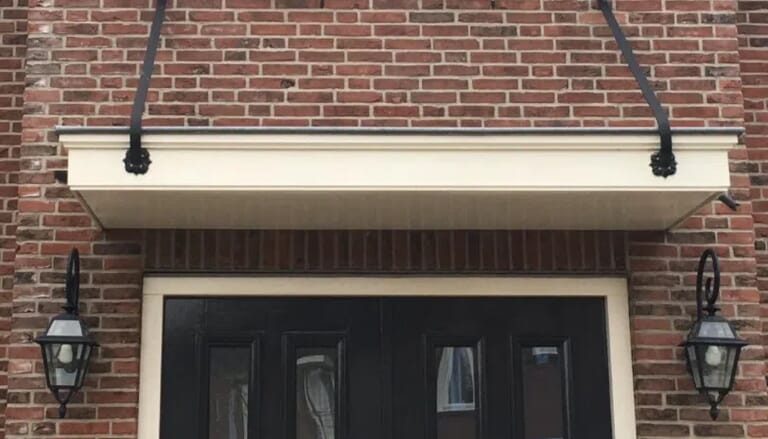
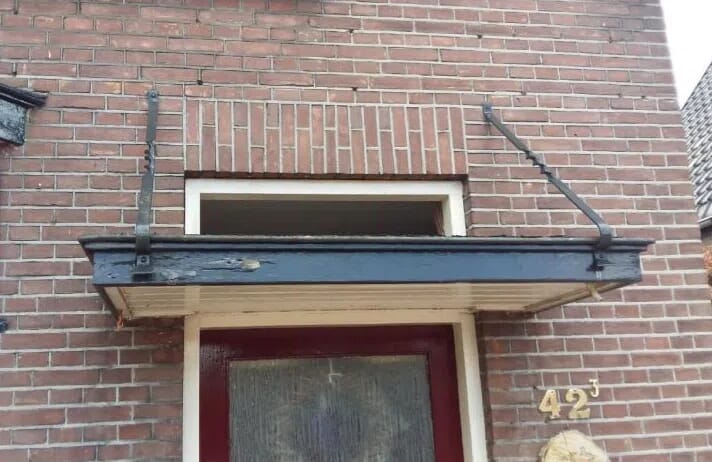
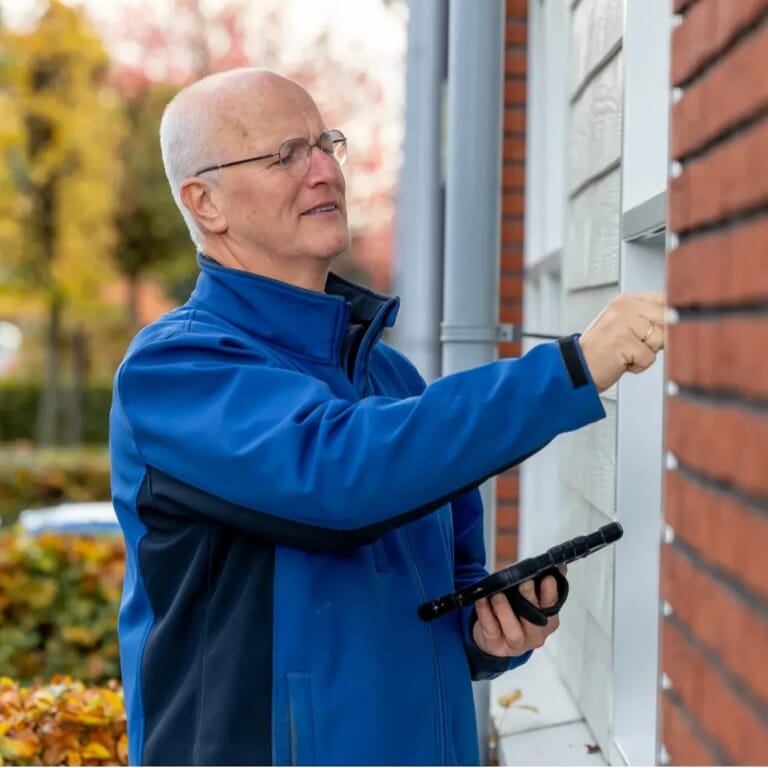
There may be defects in the bed joint above the lead strip between the facade and the canopy roof. In such cases, it is recommended to repair and/or replace the bed joint where necessary. Ensure the joint is sufficiently deep, remove any debris or loose material, and repair the joint in accordance with the existing work.
The lead from the facade above the canopy roof may come loose from the facade, in which case repair is usually still possible and the lead can be reinstalled.
It's also possible that the lead flashing from the facade above the canopy roof needs to be replaced. Replacing such a lead flashing isn't easy! For masonry, the best solution is to remove strips of brick so the flashing can be installed in the cavity wall against the inner leaf. Another solution would be to grind the flashing at least 4 cm deep into a joint. If installing under a window frame, a professional is recommended.
There's a connection between the awning roof and the house's facade. This connection is usually made waterproof with a lead strip (foot lead). This lead runs through the cavity wall of the facade and is attached to the inner leaf. Rainwater absorbed by the facade and seeping down is thus forced out. If this foot lead is not present, it must be installed.
- For masonry, the best solution is to remove strips of brick so that the lead can be installed in the cavity against the inner leaf. Another solution would be to grind the lead at least 4 cm deep into a joint. If installing under a window frame, a professional is recommended.
The lead from the facade above the awning roof may be too high and then hang (or rest) too much on the horizontal roof surface of the awning. Due to creep and capillary action of water that may remain on the roof, there is an increased risk of water ingress and/or leakage in the cavity or at this connection. Correcting this is easily accomplished by shortening the height of this lead.
- Lead can easily be cut and 'torn off' with a utility knife.
- Always place a piece of board under the lead to be cut, this will prevent you from accidentally cutting the roof covering.